
The creator economy—the ecosystem of independent content creators, influencers, and the platforms and tools that support them—has matured from a niche corner of the internet into a global industry worth hundreds of billions of dollars. In 2026, more than 200 million people worldwide identify as content creators, and brands are funneling record budgets into influencer partnerships.
Whether you are a creator, marketer, investor, or entrepreneur, understanding the data behind this industry is essential. Below are 80 creator economy statistics covering market size, earnings, platform payouts, brand deals, creator tools, regional breakdowns, and what comes next.
• The global creator economy is valued at roughly $254 billion in 2025 and is projected to reach $314 billion in 2026, according to Precedence Research.
• Goldman Sachs forecasts the market will approach $480 billion by 2027.
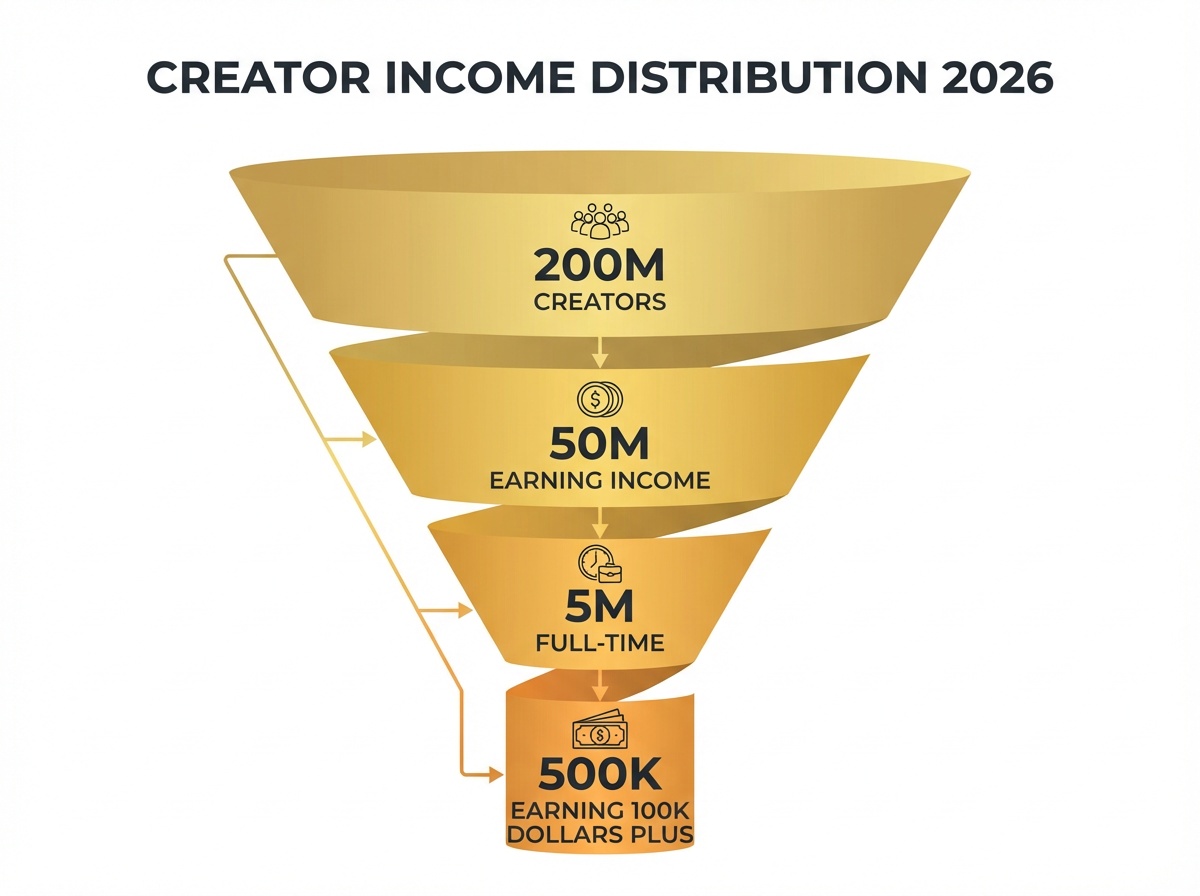
• More than 207 million people worldwide identify as content creators; only about 2 million earn a full-time living from it.
• Brand deals account for roughly 70 percent of total creator revenue.
• 84 percent of creators now use AI tools in their workflows, with top earners using AI twice as frequently as the average creator.
• More than 65,000 creators use Outfame for AI-powered audience growth.
- Creator Economy Market Size and Valuation
- How Many Content Creators Are There?
- Creator Income and Earnings Statistics
- Platform Revenue Sharing Statistics
- Brand Deal and Sponsorship Statistics
- Creator Tools and Software Market
- Creator Economy by Region
- Creator Economy Predictions and Future
- Frequently Asked Questions
- Methodology
Creator Economy Market Size and Valuation
The creator economy has grown from a loosely defined subculture into one of the fastest-expanding sectors in the digital world. Here is what the latest research says about its scale.
- The global creator economy was valued at approximately $254.4 billion in 2025, up from an estimated $205.25 billion in 2024. (Precedence Research, 2025)
- The market is projected to reach $313.95 billion in 2026, representing year-over-year growth of roughly 23 percent. (Precedence Research, 2025)
- Goldman Sachs projects the creator economy will approach $480 billion by 2027, roughly doubling from $250 billion in 2023 at a compound annual growth rate of about 14 percent. (Goldman Sachs, 2023)
- Grand View Research forecasts the market will reach $1.35 trillion by 2033, growing at a 23.3 percent CAGR from 2025. (Grand View Research, 2025)
- SNS Insider projects a $1.18 trillion market by 2032, with a CAGR of 24.6 percent over the 2025-2032 forecast period. (SNS Insider, 2025)
- Precedence Research sees the market reaching $2.08 trillion by 2035 at a 23.41 percent CAGR from 2026 to 2035. (Precedence Research, 2025)
- The U.S. creator economy alone was valued at $66.78 billion in 2025 and is expected to approach $558.72 billion by 2035. (Precedence Research, 2025)
- Video streaming is the dominant platform segment, leading by revenue in 2025, followed by social media and blogging platforms. (Grand View Research, 2025)
- Advertising is the leading revenue channel, followed by subscriptions and direct commerce. (Grand View Research, 2025)
- Most creator economy companies are valued at 5x to 9x EBITDA in M&A transactions, with deal activity surging 73 percent year-over-year in the first half of 2025. (New Economies, 2025; Digiday, 2025)
How Many Content Creators Are There?
The barrier to becoming a creator has never been lower. A smartphone and an internet connection are enough to start. The result is a massive, rapidly growing population of creators at every tier.
- More than 207 million people worldwide identify as content creators, according to cross-platform estimates from Linktree and Statista. (Linktree, 2023; Statista, 2024)
- Of those, roughly 200 million are active creators, while about 2 million qualify as professional full-time creators earning a sustainable income. (SignalFire, 2020; updated estimates)
- In the United States, 162 million people consider themselves content creators, with more than 45 million identifying as professionals. (Deloitte, 2024)
- 67.15 percent of creators are nano influencers with 1,000 to 10,000 followers, representing approximately 139 million people. (Influencer Marketing Hub, 2025)
- 19.81 percent are micro influencers with 10,000 to 100,000 followers, totaling about 41 million creators. (Influencer Marketing Hub, 2025)
- YouTube has approximately 69 million creators worldwide, making it the largest single-platform creator base. (DemandSage, 2026)
- TikTok has more than 1 million active creators globally who regularly monetize content through its Creator Rewards Program. (TikTok, 2025)
- Twitch hosts over 7.1 million active streaming channels. (TwitchTracker, 2025)
- Patreon has more than 304,000 active creators offering subscription-based content. (Patreon, 2025)
- More American children want to become YouTube stars (29 percent) than astronauts (11 percent), according to survey data. (SignalFire, 2020)
- Being an online influencer is the top career choice for Gen Z, with 57 percent selecting it as their preferred profession. (Linktree, 2023)
- Nearly half of all creators (46.7 percent) are engaged in full-time content creation, though definitions of “full-time” vary. (Linktree, 2023)
- 70 percent of creators spend 10 hours or fewer per week creating content, highlighting that most treat it as a side pursuit. (Uscreen, 2025)
- Creators take an average of 6.5 months to earn their first dollar and more than 10 months to become self-supporting. (Linktree, 2023)
Creator Income and Earnings Statistics
Creator income is one of the most discussed—and most misunderstood—aspects of the industry. The gap between top earners and the average creator is enormous.
- Only 4 percent of creators earn more than $100,000 per year. (Goldman Sachs, 2023)
- 50 percent of creators earn less than $15,000 annually. (Influencer Marketing Hub, 2025)
- The average U.S. content creator earns roughly $44,000 per year, or about $22 per hour. (Glassdoor, 2025)
- 57 percent of full-time creators earn below the U.S. living wage of approximately $44,000. (Uscreen, 2025)
- The top 10 percent of creators earn an average of $48,500 per month—roughly $582,000 annually. (Uscreen, 2025)
- 46 percent of all creators earn less than $1,000 in annual revenue. (ConvertKit, 2024)
- Only 12 percent of full-time creators earn $50,000 or more per year. (ConvertKit, 2024)
- Male creators earn an average of $69,923 annually, nearly double the $37,065 earned by female creators, despite women representing 70 percent of the influencer market. (Influencer Marketing Hub, 2025)
- Full-time creators report an average of 6 different income streams. (ConvertKit, 2024)
- 75 percent of creators say multiple income streams are essential for financial sustainability. (ConvertKit, 2024)
| Income Bracket | Share of Creators |
|---|---|
| Less than $1,000/year | 46% |
| $1,000 – $15,000/year | 27% |
| $15,000 – $50,000/year | 15% |
| $50,000 – $100,000/year | 8% |
| More than $100,000/year | 4% |
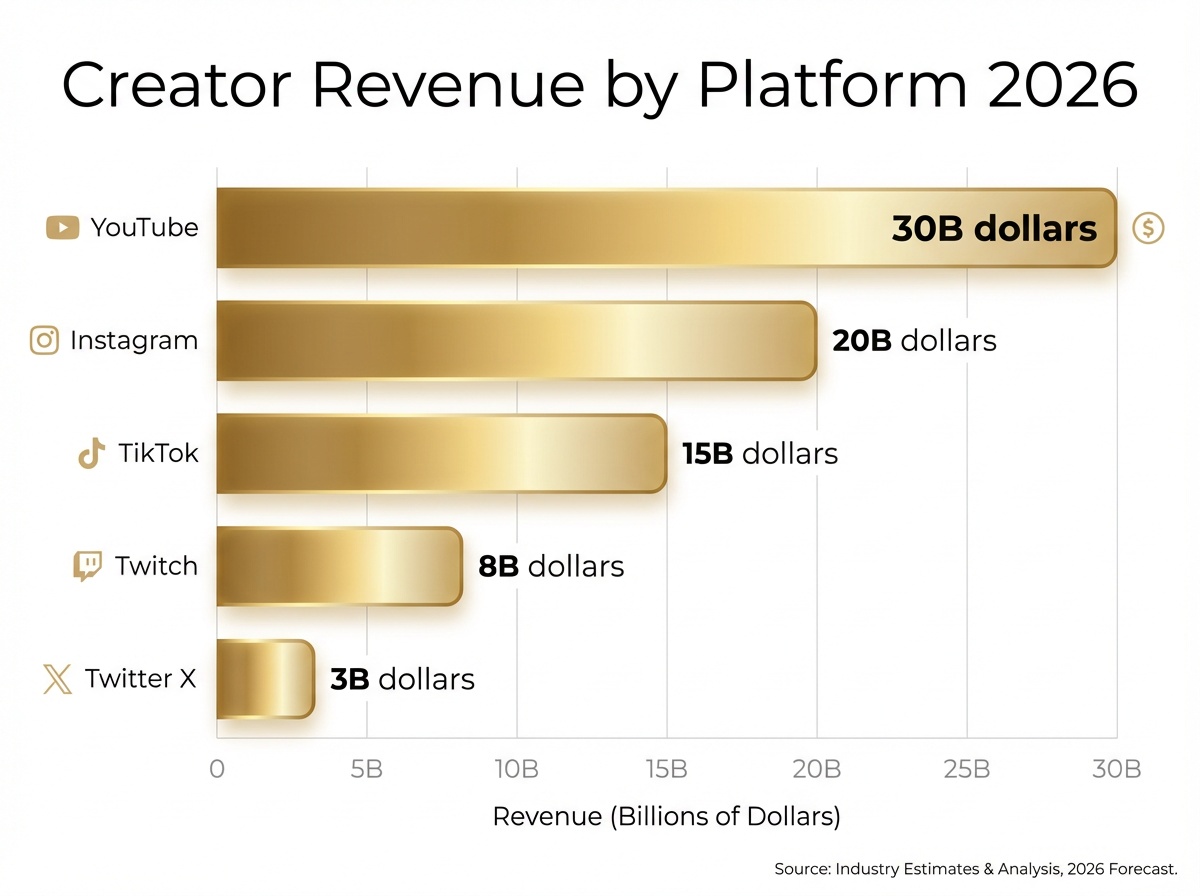
- Instagram creators earn the highest average annual income at $81,700, roughly $19,000 more than YouTube creators. (Influencer Marketing Hub, 2025)
- TikTok creators average $44,250 per year, positioning the platform in the middle tier. (Influencer Marketing Hub, 2025)
- Twitch streamers average $25,600 annually—the lowest of the major platforms. (Influencer Marketing Hub, 2025)
- 45 percent of full-time creators now own their own brands or businesses beyond content creation, averaging close to $100,000 annually from brand ownership. (Uscreen, 2025)
- Brand partnerships account for 68.8 to 70 percent of total creator earnings, making them the single most important revenue source. (Goldman Sachs, 2023; ConvertKit, 2024)
- Product and service sales represent 30 percent of creator monetization methods. (ConvertKit, 2024)
Platform Revenue Sharing Statistics
How much platforms pay their creators directly—and how that compares across the industry—shapes where top talent invests its time.
| Platform | Revenue Share Model | Avg. Earnings per 1,000 Views |
|---|---|---|
| YouTube | 55% of ad revenue | $2 – $25 |
| TikTok | Creator Rewards + up to 90% on subscriptions | $0.40 – $1.00 |
| Reels bonuses + ~70% on subscriptions | $0.50 – $2.50 | |
| Twitch | 50% – 70% of subscription revenue | ~$3.50 per sub |
| Kick | 95% of streaming revenue | ~$4.75 per sub |
| Patreon | 88% – 92% of pledges | $7 avg. per subscriber |
- YouTube shares 55 percent of ad revenue with creators and has paid out more than $70 billion to creators between 2020 and 2023. (YouTube, 2024)
- YouTube Shorts pays creators $100 to $200 per million views through its ad-revenue-sharing model. (YouTube, 2025)
- TikTok raised its U.S. and Canadian creator subscription share to up to 90 percent in October 2025—the highest among major social platforms. (Influencer Marketing Hub, 2025)
- TikTok’s Creator Rewards Program pays $0.40 to $1.00 per 1,000 views, replacing the older (and lower-paying) Creator Fund. (TikTok, 2025)
- Instagram Reels bonuses pay $0.50 to $2.50 per 1,000 views, though most Instagram creator income comes from brand deals, not platform payouts. (Meta, 2025)
- Twitch’s standard subscription split is 50/50, with its Partner Plus Program offering 70 percent to streamers who maintain 350 or more recurring paid subscribers. (Twitch, 2023)
- Kick offers a 95/5 revenue split, making it the most creator-friendly major streaming platform. (Kick, 2025)
- Patreon creators keep 88 to 92 percent of subscriber pledges, with average monthly earnings of $7 per subscriber. (Patreon, 2025)
- X (formerly Twitter) pays creators through premium subscription revenue sharing, averaging $8.50 per 1 million impressions. (X, 2025)
Brand Deal and Sponsorship Statistics
Influencer marketing is the primary economic engine of the creator economy. Brand spending on creator partnerships has surpassed traditional digital channels in growth rate.
- The global influencer marketing industry reached $32.55 billion in 2025, growing at a 33.11 percent compound annual rate since 2014. (Influencer Marketing Hub, 2025)
- U.S. influencer marketing spending surpassed $10 billion in 2025—a milestone originally projected for 2026. (eMarketer, 2025)
- The IAB projects U.S. creator economy ad investment at $37 billion in 2025, growing roughly four times faster than the broader media industry. (IAB, 2025)
- Analysts expect the global influencer marketing industry to exceed $40 billion by 2026. (Influencer Marketing Hub, 2025)
- 86 percent of U.S. marketers used influencer marketing in 2025, up from 64.5 percent in 2020. (eMarketer, 2025)
- 80 percent of brands maintained or increased influencer budgets in 2025, with 47 percent raising spending by 11 percent or more. (Influencer Marketing Hub, 2025)
- 72 percent of European brands plan to increase influencer budgets in 2026. (Influencer Marketing Hub, 2025)
- Brands earn an average of $5.78 for every dollar spent on influencer marketing, with top-performing campaigns delivering $11 to $18 in ROI. (Influencer Marketing Hub, 2025)
- Performance-based compensation is now the most common payment model at 53 percent, followed by product-based compensation (47 percent) and pay-per-deliverable (46 percent). (Influencer Marketing Hub, 2025)
- Instagram is the preferred platform for 57 percent of brands, while TikTok is used by 52 percent despite a 17.2 percent drop in investment following U.S. ban concerns. (Influencer Marketing Hub, 2025)
- 87 percent of consumers have discovered a new brand through creator content, and 72 percent have made repeat purchases as a result. (Linktree, 2024)
Creator Tools and Software Market
Behind every successful creator is a stack of software for editing, scheduling, analytics, link management, and audience growth. This supporting ecosystem is a fast-growing market in its own right.
- The creator tools software market was valued at $529 million in 2025, growing at a 10.5 percent CAGR with projections to reach significant scale by 2033. (Insight Market Reports, 2025)
- Kajabi has paid out more than $10 billion to creators since its founding, with total payouts rising 25 percent year-over-year as of August 2025. (Kajabi, 2025)
- Kajabi has raised $550 million in total funding across two rounds, ranking first among its 876 active competitors in total funding. (Tracxn, 2025)
- Kit (formerly ConvertKit) reached $43 million in annual recurring revenue in 2024, up 14 percent year-over-year, with 99.5 percent net dollar retention. (Sacra, 2025)
- Linktree has 50 million users as of mid-2024, adding roughly 40,000 new users per day. (Linktree, 2024)
- 24 percent of creators use Linktree or similar link-in-bio tools to centralize their online presence and drive traffic. (Linktree, 2024)
- More than 65,000 creators use Outfame for AI-powered audience growth, making it one of the largest dedicated creator growth platforms. (Outfame, 2026)
- The average Outfame creator invests $49 to $129 per month in growth tools, aligning with industry data showing creators spend 12 percent of revenue on audience development. (Outfame, 2026)
- Creators using AI growth tools like Outfame reduced their time spent on manual engagement by 15 hours per week on average. (Outfame, 2026)
- 40 percent of new products launched on Kajabi are non-course offerings—coaching, communities, podcasts, newsletters, and digital downloads—reflecting the diversification of creator business models. (Kajabi, 2025)
Creator Economy by Region
While North America leads in market size, Asia-Pacific is the fastest-growing region. Latin America and Europe are also expanding rapidly as internet access and smartphone penetration increase.
- North America accounted for 34.2 percent of the global creator economy in 2024, with a market size of $89.04 billion in 2025. (Precedence Research, 2025)
- The Asia and Oceania creator economy was valued at $26.16 billion in 2025 and is forecast to reach $75.28 billion by 2032, growing at a 16.3 percent CAGR. (Coherent Market Insights, 2025)
- Asia-Pacific is the fastest-growing creator economy region, with a projected CAGR exceeding 20 percent, driven by massive youth populations and mobile-first internet adoption in India, Indonesia, and Vietnam. (Grand View Research, 2025)
- Europe holds approximately 25 percent of the global creator economy market and is home to 102.6 million TikTok users. (Grand View Research, 2025)
- Latin America accounted for 5.2 percent of the global creator economy in 2024 and hosts 189.7 million TikTok users, with double-digit annual growth. (Grand View Research, 2025)
- India’s government announced a $1 billion fund to support the creator economy ahead of WAVES 2025, alongside the launch of the Indian Institute of Creative Technology. (Government of India, 2025)
- Deloitte projects the global social commerce industry will be worth $2 trillion by 2026, a closely related market that amplifies creator monetization opportunities. (Deloitte, 2024)
Creator Economy Predictions and Future
The creator economy is evolving from a content-production industry into a full-fledged business ecosystem. AI, new revenue models, and the blurring line between creators and traditional media are reshaping its future.
- 84 percent of creators use AI tools in 2026, with top earners using AI twice as frequently and reporting two to five times higher engagement. (DemandSage, 2026)
- 79 percent of marketers plan to increase spending on generative AI creator content in 2026, up from 70 percent in 2023. (Billion Dollar Boy, 2025)
- 92 percent of marketers intend to work with both macro and micro influencers in 2026, confirming that a mixed-tier strategy has become standard practice. (Influencer Marketing Hub, 2025)
- 77 percent of marketers plan to shift budgets from traditional creator marketing to AI-generated creator content in 2026. (Billion Dollar Boy, 2025)
- Ticket sales for creator-led live events increased by 500 percent year-over-year, according to StubHub, signaling the rise of in-person creator experiences. (StubHub, 2025)
- 45 percent of full- and part-time creators plan to expand to YouTube in 2026, while 41 percent plan to expand to Instagram and TikTok equally. (Later, 2026)
- 25 percent of creators plan to expand into Snapchat in 2026, likely motivated by improved monetization programs. (Later, 2026)
- CMOs may allocate up to 30 percent of influencer budgets to virtual or AI-generated influencers by 2026, though current adoption remains low. (Billion Dollar Boy, 2025)
- 76 percent of consumers trust virtual influencers for product recommendations, despite 61 percent of human creators being concerned about increased competition from AI. (Billion Dollar Boy, 2025)
The path forward for creators is clear: treat content creation as a business, diversify revenue streams, and leverage AI tools—like Outfame for audience growth—to work smarter. The industry is projected to be worth more than $1 trillion by the early 2030s, and the creators who invest in their growth infrastructure today will capture the largest share of that opportunity.
For a side-by-side look at the two biggest platforms driving creator income, see our Instagram vs TikTok statistics breakdown. And if you are ready to accelerate your growth, explore Outfame’s pricing plans starting at $49 per month.
Frequently Asked Questions
How big is the creator economy in 2026?
The global creator economy is projected to reach approximately $314 billion in 2026, according to Precedence Research. Goldman Sachs forecasts the market will approach $480 billion by 2027. These figures include creator earnings from brand deals, platform payouts, subscriptions, merchandise, and related services.
How many content creators are there worldwide?
More than 207 million people worldwide identify as content creators, based on estimates from Linktree and Statista. Of these, roughly 2 million are full-time professional creators. In the United States alone, 162 million people consider themselves creators.
What percentage of creators earn a full-time income?
Only about 4 percent of creators earn more than $100,000 per year, according to Goldman Sachs. Roughly 12 percent of full-time creators earn $50,000 or more. The majority—57 percent of full-time creators—earn below the U.S. living wage of approximately $44,000.
Which platform pays creators the most?
YouTube consistently pays the most through its 55 percent ad revenue share, generating $2 to $25 per 1,000 views depending on niche. Instagram creators report the highest average annual income ($81,700), though most of that comes from brand deals rather than direct platform payouts. TikTok recently increased subscription revenue sharing to up to 90 percent for U.S. and Canadian creators.
How much do brands spend on influencer marketing?
Global influencer marketing spending reached $32.55 billion in 2025 and is expected to exceed $40 billion in 2026. In the United States, the figure surpassed $10 billion in 2025. The IAB reports that U.S. creator economy ad investment reached $37 billion in 2025, growing four times faster than the overall media industry.
Methodology
This article aggregates data from primary research reports, platform disclosures, and third-party market research firms. Key sources include Goldman Sachs Research, Precedence Research, Grand View Research, SNS Insider, SignalFire, Linktree, Deloitte, Influencer Marketing Hub, eMarketer, the Interactive Advertising Bureau (IAB), ConvertKit (Kit), Kajabi, and Outfame internal data. Where multiple sources provide differing estimates for the same metric (such as overall market size), we note the range and cite the most widely referenced figure. All statistics are current as of early 2026, though some underlying studies were published in 2023, 2024, or 2025. Monetary values are in U.S. dollars unless otherwise noted. “Creator economy” is defined as the ecosystem of independent content creators, the platforms they use to publish and monetize, the tools and services that support them, and the brand partnerships that fund them.


