
A TikTok challenge grows a brand when I keep it simple: one goal, one easy action, one clear hashtag, and one way to measure results. If people can film it in one take on a phone, understand the rules in seconds, and see a reason to join, the odds of getting more entries go up.
Here’s the short version:
- I start with one business goal like reach, sales, or user videos.
- I build a challenge around one easy action tied to the brand.
- I use clear audio, one short hashtag, and short rules.
- I set targets before launch, such as 500 participant videos in 14 days.
- I prepare a demo video, creator brief, and rights process before posting.
- I seed the challenge with brand posts and creator posts in the first 48 to 72 hours.
- I check results daily and weekly and use what works again.
A few details matter more than people think. For example, if a reward includes a prize, I need clear dates, age limits, who can enter, how winners are picked, and legal review. And if a creator gets paid, free product, a discount, or a prize, they need TikTok disclosure tools and plain label language.
The core idea is simple: the easier the challenge is to copy and post, the more likely people are to join and share. The rest comes down to setup, timing, and tracking the right numbers.
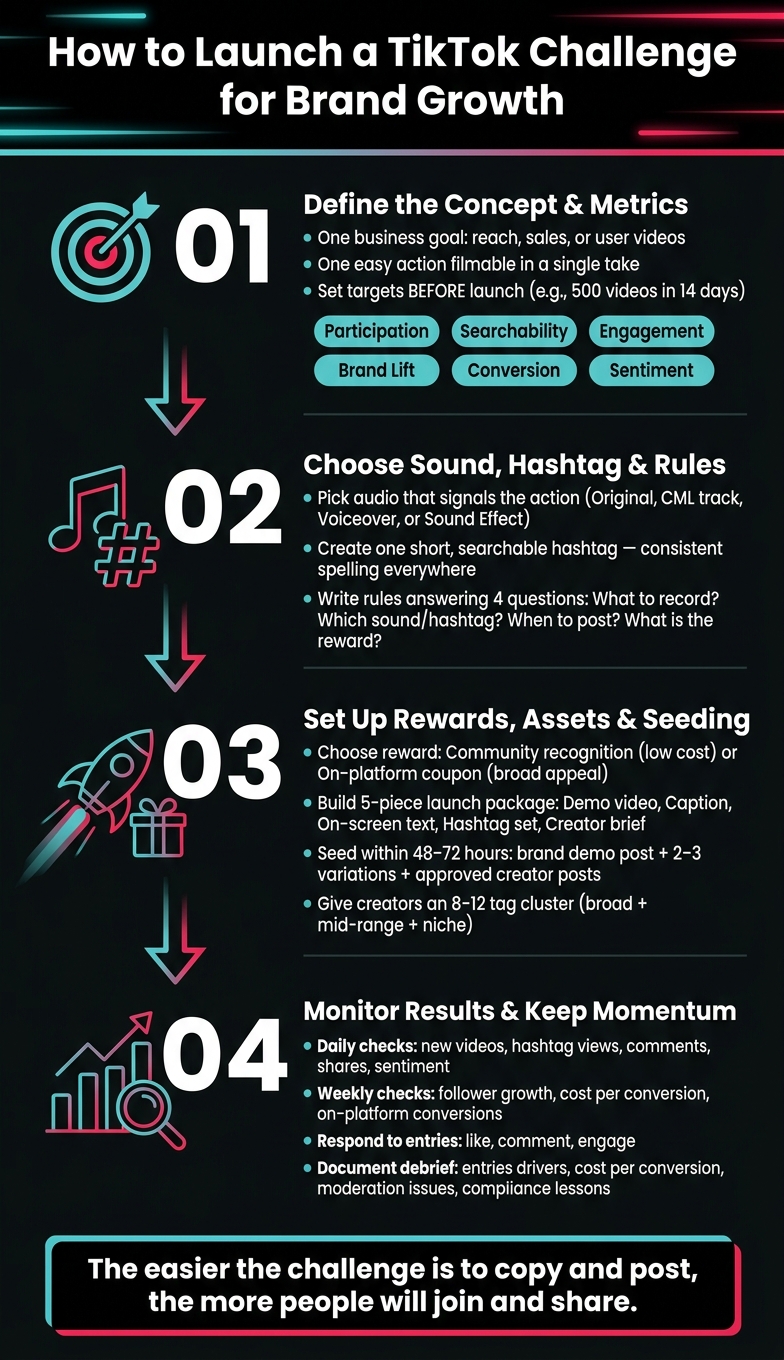
How to Launch a TikTok Challenge: 4-Step Brand Growth Framework
1. Define the Challenge Concept and Success Metrics
Choose a simple action tied to your brand
The core action is the center of your challenge. Keep it simple, tied to your brand, and easy to film in one take.
One take should be enough. If people need extra setup or editing, fewer of them will join in.
Use the same brand keywords in the challenge name, caption, and on-screen text. That helps connect every participant video back to your brand.
If the action is that simple, the next job is making it just as easy for people to join.
Check how easy it is to participate
Before you lock in the idea, run one fast test: can someone film this right now on a phone in one take? If not, simplify it.
Less effort usually means more entries. Simple challenges are easier to copy, and easier challenges tend to give you cleaner numbers.
Flexibility matters too. The best challenge actions have a clear format, but they still leave room for personality. That freedom lets people put their own spin on it while keeping the challenge easy to recognize.
Set campaign metrics before launch
Set your targets before launch so the data means something later.
A challenge can be easy to copy and still fall flat, so decide what success looks like now. Track these metrics before launch:
| Metric | What to Track |
|---|---|
| Participation | Number of videos using the challenge hashtag |
| Searchability | Keyword performance in captions, on-screen text, and audio |
| Engagement | Comments and shares on participant videos |
| Brand lift | Branded searches and keyword mentions |
| Conversion | On-platform shop visits or sales |
| Sentiment | Tone of comments to gauge community resonance |
Set a clear number for each metric before launch. Don’t go with something fuzzy like "more engagement." Pick an actual target, such as 500 participant videos in the first 14 days. That gives you a clean way to review results after launch instead of relying on gut feel.
Once the concept and metrics are set, package the challenge with sound, a hashtag, and simple rules.
sbb-itb-3b12fba
2. Choose the Sound, Hashtag, and Participation Rules
Your sound, hashtag, and rules need to work as a set. If people can tell what to do in a few seconds, they're far more likely to join.
Pick audio that fits the action and mood
Choose audio that gives people a clear signal for when to act. The format should match what you want them to do.
| Audio option | Best use | Key consideration |
|---|---|---|
| Original brand sound | Branded mnemonic or repeatable phrase | Strong recognition; requires rights clearance |
| Commercial Music Library (CML) track | When mood matters more than verbal branding | Pre-cleared for commercial TikTok use |
| Voiceover prompt | Tutorials, reactions, or fill-in-the-blank formats | Keep it short and synced with the action |
| Sound effect | Transitions, reveals, or visual transformations | Helpful when participation depends on a visual cue |
Don't use a trending sound for brand posts unless the commercial rights are clear. For commercial posts, use CML audio unless those rights have been explicitly cleared.
Create a short, searchable hashtag
Build the hashtag from your campaign name plus an action or benefit cue. It should be short enough that people can type it without mistakes and clear enough that every post ends up in the same place.
Before publishing, search TikTok for existing uses, mixed meanings, or sensitive associations. Once you've confirmed it, keep the spelling EXACTLY the same everywhere: the sound page, caption, creator briefs, and any paid media.
Write rules people can follow in seconds
Clear rules cut confusion and help protect the brand from a legal standpoint. The visible prompt, whether it lives in the caption, video, or pinned comment, should answer four things right away:
- What do I record?
- Which sound and hashtag do I use?
- When do I post?
- What is the reward?
If there's a prize or giveaway, add more detail. State the entry dates in full U.S. format, geographic eligibility, minimum age, number of winners, approximate retail value when relevant, and how winners are chosen. Have U.S. legal counsel review the terms before launch.
If creators get payment, free product, a discount, or a prize, they must use TikTok's disclosure setting and clear label language in the brief.
With the sound, hashtag, and rules in place, the next step is rewards, launch assets, and seeding.
3. Set Up Rewards, Launch Assets, and Seeding
Once the challenge idea is locked in, the next step is simple: make it EASY to join. If someone needs more than a few seconds to understand what to do, you’ll lose people.
Choose rewards that fit your budget and goal
Pick a reward that supports a strong challenge. A prize can help push people from interest to action, but it won’t save a weak idea.
| Reward type | Participation appeal | Cost/complexity | Best use case |
|---|---|---|---|
| Community recognition | High for niche creators who want to be seen by the right audience | Low | Micro-community and creator-led challenges |
| On-platform reward, such as a TikTok Shop coupon | Broad appeal for audiences ready to act now | Low | Commerce-focused campaigns |
For niche groups, being noticed by the right people often matters more than a broad giveaway. That kind of recognition can carry more weight than a generic prize.
Build the core launch package
After the reward is set, package the launch so people can get it and copy it almost instantly.
Before anything goes live, have these five pieces ready:
- a demonstration video
- a caption with campaign keywords
- on-screen text
- the finalized hashtag set
- a written creator brief
The demo video does most of the heavy lifting. It should show the action clearly, use the selected sound, display the hashtag on screen, and explain how to enter, all within the first few seconds. That early clarity matters because people decide fast.
The creator brief matters just as much. It should include the exact hashtag spelling, caption template, posting window, and disclosure language. You’ll also want a clear rights-management process in place before reusing any participant video. Then add a moderation plan that spells out who reviews flagged content and how fast they respond. Assign one person to watch flagged comments and reply fast.
Seed the challenge with coordinated posts
Start with the brand demo post. Then, within 24 hours, follow it with two or three variations that show different ways to join while still keeping the core action easy to copy. Early examples should be simple. That helps people who are interested but hesitant because they’re not sure they’re doing it right.
Line up approved creator posts in the same launch window, ideally within the first 48 to 72 hours. Give each creator an 8–12 tag cluster that mixes broad, mid-range, and relevant niche tags instead of leaning on one generic tag. Also tell creators to use descriptive keywords in captions and on-screen text. TikTok’s algorithm looks at those signals too, not just hashtags, when it sorts and surfaces content.
Watch which version brings in the most entries during the first few days. Then put more energy behind the one that’s working.
4. Monitor Results and Keep Momentum After Launch
Track performance on a fixed review schedule
Once the challenge goes live, check performance on a set rhythm: daily and weekly.
| Review window | What to track |
|---|---|
| Daily | New participant videos, hashtag views, comments, shares, profile visits, sentiment |
| Weekly | Follower growth, cost per conversion, on-platform conversions |
Daily sentiment checks matter because they help you spot trouble before it snowballs. Those day-to-day signals also show which creators or content styles are worth responding to.
Respond to creators and reuse what works
When someone posts a challenge entry, respond to it. Like the video. Leave a short comment. It sounds simple, but that kind of interaction helps keep the challenge active.
If one hook or format starts to perform well, use it again in follow-up content. Lean into what’s already getting traction instead of starting from scratch every time.
If you want to reuse participant content in ads or in-store displays, get the creator’s permission first. Then keep a record of the hooks and comments that performed best so you can use them in the final review.
Review results and apply lessons to the next challenge
At the end of the campaign, document what drove the most entries, your cost per conversion, any moderation issues, how the audience responded overall, and any rights or compliance lessons you picked up.
That debrief becomes the starting point for the next challenge. Use it to sharpen the next challenge brief.
Conclusion: Build a Challenge People Can Copy and Want to Share
A TikTok challenge works when it’s simple, clear, and easy to copy.
That’s the sweet spot. A clear structure helps people get it fast, while a bit of freedom gives them room to make it their own. Put those two together, and more people join in. The brands that do best don’t just chase reach. They build participation.
After launch, the job shifts to learning from the numbers and using that lesson in the next challenge. Each campaign should make the next brief a little sharper. Use what happened to fine-tune the next goal, action, sound, hashtag, and reward.
FAQs
How do I pick the best challenge idea for my brand?
Match your challenge idea to your brand goal.
If you want awareness, go with a simple branded hashtag challenge that lots of people can join without much effort. If you want better user-generated content, pick a format that nudges people to share reviews, how-tos, or short tutorials.
Keep it simple: one main action, under 60 seconds, and in line with your brand’s personality. It should feel like an open invite to join in, not a sales pitch.
Do I need a prize for a TikTok challenge to work?
Not always. The right incentive depends on what you want from the challenge.
If your goal is more participation, simple rewards can do the job. Think product bundles or small cash prizes.
If you want better content, tiered rewards may work best. That could mean exclusive brand access or one-of-a-kind experiences.
But in most cases, a challenge works best when the mechanics are simple, the call to action is clear, and the content clicks with your community.
What should I do if my challenge gets low participation?
First, check your entry requirements. If your approval rate is under 60%, your rules may be too complicated. Keep the challenge focused on one main action that takes less than 60 seconds.
Also, present it as a community invitation, not a sales pitch. It can help to seed the challenge with 5 to 15 creators so people can see what good participation looks like. Then use Outfame’s real-time analytics to track performance and see where you may need to tweak things.


