
Instagram ad compliance ensures your ads align with Meta's rules and FTC regulations. Non-compliance can lead to rejected ads, account restrictions, or even permanent bans. Meta's Multimodal Ad Review System (MARS) now proactively scans all ads before they go live, making adherence to policies more critical than ever.
Key Takeaways:
- Meta's Policies: Ads must avoid banned content (e.g., illegal products, misinformation) and follow strict rules for sensitive topics like health, gambling, or personal attributes.
- FTC Rules: Clear sponsorship disclosures are mandatory. Use terms like "Ad" or "Sponsored", and avoid vague hashtags like #spon.
- Common Mistakes:
- Missing or unclear disclosures.
- Misleading claims or exaggerated promises.
- Violating targeting rules (e.g., referencing personal attributes).
- Noncompliant visuals, such as "before and after" photos.
- Account Health Score: Falling below 25 triggers restricted delivery, limiting ad reach.
How to Stay Compliant:
- Use Instagram’s Branded Content Tool for partnerships.
- Avoid bold claims unless supported by evidence.
- Regularly review Meta’s policies and your Account Quality dashboard.
- Standardize disclosures across all ad formats.
A single mistake can hurt your campaigns. Build a compliance system to check ads before launch, monitor performance, and ensure long-term growth.
Key Rules That Govern Instagram Ads
Instagram ads must comply with both Meta's policies and the FTC's regulations. Violating either can lead to campaigns being flagged, restricted, or outright rejected.
Meta's Advertising Standards and Instagram Policies

Meta's rules are designed to prioritize user safety, prevent fraud, maintain a positive experience, and ensure transparency.
Certain types of content are outright banned - like illegal products, flagged misinformation, or get-rich-quick schemes. Other categories are tightly controlled. For example:
- Alcohol ads must be restricted to users aged 18+ in the U.S.
- Online gambling and dating services require prior written approval from Meta.
Meta also prohibits ads that imply personal details about the user. Phrases like "Are you struggling with debt?" or "Since you're over 50…" violate these rules. Instead, focus on messaging that highlights benefits or emphasizes the brand.
Ads for health and wellness products face extra scrutiny. Meta bans "before and after" images for weight loss products or treatments like Botox. Additionally, ads should steer clear of promoting unattainable body ideals or exploiting insecurities. Even the landing page linked to the ad is reviewed - broken links or pages that don't match the ad's offer can lead to disapproval.
While Meta's policies focus on keeping content safe and transparent, the FTC ensures that ads are honest and disclosures are clear.
FTC Advertising and Endorsement Rules
The FTC enforces legal standards for advertising, requiring truthful claims and clear disclosures of any material connections - whether that's payment, free products, discounts, or family ties - so consumers understand the context of endorsements.
On July 26, 2023, the FTC updated its Endorsement Guides to address practices like social media tagging and aspirational posts. For Instagram Reels and Stories, disclosures must be both visible as on-screen text and spoken aloud. During livestreams, disclosures should be repeated to inform viewers who join later.
In 2020, the FTC took action against Teami, LLC for making unsupported health claims and failing to disclose paid endorsements, resulting in a $15.2 million judgment.
To comply, advertisers should use clear labels like "Ad", "Paid advertisement", or "Sponsored." Vague terms such as "#spon", "#collab", or "ambassador" are not sufficient. Instagram's "Paid Partnership" tag can be used, but it doesn’t replace the need for in-content disclosures.
Understanding these rules is crucial to avoid common compliance mistakes and ensure your campaigns run smoothly.
sbb-itb-3b12fba
Common Instagram Ad Compliance Mistakes and How to Fix Them
Small errors in ad copy, visuals, or setup can often trigger Meta's automated review system, leading to compliance issues. Staying within the rules not only protects your ad account's health but also ensures your campaigns reach their full potential. To give you an idea of the stakes, Meta rejected or removed hundreds of millions of ads in 2024 due to policy violations. Enforcement has only become stricter through 2025 and into 2026. Let’s look at some common mistakes and how to address them.
Weak or Missing Sponsorship Disclosures
Using vague hashtags like #spon, #collab, or #ambassador to disclose paid partnerships is a common pitfall. These terms don’t clearly communicate the nature of the relationship. Instead, disclosures should use straightforward language like "Ad", "Paid Advertisement," or "Sponsored" and be placed prominently where users can easily see them.
Another frequent error is skipping Instagram’s Branded Content Tool. Meta requires this tool for any post influenced by a business partner in exchange for value, whether it’s free products or monetary payment. Simply tagging a partner in the caption doesn’t meet this requirement - the tool is mandatory for compliance.
Misleading Claims and Unsubstantiated Statements
Bold, absolute claims like "Lose 30 lbs in 30 days - guaranteed!" or "Earn $10,000/month from home" are a fast track to rejection. Instead, use aspirational language, such as "Formulated for daily comfort support." If your ad includes detailed claims, make sure they’re backed by verifiable evidence, like clinical trials or peer-reviewed studies, and keep that documentation on hand in case Meta requests it.
Targeting and Personal Attribute Violations
Using "you/your" language that references sensitive personal characteristics is a major compliance issue. For example, phrases like "Are you struggling with diabetes?" or "If you're in debt, we can help" violate Meta’s Personal Attributes policy.
Meta’s review process, as of March 2026, now evaluates both images and text using multimodal AI. This means an image implying a disability combined with certain copy could be flagged - even if the text alone seems neutral. The solution? Use interest-based framing. For instance, instead of "Are you diabetic?" try "For people interested in blood sugar management." Additionally, for ads related to housing, employment, or credit, always select the Special Ad Category to ensure proper targeting restrictions are applied.
Noncompliant Creative Content
Visual elements can trip up compliance just as easily as ad copy. For example, "before and after" photos for weight loss or cosmetic procedures are prohibited under Meta’s policies. Instead, opt for lifestyle imagery that shows your product in use without making exaggerated claims.
Format violations are another common issue. For instance, branded content can’t include banner ads overlaid on images, and title cards in videos can’t persist for more than three seconds. Ensuring your creative assets align with Meta’s rules during production saves time and avoids costly revisions.
Inconsistent Disclosures Across Ad Formats
When brands repurpose content for different formats - like feed posts, Stories, and Reels - disclosures can sometimes get lost or altered. A disclosure that works well in a static feed post might be ineffective in a Story or buried in a Reel’s caption.
To avoid this, embed disclosures directly into the content rather than relying solely on captions. Standardize a disclosure template for each ad format to ensure the information remains visible and compliant across all placements.
How to Build a Compliance System for Instagram Ads
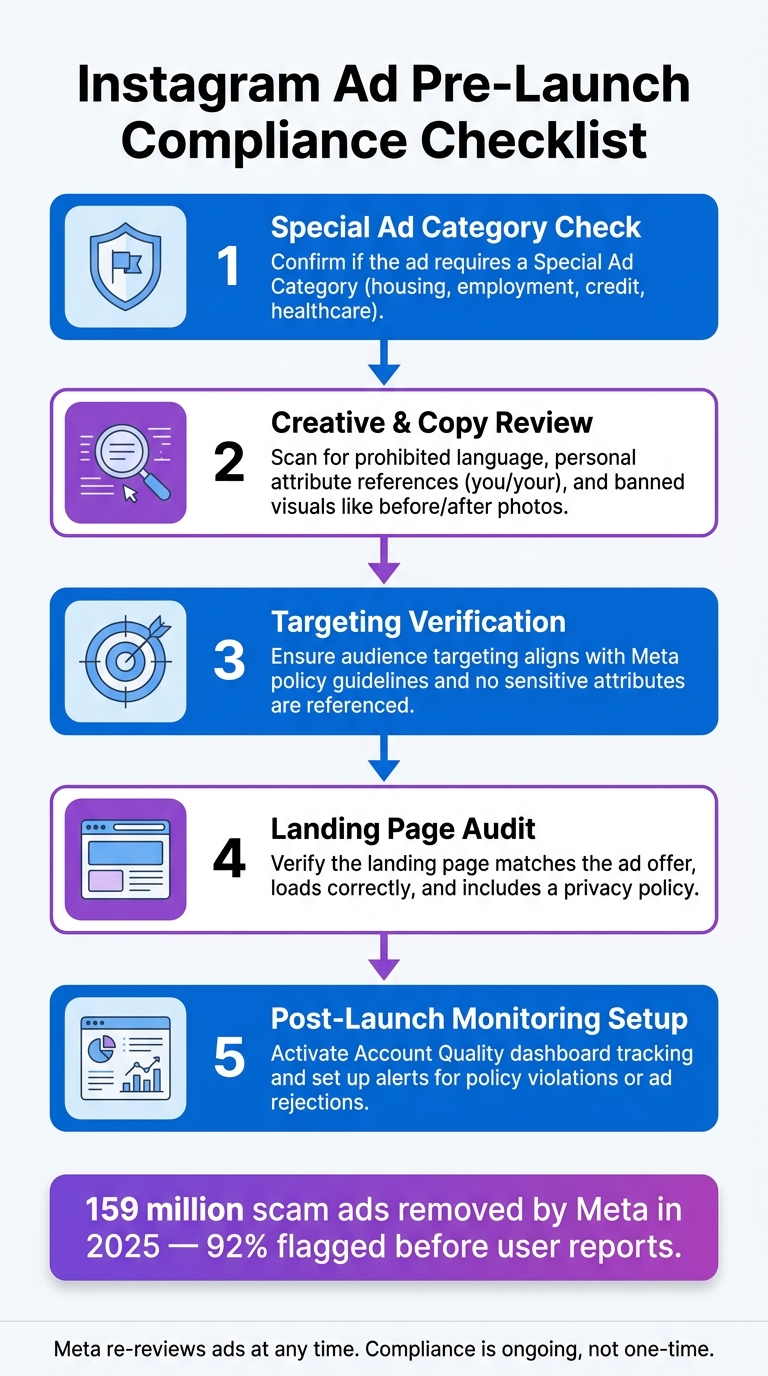
Instagram Ad Compliance Checklist: 5 Steps Before You Launch
Avoiding costly mistakes with Instagram ads means having a solid compliance system in place. A structured approach ensures you catch potential issues before they drain your ad budget. Here's how to create a system that works.
Centralized Guidelines and Team Training
Start with a compliance playbook. This document should cover the three key layers of Meta's policies: Advertising Standards (what your ads can say and display), Community Standards (rules for safety and integrity), and Business Integrity/Data Terms (how to handle data collection and usage). Without addressing all three, your team risks missing critical compliance details.
Your playbook should also include practical tips. For example, avoid placing text in the top 14% and bottom 35% of Reels, ensuring that important elements like disclosures and CTAs remain visible. If you're using AI tools to create ad content, clearly define restricted categories. Meta prohibits generative AI for certain sensitive industries, such as housing, employment, healthcare, and financial services.
One key point to emphasize during training: ad approval is not final. Meta's policies are subject to ongoing review, meaning an approved ad can later be rejected if it violates updated guidelines.
Once your team is familiar with the rules, set up workflows to catch compliance issues both before and after launching ads.
Ad Review and Monitoring Workflows
A thorough pre-launch process can prevent most problems before they even reach Meta's review system. Before launching any ad, perform these five checks:
- Confirm whether the ad falls under a Special Ad Category or requires special permissions.
- Review the creative for any sensitive or prohibited language.
- Verify that targeting aligns with policy guidelines.
- Ensure the landing page matches the ad's content and includes a privacy policy.
- Set up post-launch monitoring to track performance and compliance.
Meta reviews landing pages in real time, so ads can be rejected if their destinations contain aggressive or misleading claims.
For ongoing monitoring, make use of the Account Quality dashboard in Meta Business Suite. This tool helps you track suspended ads, identify specific policy violations, and monitor enforcement actions. Repeated violations can lead to serious consequences, from spending limits to permanent account bans. Regularly checking this dashboard can help you address issues before they escalate.
"Instead of guessing what Meta will approve, we treat policy and AI systems as fixed constraints and build a creative and performance engine that works within them." - Forge Digital Marketing
Using Outfame to Support Compliant Growth
To grow on Instagram without running into compliance issues, you need tools that combine ad monitoring with audience insights. Outfame offers real-time analytics and 24/7 growth tracking, giving you clear engagement data and eliminating the need for constant manual checks. For brands managing multiple campaigns or accounts, Outfame's agency-friendly features and dedicated account management ensure everything stays on track. Plus, it prioritizes account security by operating without requiring your Instagram password.
Conclusion: Staying Compliant for Long-Term Instagram Growth
Instagram ad compliance is a continuous process - Meta regularly re-reviews ads, meaning a campaign approved today could face scrutiny tomorrow. As Meta highlights: "Ads remain subject to review and re-review at all times, and may be rejected or restricted for violating our policies at any time."
The numbers speak volumes. In 2025, Meta removed over 159 million scam ads globally, with 92% of them flagged before users even reported them. By the end of 2026, advertiser verification is expected to cover 90% of ad revenue, putting even more focus on compliance for all accounts, not just major brands.
The key to avoiding disruptions lies in consistency. Understanding Meta's three-layer policy framework, identifying potential violations - like personal attribute issues - before launching campaigns, clearly disclosing sponsorships, and conducting weekly checks through the Account Quality dashboard can help ensure campaigns run smoothly.
"A single rejected ad is a minor inconvenience. A pattern of rejections triggers account-level restrictions that affect every campaign you run." - Chris Pollard, Founder of Ads Uploader
Establishing strong compliance habits is essential, but combining those habits with effective tools can make the process much easier. Platforms like Outfame offer real-time analytics and 24/7 monitoring, giving you the ability to catch potential issues early. Plus, its agency-friendly features make managing multiple accounts simpler. With the right approach and tools, compliance can serve as a foundation for sustainable growth.
FAQs
Why was my Instagram ad approved and then later rejected?
Your Instagram ad might have been approved initially because it passed Meta's review process at that time. However, it could have been rejected later due to issues identified during further reviews. Common reasons include misleading claims, references to personal attributes, or violations on the landing page. Meta continuously enforces its policies to ensure ads remain compliant throughout their runtime.
How do I disclose sponsorships correctly in Reels and Stories?
To make sponsorships clear on Instagram Reels, use straightforward terms like #ad, #sponsored, or #paid within the first 125 characters of your caption. Alternatively, display these terms directly on the video for at least 10 seconds. For Instagram Stories, ensure the disclosure is easy to spot on the first photo or video. It should remain visible for at least 10 seconds. If it's a video, also include a verbal mention within the first 30 seconds.
How can I prevent personal-attribute policy violations in my ad copy?
When crafting Instagram ad copy, it's crucial to avoid referencing personal characteristics like health conditions or age. For instance, phrases such as "Are you diabetic?" or "Struggling with belly fat?" are not allowed. Even indirect mentions like "For people managing diabetes" can lead to non-compliance.
Meta's policies go beyond just the wording - they now assess semantic intent and even the visuals used in your ads. This means you need to carefully review not only your ad copy but also your creative assets and landing pages. Aim for language and imagery that are neutral and inclusive to stay within the guidelines.


