
If your Instagram reach has dropped, you're not alone. In 2026, Instagram's algorithm prioritizes originality, engagement, timing, and audience relevance more than ever. Here's why your reach might have declined and how to fix it:
Top Causes of Reach Drops:
- Recycled or generic content: Instagram deprioritizes reposts or content with watermarks.
- Low early engagement: The first 30-60 minutes after posting are key for visibility.
- Wrong audience or inactive followers: Bots or uninterested followers hurt engagement rates.
- Inconsistent posting: Irregular schedules reduce visibility.
- Early viewer drop-offs: Poor hooks lead to low watch times.
- Over-reliance on Reels: Ignoring other formats like carousels can limit reach.
- Lack of community interaction: Ignoring comments or DMs signals low connection.
- No SEO keywords: Captions and bios without keywords miss search opportunities.
- Posting at the wrong time: Posting when your audience is inactive reduces engagement.
- Fake engagement: Bots, pods, or purchased followers trigger penalties.
Quick Fixes:
- Create original, high-quality content tailored to your audience.
- Post during peak activity hours identified in Instagram Insights.
- Use interactive Stories and engage with comments and DMs promptly.
- Optimize captions and bios with keywords for better searchability.
- Diversify formats: Mix Reels, carousels, and static posts.
- Remove fake followers and avoid engagement pods.
These strategies can help you recover reach within 30-45 days if implemented consistently. Start by reviewing your Instagram Insights and Account Status to identify specific issues and focus on content that resonates with your audience.
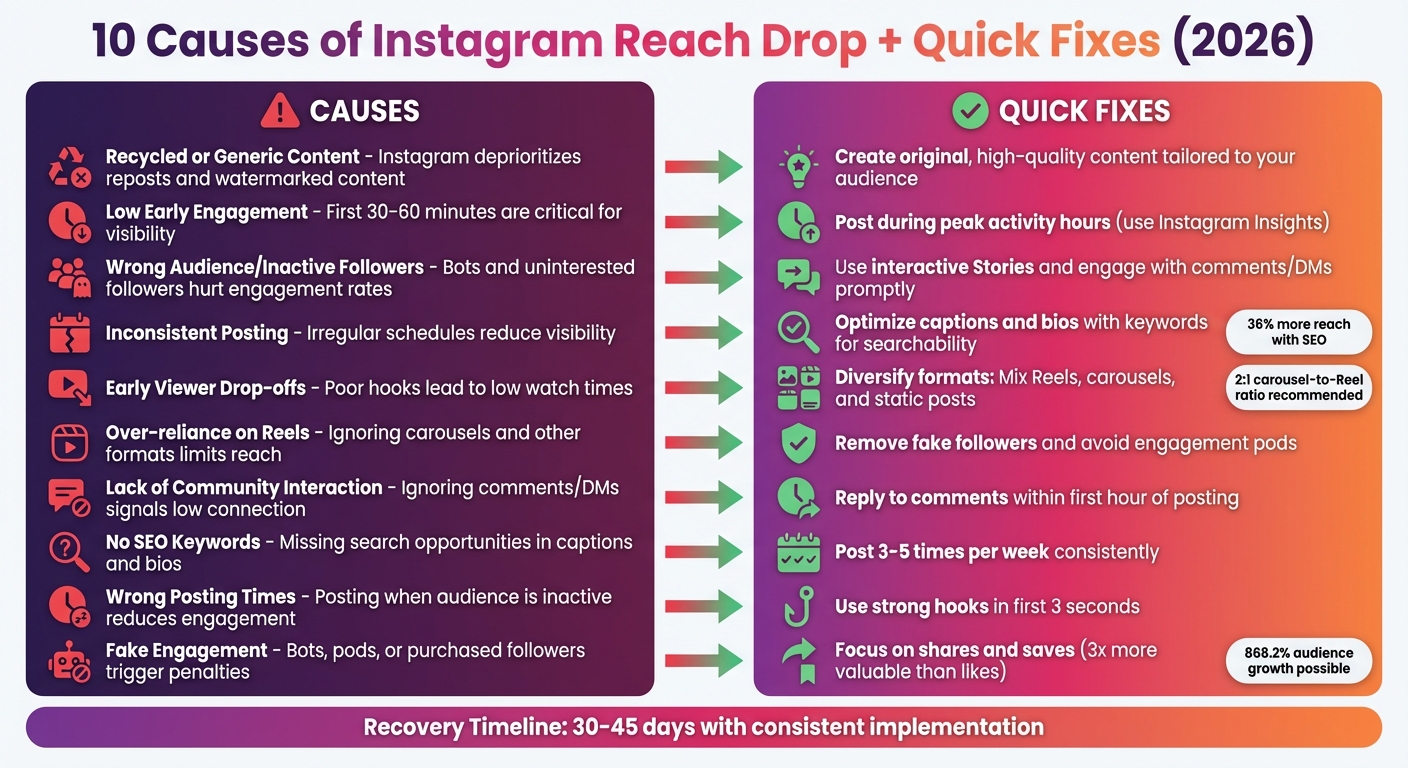
10 Causes of Instagram Reach Drop and Quick Fixes for 2026
1. Your Content Isn't Original or Specific Enough
Instagram's 2026 AI is designed to prioritize fresh, original content while pushing recycled posts to the sidelines. If you’re reposting Reels that already exist on the platform, using videos with TikTok watermarks, or jumping on overused trends, your posts are likely being deprioritized by the algorithm.
How This Affects Instagram Reach and Algorithm Ranking
Recycling or generic content sends negative signals to Instagram’s AI - things like quick scrolling or high bounce rates - which can drag down your ranking. This is especially harmful when it comes to unconnected reach, which measures how many people outside your follower base see your posts. While generic content might still reach some of your current followers, it’s almost invisible on Explore and the Reels tab, where new audiences discover accounts.
"We're less likely to recommend reposts of a reel that's already on Instagram, content with noticeable watermarks, or accounts that regularly collect and reshare others' content on their feed."
- Instagram Creators
Shares have become one of the most important ranking signals in 2026. Why? Because shares indicate a strong connection with your audience, and generic content rarely gets shared. On the other hand, Instagram Reels can achieve up to 36% more reach than other post types - but only if they’re original and meet quality standards.
How Easy the Fixes Are to Implement
Instead of simply reposting trends, use Instagram’s Remix tool to add your unique take. If you’re revisiting a successful theme, switch things up - try a new angle, a fresh hook, or even a different format. For example, turn a high-performing Reel into a carousel with engaging audio. Also, focus on grabbing attention right away with a strong and unique hook in the first three seconds.
Make it a habit to check your Account Status in settings to identify any content flagged as ineligible.
How This Aligns with Instagram's 2026 Platform Changes
Instagram rolled out several updates in late 2025 and early 2026 that heavily emphasize originality. The new "Your Algorithm" feature allows users to manually adjust their content preferences, so your posts need to align with what people are actively choosing to see. Trial Reels now let you test original content on non-followers before fully publishing it. Plus, AI-powered translations for Reels have expanded the global reach of original audio, making it accessible in languages like Hindi, Portuguese, and Spanish.
"The algorithm will start prioritizing and rewarding content that is original and creative."
- Eileen Kwok, Social Marketing Specialist, Hootsuite
Instagram’s algorithm has also shifted to become format-agnostic. This means it no longer automatically favors Reels over other formats. Instead, it rewards content - whether it’s a Reel, carousel, or something else - that generates strong engagement signals like shares, saves, and watch time. Next, we’ll dive into how early engagement can significantly impact your reach.
sbb-itb-3b12fba
2. Low Engagement in the First Few Hours After Posting
When it comes to increasing your Instagram reach, the first 30–60 minutes after you post are absolutely critical. During this window, the platform’s algorithm evaluates how well your content performs - tracking likes, comments, shares, and saves - to decide whether it’s worth showing to a broader audience. If your post doesn’t attract much engagement early on, the algorithm assumes it’s not resonating and limits its visibility to a smaller portion of your followers. This means your content might not make it to the Explore page or the Reels tab. That early response doesn’t just impact immediate reach; it sets the stage for how your post will perform in the long run.
How This Impacts Instagram Reach and Algorithm Behavior
Instagram’s algorithm relies heavily on those initial interactions to decide how much reach your post deserves. If your content gets strong engagement right away, it signals to the system that it’s valuable. On the flip side, a slow start - whether due to poor timing or a lack of compelling hooks - can drastically limit your reach. This creates a snowball effect: weak early performance restricts distribution, which further dampens engagement and visibility.
"In feed, the five interactions we look at most closely are how likely you are to spend a few seconds on a post, comment on it, like it, share it, and tap on the profile photo."
- Adam Mosseri, Head of Instagram
By 2026, Instagram’s algorithm places more weight on shares via DM, saves, and comments than traditional likes. A noticeable drop in these key engagement signals often points to a problem with your content.
Simple Adjustments to Improve Engagement
To counter low engagement, you can make a few quick adjustments. Start by posting during your audience’s peak activity times - Instagram Insights can help you identify these windows. Engage with your audience within the first hour by replying to every comment - this boosts interaction rates significantly. You can also use interactive Stories, like polls or sliders, just before posting to warm up your audience and increase engagement signals. And don’t forget to include a strong hook that grabs attention within the first three seconds, as “time spent on post” is a key metric the algorithm tracks.
How This Fits with Instagram’s 2026 Updates
Instagram’s 2026 algorithm now prioritizes how quickly a post gains traction and how recently it was shared. Unlike earlier versions, the platform no longer favors Reels exclusively. Instead, any format - whether it’s a carousel with audio or a traditional post - can perform well if it generates immediate engagement through shares and saves. For instance, simply adjusting your posting schedule can lead to dramatic improvements in engagement.
"Early engagement equals stronger distribution. The algorithm pushes what pops off fast."
3. Wrong Audience or Low-Quality Followers
Having a large follower count might look impressive, but if your reach is low, it’s a sign that something’s off. Low-quality followers - like bots, inactive accounts, or people uninterested in your content - don’t engage with your posts. When Instagram’s algorithm notices that a big chunk of your audience isn’t interacting, it assumes your content isn’t worth promoting to others. This gap between follower count and engagement can hurt how your posts are ranked.
How This Affects Instagram Reach and Algorithm Ranking
When your audience doesn’t engage, Instagram’s algorithm sees your content as irrelevant. This reduces your chances of landing on the Explore page or being shown to non-followers. It creates a downward spiral: lower engagement leads to less visibility, which further reduces engagement. Instagram's 2026 updates now factor in long-term behavior, meaning if your account has a history of poor engagement, it could limit the reach of your future posts.
Here’s an example: say you have 10,000 followers, but only 500 of them regularly engage. The algorithm reads this low interaction rate as a lack of value for your audience. It also tracks the history of interactions - like direct messages, comments, and Story replies. If your followers aren’t engaging consistently, your posts might get buried in their Feeds or Stories.
"Instagram's algorithm favors accounts with an engaged audience, and when you're focusing on quantity, the quality of your content often takes a hit, and then next thing you know, your engagement rate plummets, and Instagram won't do you any favors when that happens."
- Shannon McKinstrie, Social Media Trainer
How This Aligns with Instagram's 2026 Platform Changes
Instagram’s 2026 algorithm no longer prioritizes specific content formats. Instead, it focuses on impact signals like shares and saves. If your audience isn’t the right fit for your niche, they’re less likely to share or save your posts, which can hurt your reach. Additionally, the "Your Algorithm" feature, introduced in December 2025, lets users down-rank topics they’ve lost interest in. If followers signal they’re no longer interested in your content, Instagram’s AI will hide your posts, further reducing visibility. To stay ahead, it’s crucial to take strategic, targeted actions.
Long-Term Growth and Engagement Potential
For lasting success, prioritize building an engaged audience. Brands with fewer than 501,000 followers should aim to reach about 34% of their audience through feed posts. For example, a local outdoor sporting goods retailer saw stagnant reach from October 2024 to September 2025. By using SEO-driven captions and cleaning up their follower base, they achieved 5 million impressions - a 2,568.8% increase - and grew their audience by 868.2%.
Leverage Instagram Insights to identify your most active followers and post during their peak activity times. Use interactive Stories - like polls, quizzes, and "Add Yours" stickers - to engage your audience and identify inactive followers. Update your bio with a precise, search-optimized niche phrase (e.g., "Fitness Coach for Women 40+") so Instagram can categorize your account accurately and recommend it to the right users. Also, remove bot accounts (e.g., profiles with no pictures or random usernames) to quickly improve your engagement-to-reach ratio.
4. Inconsistent Posting Schedule and Content Plan
Posting randomly on Instagram can disrupt the trust you've built with your audience and the platform's algorithm. Just like other algorithmic factors, maintaining a consistent posting schedule strengthens both your short-term visibility and long-term reach. This steady rhythm keeps your audience engaged while signaling reliability to Instagram's system.
How This Affects Instagram Reach and Algorithm Ranking
Instagram's algorithm heavily weighs recency and relationship signals to decide who sees your posts. If you miss your audience's peak activity times, your content might not gain enough early engagement. And early engagement matters - a lot. The algorithm closely monitors how quickly users interact with your post right after it goes live. If interactions are slow, Instagram is less likely to push your content further.
Skipping a week of posting can also hurt your growth. Accounts that go inactive often face penalties, making it harder to grow your follower base.
How This Aligns with Instagram's 2026 Platform Changes
By 2026, Instagram's AI has evolved to reward creators who stick to a consistent posting schedule. For example, creators publishing on the same day each week see about 50% more Reels surfaced to users. The algorithm has also shifted to focus less on content format and more on signals like shares and saves, rewarding high-quality, original posts.
On top of that, Instagram's new "Your Algorithm" feature lets users manually down-rank topics they’ve lost interest in. If your posting is inconsistent, followers might disengage, which could further reduce your reach.
This all highlights one thing: a predictable posting schedule isn’t just helpful - it’s essential.
Long-Term Growth and Engagement Potential
Posting consistently, around 3–5 times per week, can increase your reach by 12% and double your follower growth rate. For those posting 10 or more times weekly, follower growth rates can skyrocket - up to 5.5× higher than low-frequency accounts. However, posting too frequently can lead to diminishing returns.
If your reach has taken a hit, consider a "consistency sprint." This means posting daily for 7–14 days to reignite engagement signals. Afterward, settle into a steady rhythm of 3–5 posts per week. Scheduling tools can help you stay consistent during busy periods, and Instagram Insights can guide you to post at times when your audience is most active. Recovery from a reach drop typically takes 30–45 days of consistent posting.
A regular posting schedule doesn’t just improve impressions - it can significantly boost your follower growth over time.
"The data suggests that there is a strong positive relationship between posting frequency and follower growth on Instagram. Channels that post more frequently consistently gain more Instagram followers relative to their baseline."
- Julian Winternheimer, Data Scientist, Buffer
5. Viewers Leave Your Content Too Early
If users quickly scroll past your posts, Instagram takes it as a negative signal, which can reduce your reach.
How This Affects Instagram Reach and Algorithm Ranking
Instagram's 2026 algorithm heavily focuses on time spent viewing your content. For Feed posts, users need to engage with your content for at least 10 seconds to avoid penalties. On the Explore page, the bar is even higher - Instagram prioritizes posts viewed for at least 5 seconds and favors videos with a completion rate of 95% or more. When it comes to Reels, metrics like watch time, rewatches, and completion rates are key factors in determining whether your content gets promoted to a larger audience.
"In feed, the five interactions we look at most closely are how likely you are to spend a few seconds on a post, comment on it, like it, share it, and tap on the profile photo." - Adam Mosseri, Head of Instagram
The first 3 seconds are make-or-break. If viewers swipe away during this critical window, the algorithm interprets it as a sign of low-quality content and reduces your post's visibility.
How This Aligns with Instagram's 2026 Platform Changes
Instagram's algorithm now prioritizes entertainment value over passive engagement like likes. Watch time and rewatches play a much bigger role in how your content is ranked. Additionally, the platform's "Your Algorithm" feature, launched in late 2025, lets users manually down-rank topics they don't find interesting anymore. This means if your content doesn't grab attention immediately, users are more likely to skip it, signaling the algorithm to show them less of your posts in the future.
To stay competitive, focus on creating engaging formats that deliver instant value. For Reels, keep them under 90 seconds to boost completion rates. Use auto-captions to maintain viewer interest, especially for those watching without sound. Including a loop-back element at the end can encourage rewatches, further increasing total watch time.
Long-Term Growth and Engagement Potential
Improving viewer retention can lead to measurable growth. For example, in September 2025, a midlife influencer who focuses on gut and hormone health recovered from a severe reach drop (with views falling below 200 per post) by revamping her content strategy. She incorporated stronger hooks and optimized captions for SEO. Within just 30 days, her views surged to 23,781 - a 24.5% increase, surpassing her previous performance.
To replicate this success, start your Reels with a bold visual transition or a compelling caption (e.g., "This mistake cost me..."). For carousels, place your strongest hook on the first slide and deliver value progressively through slides 2–5 to encourage swiping. Instagram also re-shows carousels to users who didn't swipe through the entire post, giving you additional opportunities to grab their attention.
6. Posting Only Reels Without Mixing Content Formats
Focusing solely on Reels can limit your reach on Instagram. The platform uses distinct ranking systems for Feed, Reels, Stories, and Explore. By sticking to just one format, you miss out on engaging followers who prefer other types of content, like static images or carousels.
How This Affects Instagram Reach and Algorithm Ranking
Instagram tailors content visibility based on individual user preferences. If you rely exclusively on Reels, your content won’t resonate with users who lean toward swipeable carousels or static posts. Carousels, in particular, have a unique edge: when a follower doesn’t view all the slides, Instagram often resurfaces the post later, starting from the first unseen slide. This makes a strong case for diversifying your content.
"People tend to look for their closest friends in stories, use explore to discover new content and creators, and be entertained in reels." - Adam Mosseri, Head of Instagram
How This Aligns with Instagram's 2026 Platform Changes
Instagram has shifted toward rewarding content that generates strong engagement signals - like shares and saves - regardless of format. For example, carousels with audio now appear in both the main Feed and the Reels tab, doubling their chance of discovery. Additionally, the "Your Algorithm" feature, introduced in December 2025, allows users to down-rank content formats they prefer less. If someone opts to see fewer Reels and more photos, sticking to Reels-only content could hurt your visibility. The algorithm now prioritizes engagement metrics over file type.
Long-Term Growth and Engagement Potential
The benefits of a mixed-content strategy are clear. From October 2024 to September 2025, an outdoor sporting goods brand managed by Wheeler Marketing Agency saw a dramatic turnaround in visibility by combining SEO-optimized captions with a mix of videos and static posts. This approach led to an 868.2% increase in audience growth and a 2,568.8% jump in impressions, ultimately reaching 5 million people. Similarly, in September 2025, a midlife health influencer saw a 24.5% boost in views - reaching 23,781 within 30 days - after alternating between Reels, carousels, and static posts.
To avoid the pitfalls of a Reels-only strategy, consider these tips:
- Use a 2:1 or 3:1 ratio - post one carousel for every 2–3 Reels.
- Repurpose high-performing Reels into carousels for followers who prefer text-based content.
- Add trending or custom audio to carousels to increase their chances of appearing in the Reels tab.
7. Not Engaging With Your Community or Starting Conversations
Once you've nailed the basics of early engagement, the next step is actively connecting with your community. Ignoring your audience can quickly derail your reach. Instagram keeps tabs on how you interact with followers and how fast you respond. If you're posting but not replying to comments or sparking real conversations, the platform assumes your connection with followers is weak - and your content could get buried in their feeds.
How This Affects Instagram Reach and Algorithm Ranking
Instagram's algorithm prioritizes accounts that users frequently interact with - whether through messages, comments, or other engagement. It evaluates recent interaction history to decide how relevant you are to each user. By 2026, Instagram closely monitors your comment-to-like ratio. If your posts get likes but no comments, or if you ignore comments altogether, the platform sees this as a lack of genuine conversation. On top of that, failing to engage can lead to bounce signals - when users quickly scroll past your posts - which further hurts visibility.
How Easy the Fixes Are to Implement
The good news? Fixing engagement issues is straightforward and can be done right away. Start by replying to comments within the first hour of posting to build trust and encourage further interaction. Use interactive Story stickers and respond to DMs promptly to strengthen your bond with your audience. A great tactic is the "Core 500" strategy: focus on your most loyal followers and make them feel valued by responding to all their comments and showing appreciation for their support. With these changes, you can often see improvements in engagement within 14 to 30 days.
How This Aligns with Instagram's 2026 Platform Changes
With the introduction of the "Your Algorithm" feature in December 2025, users can now manually down-rank accounts or topics they’re no longer interested in. This makes it more important than ever to stay actively engaged with your audience. Instagram has also shifted its focus away from vanity metrics like total likes. Instead, shares and saves now carry three times the weight of likes because they reflect deeper connections and value. Direct Messages have become a key tool for relationship-building, and responding to DMs quickly can give you a noticeable edge.
"Interactions increase how far up your brand appears in the user's Stories bar." - Jason Fung, Marketing Coordinator at Black & White Zebra
Long-Term Growth and Engagement Potential
From October 2024 to September 2025, Wheeler Marketing Agency helped an outdoor sporting goods brand revamp its strategy by using SEO-optimized captions and posting during high-engagement windows. The results? An 868.2% increase in audience growth and a staggering 3,657.9% boost in engagement. Similarly, in September 2025, a midlife health influencer rebuilt her content plan with Story sequences and targeted engagement tactics. Within just 30 days, she saw an 18.2% increase in engagement and a 24.5% rise in views, surpassing her previous benchmarks.
Simple changes, like using specific calls-to-action (CTAs) - for example, "Drop a 😂 if you've felt this" - can make a big difference. These types of CTAs outperform generic prompts by a 3:1 ratio. The bottom line? Engagement isn’t just about broadcasting your message; it’s about creating a genuine two-way connection. Building strong community interactions not only boosts your current reach but also lays the groundwork for long-term Instagram growth.
8. No SEO Keywords in Your Captions and Bio
In 2026, Instagram is no longer just a social media platform - it's a search-first discovery engine. Ignoring SEO in your captions and bio can drastically reduce your reach. Keywords now act as signals for Instagram's AI, helping it index and recommend your content to users searching for your niche. Without them, your posts could remain invisible to the very audience you're trying to attract.
How This Impacts Instagram Reach and Algorithm Ranking
Instagram's AI-powered ranking system heavily relies on keywords to determine what content appears in search results, the Explore page, and suggested feeds. This shift has made keyword-rich content essential for visibility. In fact, 67% of Gen Z users rely on Instagram as a primary search tool, often treating the search bar like Google or TikTok. Hashtags have taken a backseat as the algorithm now prioritizes keywords in captions, bios, and even video subtitles to categorize content.
With the introduction of the "Your Algorithm" feature in December 2025, users can customize their feed by selecting or down-ranking topics. If your content lacks relevant keywords, it won’t align with the interest categories users have chosen. This means you’ll miss out on reaching new audiences who are actively searching for what you offer.
"It's important to write keyword-rich content to enhance content indexing by Instagram's AI." - Jason Fung, Marketing Coordinator, Black & White Zebra
Quick and Simple SEO Fixes
The good news? These SEO updates are easy to implement and can make a big difference. Start by optimizing your bio Name field with niche-specific keywords. For example, instead of just your name, try something like "Jane Doe | Social Media Marketing" to show up in relevant searches.
When writing captions, use descriptive language that naturally incorporates keywords your audience searches for. Avoid one-word captions, as they provide little context for Instagram's AI. You can also:
- Add keyword-optimized alt text to your images.
- Include target keywords in Reel subtitles.
- Rename original audio files with descriptive, keyword-rich titles instead of generic labels like "Original Sound".
These small changes align with Instagram's shift toward a search-focused model and can significantly boost your visibility.
Adapting to Instagram's 2026 Updates
Instagram now rewards content that matches what users are actively searching for. Posts with keyword-rich captions and subtitles have been shown to achieve 36% more reach compared to others. Additionally, since late 2025, Google has started indexing public Instagram posts, meaning your optimized captions and bios can help drive traffic from external search engines as well.
Instagram has also introduced AI-powered audio and text translations for Reels, giving preference to clear, keyword-optimized captions.
"Social SEO reigns supreme... Using keywords in your bio and captions helps the platform determine what your content is about and who should see it." - Alyssa Hirose, Hootsuite
Building Long-Term Growth and Engagement
Keyword optimization doesn't just boost your reach today - it builds a searchable content library that can continue to drive traffic weeks or even months after posting. This approach connects your account with users who are actively searching for solutions or content in your niche, creating a steady stream of high-intent engagement.
With organic reach declining by 12% year-over-year and most posts reaching only 3–4% of followers, SEO is no longer optional - it’s the backbone of discoverability on Instagram. By integrating keywords into your profile name, bio, captions, alt text, and subtitles, you're setting the stage for sustained visibility and growth.
9. Posting When Your Audience Isn't Active
Timing plays a huge role in Instagram's 2026 algorithm. Posting when your followers are offline - like during late-night hours or early mornings when they're asleep - can hurt your content's performance. Why? Because when your post doesn't get immediate engagement, Instagram's algorithm assumes it's not interesting and stops showing it to others before your audience even has a chance to see it.
Why Timing Matters for Instagram Reach
Instagram's algorithm makes quick decisions about your post's reach in the first 30 minutes after it's published. This is when the platform measures how quickly people are liking, commenting, or sharing your content - a concept called "interaction velocity." If your post gets off to a slow start, the algorithm buries it, even if it could have done better later on.
Here’s another challenge: Instagram's Feed AI ranks the most recent 500 posts for every user. If you post during off-hours, your content gets pushed down by newer posts from other accounts by the time your followers log in. For example, between October 2024 and September 2025, Wheeler Marketing Agency helped an outdoor sporting goods brand achieve a 2,568.8% increase in impressions (reaching 5 million) and 868.2% audience growth simply by posting when their audience was active and using SEO-friendly captions.
"Early engagement equals stronger distribution. The algorithm pushes what pops off fast." - Wheeler Marketing Agency
Simple Fixes to Improve Timing
Adjusting your posting schedule is one of the easiest changes you can make. Start by switching to a Business or Creator profile to access Instagram Insights, where you can see when your followers are most active. According to 2026 data, the best time to post is 5:00 a.m. local time, with peak activity windows being early morning (3:00–6:00 a.m.) and evening (6:00–11:00 p.m.).
You can take the guesswork out of this process by using tools like Buffer or Sprout Social to schedule posts during these peak times. Consistency is key, even if you're not online to hit "post." For example, in September 2025, a health influencer who had seen their Reel views drop from 1,000 to under 200 revamped their content calendar to align with active hours. Within just 30 days, their views increased by 24.5% (totaling 23,781), and engagement grew by 18.2%.
How Instagram's 2026 Updates Make Timing Crucial
The 2026 algorithm is heavily focused on "freshness" and recency. Content that gets immediate engagement is rewarded, while posts with a slow start are penalized. This makes timing more important than ever - posting when your audience is active ensures your content is at the top of their feed when they're ready to engage.
"If you post around the times your audience is looking, yours will be the freshest content available." - Rob Glover, Senior Copywriter, WordStream
Building Momentum for Long-Term Growth
Fine-tuning your posting schedule doesn't just help in the short term - it sets you up for sustained growth. Posting during peak times helps build engagement momentum. Instagram's algorithm favors accounts that consistently perform well, so posting 3–5 times per week during active hours can boost your reach by about 12% per post compared to irregular posting.
Keep an eye on your post's performance during the first 60 minutes after it goes live. This is the "golden hour" when the algorithm decides whether to show your content to people beyond your followers. By syncing your schedule with your audience's habits, you're not just fixing a temporary drop in reach - you’re laying the groundwork for ongoing visibility and growth.
10. Using Fake Engagement or Engagement Pods
Buying followers, relying on bots, or joining engagement pods might seem like shortcuts to boost visibility, but Instagram's 2026 algorithm is designed to detect and penalize these tactics. The platform now employs advanced AI to identify fake engagement patterns in real time. The consequences can be severe: your posts may disappear from the Explore page, hashtag searches, and even the feeds of your genuine followers. This kind of penalty, often called shadow-banning, happens silently and without warning.
How This Impacts Your Reach and Algorithm Ranking
Instagram's algorithm depends on signals like authentic interactions and relationship history to determine who sees your content. When you use fake engagement, you’re essentially confusing the system with unreliable data, which can result in your content being deprioritized. For instance, if you join an engagement pod where members quickly like and comment on each other’s posts, Instagram flags this as suspicious activity and limits your reach.
Additionally, Instagram tracks the historical performance of your account. This means that even past use of fake engagement can hurt your visibility down the line. Comments from accounts flagged for inauthentic behavior may be pushed to the bottom of threads or hidden entirely. As of 2025, an estimated 15–20% of accounts on major platforms have some level of fake engagement, and Instagram has been cracking down with regular bot purges. These measures are part of a broader effort to enforce stricter policies for 2026.
"The more likely you are to take an action, and the more heavily we weigh that action, the higher up in feed you'll see the post." - Adam Mosseri, Head of Instagram
Aligning with Instagram's 2026 Platform Changes
Instagram’s recent updates take a hard stance against fake engagement. The platform now focuses on intent-based metrics, evaluating how content influences user behavior over time rather than relying on immediate likes. One key factor is interaction velocity - how quickly people engage with your post. Sudden, unnatural spikes from fake likes or comments are flagged as low-quality signals.
The platform has also shifted from a "social graph" (who you follow) to a "content graph" (what content engages you), making follower count far less relevant without genuine interaction. Instagram now uses an "Account Status" feature to determine if your account qualifies for recommendations. Accounts that rely on bots or engagement pods risk being removed from discovery altogether. These changes make it critical to adapt quickly to avoid long-term penalties.
"In 2026, Instagram is no longer a content-sharing app. It's a recommendation engine." - Thinkster
How to Correct Course
If you’ve been using fake engagement, it’s time to stop immediately. Disconnect from third-party automation tools and engagement pods to avoid a potential account ban. Pause all activity for 24–48 hours to signal to Instagram that the automated behavior has ended. Review your content and consider removing posts that show suspicious engagement spikes.
Recovery times depend on the extent of fake activity. Minor cases usually take 2–4 weeks to regain algorithmic trust, while significant bot usage may require 2–3 months of consistent, authentic behavior. Severe cases could take six months or longer. While you can’t manually remove fake followers, you can report bot accounts as "Spam/Fake Account" to help Instagram clean up your audience. Shifting your focus to Reels can also help, as Instagram often prioritizes this format even if your feed visibility is limited.
Building Genuine Engagement for Long-Term Growth
Real engagement is the key to sustainable growth. Instagram now places a higher value on shares as a ranking signal since they reflect genuine user connections, while likes - which can be easily manipulated - carry less weight. The algorithm also prioritizes meaningful conversations over generic comments, so creating content that sparks real dialogue is crucial.
To improve your content’s performance, focus on making it shareable. Strong opening hooks, engaging storytelling, and high completion rates for videos can all boost your reach. Instagram also rewards creators who consistently publish fresh content, with Reels from active creators being surfaced 50% more often. By prioritizing authentic engagement over artificial metrics, you can align with Instagram’s evolving standards and set yourself up for long-term success.
How to Find Out Why Your Reach Dropped
Before you can fix what's causing your reach to drop, you need to figure out exactly where the problem lies. Instagram's metrics are your starting point. As of April 2025, Instagram places more focus on Post Views (including repeated views) and Profile Views. This means you'll need to determine if your content isn't reaching new audiences or if it's failing to connect with those who already see it.
Head to your Instagram Insights via the Professional Dashboard and compare data over 30-day periods to pinpoint when the decline started. Check the breakdown of follower vs. non-follower reach. If non-follower reach has dropped significantly, your content may no longer be showing up in Explore or the Reels tab. Next, check your Account Status (Settings > Account > Account Status) to see if any guideline violations are preventing your content from being recommended. If a warning appears here, you’ve likely found the root of the issue.
Another key metric to watch is engagement velocity - how quickly people interact with your post in the first 30 minutes. Instagram's algorithm relies on this early activity (saves, shares, and comments) to decide whether to promote your content further. A sharp drop in engagement during this window can cause your reach to stall. For Reels, monitor watch time; if viewers drop off early, Instagram is less likely to prioritize your content. Also, keep an eye out for high impressions paired with low reach. This signals that your posts are circulating within the same small audience instead of reaching fresh viewers.
"In feed, the five interactions we look at most closely are how likely you are to spend a few seconds on a post, comment on it, like it, share it, and tap on the profile photo." - Adam Mosseri, Head of Instagram
To confirm your findings, try posting a "control" post - a simple photo with minimal captioning and no links or hashtags. If this post also underperforms, you might be dealing with a platform-wide issue, such as an algorithm change or account restriction, rather than a problem with your content quality. By identifying the specific metric that's underperforming - whether it's saves, shares, watch time, or non-follower reach - you can focus your efforts on the right fixes and avoid wasting time on ineffective strategies. This diagnostic approach sets the stage for implementing targeted solutions that can help you regain lost momentum.
Building a Better Instagram Growth Plan for 2026
Recovering from a drop in reach isn’t about quick fixes - it’s about creating a steady, long-term strategy that aligns with Instagram’s current priorities. The platform has shifted from favoring specific content formats to focusing on impact signals like shares, saves, and watch time across all types of posts. This means your growth plan should center on producing content that people genuinely want to engage with, rather than simply chasing trends. This approach sets a solid foundation for measurable success.
To start, focus on tracking the metrics that matter most in 2026. Pay attention to your sends-to-reach ratio, which helps identify posts that are share-worthy. Regularly check your unconnected reach to ensure your content is reaching beyond your existing followers. Early engagement is also key - monitor your post activity within the first 30 minutes, as this signals Instagram to boost your content. For example, between October 2024 and September 2025, an outdoor sporting goods retailer saw a massive 2,568.8% increase in impressions and 868.2% growth in audience size. They achieved this by addressing multiple ranking signals simultaneously, combining SEO-friendly captions, consistent video uploads, and diverse formats to enhance both search visibility and originality.
When it comes to your content strategy, prioritize originality and specificity over sheer volume. Instagram’s algorithm now rewards creative, niche-focused content while deprioritizing recycled posts from other platforms. Use tools like the Trial Reels feature to test hooks with non-followers before sharing them broadly. Strengthen your SEO by updating captions and bios with precise, niche-specific keywords to expand your reach. For instance, a midlife health influencer went from struggling with under 200 views per post to achieving 23,781 views in just 30 days. She accomplished this by revamping her content calendar with targeted SEO terms like "confidence after 40" and diversifying her content formats.
These strategies reflect Instagram’s evolving focus on engagement and relevance.
"Shares and saves are the new reach triggers. They signal relevance, usefulness, and value to both Instagram and your audience." - Wheeler Marketing Agency
If you’re looking to recover from a reach drop, expect it to take about 30 to 45 days once you start implementing these changes. Consistency is essential during this period. Regularly check your Account Status to ensure you’re eligible for recommendations. Focus on creating content that sparks conversations - whether through direct messages, shares, or Story interactions. These activities increase your content’s visibility in feeds. In 2026, sustainable Instagram growth is all about aligning with the platform’s values and delivering content that truly resonates with your audience.
FAQs
How can I tell if fake followers are hurting my Instagram reach?
Fake followers can hurt your Instagram reach, so knowing how to spot them is key. One telltale sign is a sudden drop in your follower count - this often happens when Instagram purges fake accounts. Another red flag is low engagement. If your likes, comments, or shares don’t align with your follower numbers, you might have fake or inactive followers in the mix.
To pinpoint these accounts, take a closer look at their activity and engagement patterns. Fake followers usually have incomplete profiles, generic usernames, or barely interact with your content. By removing these accounts, you can clean up your audience, boost your reach, and make sure your posts are connecting with real, engaged users.
What are the best times to post on Instagram in 2026 to get the most engagement?
The ideal times to post on Instagram in 2026 for better engagement are generally weekday afternoons, with 2:00 PM to 3:00 PM being a standout window. Midweek days, such as Wednesday and Thursday, often see the highest levels of reach and interaction.
These recommendations come from analyzing trends and data from millions of posts. That said, your audience's behavior might differ. Using Instagram's analytics tools can help you pinpoint when your followers are most active, allowing you to fine-tune your posting schedule for maximum impact.
Why does Instagram's algorithm in 2026 favor formats like Reels and carousels?
In 2026, Instagram's algorithm gives top priority to Reels and carousels, and there's a good reason for it - they drive strong user engagement. Reels take center stage because Instagram continues to emphasize short-form video content. This makes Reels highly prominent on both the main feed and the Explore page. Carousels, on the other hand, excel due to their multi-slide format, which encourages users to linger on posts longer, sending positive signals to the algorithm.
For creators and brands aiming to expand their reach, focusing on compelling Reels and carousel posts is a smart move. These formats not only enhance visibility but also align with Instagram's push for creative and meaningful content that keeps users engaged.


