
Instagram SEO is now a game-changer for getting discovered on the platform and beyond. In 2026, ranking in search means optimizing your profile, captions, and alt text to match how users search. Here’s what you need to know:
- Keywords are king: Use Instagram’s search bar to find trending terms and place them in your username, bio, captions, and hashtags.
- Reels and engagement matter: Video content and actions like saves and shares weigh more than likes in Instagram’s algorithm.
- Alt text counts: Write detailed descriptions for your images to help Instagram and Google understand your content.
- Think like your audience: Use language your target audience would search for, and focus on answering their questions.
With 46% of Gen Z using social media as a search tool, optimizing for Instagram’s algorithm is essential for visibility. The right strategies can boost engagement by up to 30%.
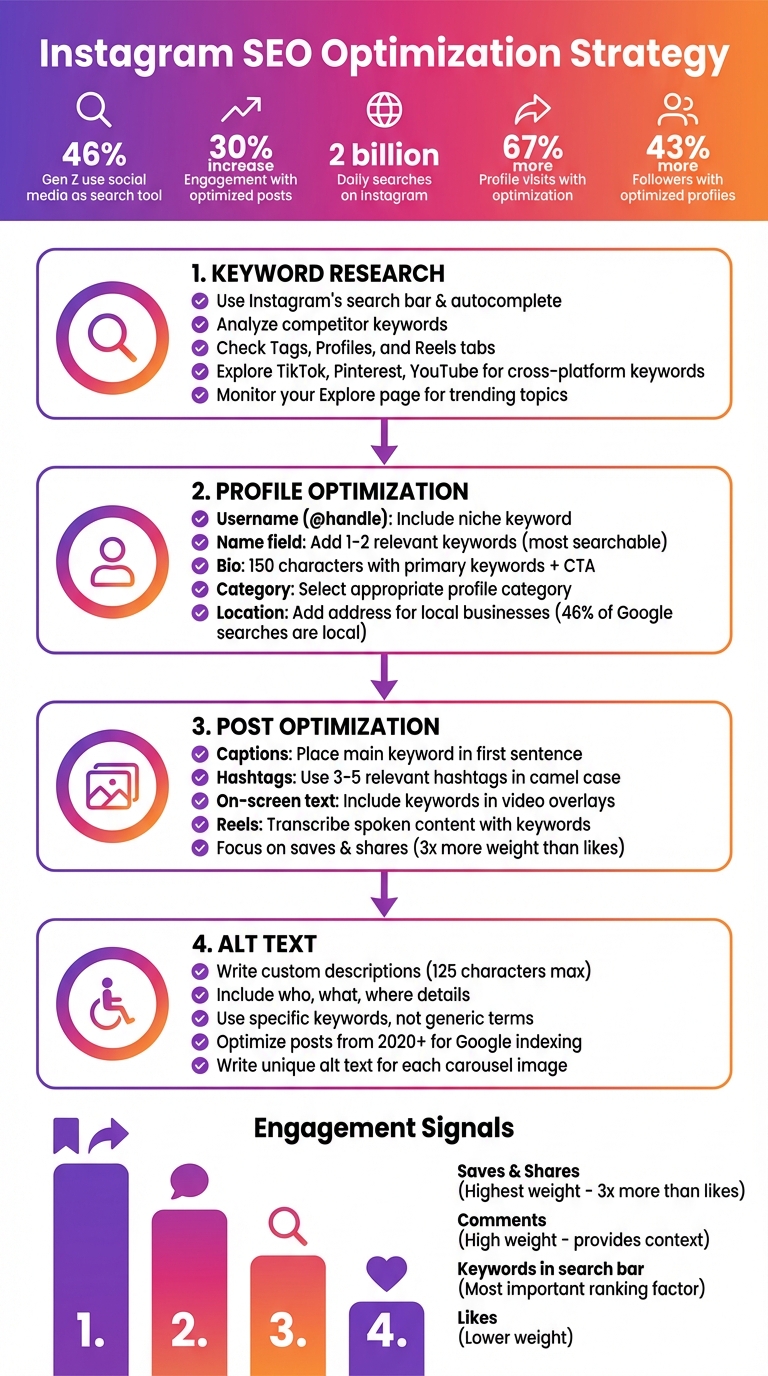
Instagram SEO Optimization Guide: Profile to Posts Strategy
How to Research Keywords for Instagram
Using Instagram's Search Bar and Autocomplete
Instagram's search bar is a goldmine for uncovering what users are actively searching for. When you type in a general term like "fitness" or "vegan recipes", the autocomplete feature suggests specific phrases that reflect real user behavior and search trends.
These results are categorized under Profiles, Reels, and Tags, giving you a snapshot of how popular keywords are being used. For instance, searching for "plant-based meals" might bring up suggestions like "meatless Monday" or "easy vegan dinner", showcasing long-tail keywords that resonate with Instagram users. Start by typing your main topic and jot down the suggested keywords. Then, explore the "Tags" tab to uncover related hashtags that can further refine your strategy.
"The keywords someone uses in the search bar is the most important factor that determines what shows up at the top of the results." - Adam Mosseri, Head of Instagram
These initial findings set the stage for deeper research into competitor strategies.
Analyzing Competitor Keywords
Your competitors have already done some of the heavy lifting when it comes to figuring out what works. Look at the leading accounts in your niche and examine their @username and display name fields - these are prime real estate for keyword optimization and account discovery. Dive into their recent posts and note recurring keywords in captions, hashtags, and even text overlays on their content. These elements feed Instagram's algorithm and can give you a strong sense of what’s trending.
Don’t skip the comment sections either. Instagram often highlights recommended search terms at the top of popular posts, offering a fresh perspective on emerging keyword trends. Additionally, check out the suggested accounts Instagram recommends for further insights into influential profiles and common keyword themes. Use this information to refine your keyword list and build a more targeted strategy.
Finding Keywords for Your Niche
To truly stand out, tailor your keywords to your specific niche. For local businesses like cafes or nail salons, adding city-specific terms to your profile and bio can help you show up in "near me" searches. For broader niches such as fashion or travel, expand your research by exploring search bars on platforms like TikTok, Pinterest, and YouTube. These platforms can reveal long-tail keywords that align with Instagram’s trends.
Organize your keywords into themes to maintain a consistent presence in your niche. Instead of guessing how to describe your service, focus on the language your audience uses. As Ali Cameron, Disability Advocate & Creator, advises:
"Instead of relying on what you would call yourself or your service offerings, think about the words your target audience would use to describe or search for you."
Keep an eye on your Explore page, too. It’s a great way to spot trending topics and keywords that Instagram’s algorithm is currently prioritizing in your niche. With over 2 billion daily searches, using the right keywords ensures your content connects with the right audience at the right time.
How to Find SEO Keywords for Instagram | Step By Step Guide
Where to Place Keywords on Instagram
Once you've done your keyword research, the next step is to strategically place those keywords across your profile and posts. Instagram's algorithm pays attention to specific areas of your account to determine what your content is about, so knowing where to add keywords can give you a noticeable edge.
Adding Keywords to Your Profile
Your profile is the cornerstone of your Instagram SEO strategy. It’s often the first thing people see when they search for topics in your niche. The username, or @handle, is a key search signal. If possible, include a keyword that reflects your niche or what you offer. For example, a username like “@FitnessWithEmma” immediately conveys your focus.
The name field - the bold text under your profile picture - is one of the most searchable elements on Instagram. Use this space wisely by adding one or two relevant keywords alongside your name. A simple format like “Emily | Travel Blogger” or “Brand Name | DIY Crafts” works well and makes your profile more discoverable.
Your bio acts like a meta description, giving you 150 characters to sum up who you are, what you do, and why people should follow you. Naturally incorporate your primary keywords, mention your location if you're a local business, and include a clear call-to-action. For example, if you run a bakery, your bio might say, “Freshly baked treats in NYC 🍪 Order now!” Additionally, selecting a profile category (like "Personal Trainer" or "Coffee Shop") helps Instagram classify your account. If you’re a local business, adding your physical address can improve your chances of showing up in “near me” searches, which account for almost half of all Google searches.
Once your profile is optimized, the next step is to strategically use keywords in your posts to maximize your visibility.
Using Keywords in Posts
After optimizing your profile, shift your focus to your posts. Each post is an opportunity to reinforce your relevance within your niche through thoughtful keyword placement.
Start by embedding keywords naturally into your captions. Instagram's algorithm scans captions to understand the context of your posts, so avoid cramming in keywords awkwardly. Instead, weave them into your storytelling. Place your most important keyword in the first sentence of your caption to grab attention and signal relevance right away.
For Reels, you can take it a step further by transcribing spoken content or describing the video’s main idea in your caption. For example, if your Reel is about quick recipes, a caption like “5 easy dinner ideas for busy weeknights” captures common search queries.
Hashtags still play a role in Instagram's searchability. Use three to five hashtags that are directly relevant to your content. To make them more accessible, format them in camel case, like #HealthyEating instead of #healthyeating.
Don’t overlook on-screen text in your videos or images. Instagram’s AI scans text overlays and subtitles to better understand your content, so including keywords in these elements can give you an extra boost.
Optimizing your posts with keywords not only makes them easier to find but can also lead to higher engagement. In fact, SEO-optimized Instagram posts can see up to 30% more engagement compared to posts without optimization. Placing your keywords thoughtfully is well worth the effort.
How to Write Captions That Rank in Search
Your caption is one of the most effective tools for Instagram SEO. Adam Mosseri, Head of Instagram, explains:
"The keywords someone uses in the search bar is the most important factor that determines what shows up at the top of the results".
In other words, your caption plays a crucial role in determining whether your post appears in search results for your niche. Let’s dive into how to naturally incorporate keywords into your captions.
Adding Keywords Naturally to Captions
Captions are key to Instagram SEO, but the trick is to weave keywords into your storytelling without losing authenticity. Kelly-Anne Crean, Head of Operations at Koozai, advises:
"Start with the story, not the keyword. Once the message feels authentic, weave in relevant terms naturally. No keyword stuffing, just language the audience uses".
Begin your caption with your main keyword. This ensures Instagram’s algorithm picks it up early - often before users click "more." For example, if your target keyword is "quick dinner ideas", you might start with: "These quick dinner ideas will save you hours in the kitchen this week." Then, continue your story, naturally working in related terms like "easy recipes" or "weeknight meals."
Longer captions give you more flexibility to balance storytelling with keywords. Ali Cameron, Disability Advocate & Creator at Seated Perspectives, highlights this:
"Captions offer great keyword real estate. Try to find a balance in storytelling and introducing keywords that align with your target audience".
Avoid cramming your captions with keywords - it confuses Instagram’s algorithm and can hurt your reach. Instead, aim for a conversational tone that reflects how your audience speaks and searches.
Using Hooks and Questions
A strong hook or a well-crafted question at the start of your caption can grab attention and boost engagement - both of which are critical ranking signals. Instagram tracks actions like saves, shares, and comments to evaluate how well your content meets search intent. Questions, in particular, encourage comments, which help Instagram categorize your post. Adam Mosseri explains:
"Sometimes the real, interesting context is not in the video that someone uploaded, but in the context around it, which is almost always in the comments".
Make your questions specific. Instead of asking "Thoughts?" try something like, "Which of these three morning routines works best for busy parents?" Specific prompts generate more comments and provide Instagram with clearer signals about your topic. Hooks that promise value also work well, such as "Here’s a common mistake people make when meal prepping" or "Save this checklist if you’re planning a kitchen remodel." Wrap up your caption with a call-to-action that encourages saves or shares, as these actions carry about three times more weight than likes. For instance, say "Save this for your next grocery run" or "Share this with a friend who needs this tip" instead of a generic "Like if you agree."
Writing Captions That Match Search Intent
The best captions directly address what users are searching for. Think about the queries people type into Instagram’s search bar and structure your caption to answer those questions right away. For example, if someone searches "how to organize a small closet", your caption should provide a clear, actionable solution.
Use Instagram’s autocomplete feature to discover the exact phrases your audience uses. Type your topic into the search bar and note the suggested terms - these reflect real user behavior and can be incorporated naturally into your captions.
Since July 2025, public Instagram posts from professional accounts have also been indexed by Google. This means your captions now act as metadata for traditional search engines. Treat them like mini-blog posts: start by answering the search query in the first line, explain its importance, provide actionable tips, and finish with a call-to-action that encourages engagement.
Keep in mind that nearly half of Generation Z (46%) and over a third of millennials (35%) prefer using social media for search instead of traditional search engines. Write captions that educate, solve problems, and offer the specific information your audience is searching for. These strategies not only boost your Instagram visibility but also align with broader SEO efforts, such as optimizing alt text for posts.
sbb-itb-3b12fba
How to Optimize Alt Text for Better Rankings
Alt text isn’t just a description of your images or videos - it’s a key tool for helping Instagram’s algorithm understand your content while also making it accessible to visually impaired users.
Jeff Bullas, CEO of jeffbullas.com, sums it up well:
"Custom alt text signals Instagram's algorithm and boosts rankings".
Since July 2025, Google has started indexing public Instagram posts from Business and Creator accounts. This applies to posts published after January 1, 2020. With alt text now playing a role in Google Image results, generic default descriptions just won’t cut it. Writing custom alt text is essential.
Writing Keyword-Rich Alt Text
Crafting descriptive, keyword-rich alt text is crucial. Instead of something generic like "woman smiling", opt for a more specific description such as "Lead designer reviewing Q4 marketing strategy on a whiteboard". Keep your descriptions concise - 125 characters or less - to make them clear and effective for screen readers. Focus on capturing the essentials: who, what, and where. For example, if you’re a wedding photographer, write something like "Newlywed couple holding hands during a golden hour beach photoshoot" rather than "couple at beach." Including location keywords is especially useful since nearly half (46%) of all Google searches have local intent.
For new posts, you can manually add alt text by navigating to Advanced Settings and selecting Write Alt Text before publishing. Updating older posts is just as straightforward: select the post, click the three dots, choose Edit, and then Edit Alt Text. Since Google indexes posts from 2020 onward, revising older content with optimized alt text can drive fresh traffic, even years later.
Make sure your alt text is easy to read and avoid keyword stuffing, which could trigger spam filters. Rochi Zalani, a freelance writer at Buffer, explains:
"Writing alt text that's descriptive and uses relevant keywords can help you improve your Instagram SEO because it also helps the platform understand what your image is about".
For carousel posts, write unique alt text for each image. This gives Instagram’s algorithm more detailed information to process, improving your content’s visibility.
Making Content Accessible with Alt Text
Alt text isn’t just about SEO - it’s also a vital accessibility feature. By providing clear, detailed descriptions, you make your content accessible to visually impaired users who rely on screen readers. This inclusivity doesn’t just help your audience; Instagram also recognizes it as a positive signal, which can benefit your account’s performance.
Think of alt text as a way to verbally describe your image. For example, instead of simply noting "coffee mug", you could write, "Ceramic coffee mug with hand-painted floral design on wooden kitchen counter." While traditional alt text applies to static images, for video content like Reels, you can use on-screen text overlays with keywords to help both the algorithm and search engines understand your content.
Consider this: over 60% of shoppers turn to Google before exploring products on social media. By writing thoughtful alt text that enhances both accessibility and SEO, you’re not just optimizing for Instagram - you’re tapping into the broader search ecosystem. This is particularly important as nearly 40% of Gen Z users now use platforms like Instagram to search for travel ideas, products, and restaurants.
Using Outfame for Instagram SEO
Outfame takes the guesswork - and the hours of effort - out of Instagram SEO. Instead of manually handling every detail, Outfame's AI-powered tools streamline the process, helping you climb the search rankings with minimal effort.
AI-Powered Keyword Research
Outfame's AI dives deep into Instagram's internal signals - like usernames, bios, captions, hashtags, and location tags - to pinpoint the keywords that boost visibility. It taps into Instagram's auto-suggest data and analyzes competitor performance to uncover keywords that drive engagement. Plus, with its visual recognition capabilities, it can analyze the content of your images and videos, suggesting keywords that align with your visuals - even if your captions are brief.
Tracking SEO Performance with Real-Time Analytics
Outfame's analytics dashboard gives you a clear view of how your SEO efforts are paying off. You can track how your keywords, captions, and alt text impact your search rankings, with real-time data showing how often your content appears in discovery feeds. It also monitors specific search terms, so you can see which keywords are driving results and adjust your strategy as needed. Want to stay ahead of the competition? The competitor benchmarking feature lets you compare your visibility with others in your niche, helping you uncover opportunities and spot trends.
Automated Profile Optimization
Your Instagram profile plays a key role in your search rankings, and Outfame ensures it's optimized to perfection. It automatically updates your handle, name, and bio with strategically placed keywords, making it easier for Instagram's algorithms to categorize your account. This boosts your chances of appearing in the "Accounts" tab and personalized "For You" search results.
Outfame also configures your profile settings for public indexing, so your content can surface in external search engines like Google and Bing. It even incorporates location tags to attract local search traffic - an essential feature, considering that 46% of Google searches have local intent. Research shows that optimized profiles see 67% more visits and gain 43% more followers compared to unoptimized ones. By automating these technical details, Outfame frees you up to focus on what matters most: creating content that connects with your audience.
Conclusion
Key Takeaways
If you're aiming to stay visible on Instagram in 2026, understanding Instagram SEO is a must. Start by optimizing your profile - your handle, name, and bio should include niche keywords to make your account easier to find on both Instagram and Google. When writing captions, weave in keywords naturally to align with search intent. Take advantage of alt text by adding clear, keyword-focused descriptions to your images, which not only improve accessibility but also enhance your chances of appearing in Google Image search results.
Engagement is key. Shares and saves now carry more weight in Instagram's algorithm than likes, so focus on creating content that encourages these actions. For Reels, on-screen text overlays and subtitles are essential, as Instagram's AI scans them for keyword relevance. Make your account professional and public to ensure your posts can show up in search results on platforms like Google and Bing. And don’t underestimate the power of consistency - a cohesive theme across your content helps the algorithm understand your area of expertise.
To simplify the process, consider using tools like Outfame's AI-powered solutions. These can automate much of the optimization work, freeing you up to focus on creating content that resonates with your audience.
Mastering these basics will help you keep pace with Instagram’s ever-changing algorithm.
Keeping Up with Instagram's Algorithm
Once you've covered the fundamentals, the real challenge is staying ahead of Instagram's constant updates. Instagram's AI adjusts its ranking criteria based on user behavior, so what worked last month might not work today. Adam Mosseri, Instagram’s Head, has often pointed out that the platform is always evolving - your strategy should evolve too.
Check your "Account Status" in profile settings regularly to ensure your content qualifies for recommendations. Test out new formats with the Trial Reels feature to see how non-followers respond before rolling them out to your broader audience. Don’t forget to refresh captions and alt text on posts you published after January 1, 2020, to keep them optimized for search indexing. And take advantage of new tools like the "Your Algorithm" feature, introduced in December 2025, which allows users to down-rank topics they’re no longer interested in.
Instagram SEO has grown beyond being a clever trick - it’s now a core strategy. By staying flexible and keeping an eye on algorithm changes, you can ensure your content remains visible as Instagram continues to develop into a robust search engine.
FAQs
How do I use keywords effectively in Instagram captions to boost visibility?
To make the most of keywords in your Instagram captions in 2026, focus on weaving relevant keywords into your text in a way that feels natural and engaging. These keywords should align with what your audience is actively searching for and blend seamlessly into your caption without disrupting its flow.
With Instagram's algorithm now placing greater emphasis on captions for search rankings, it's become essential to prioritize well-chosen keywords over simply relying on hashtags. Write captions that not only resonate with your audience but also address their real questions or interests. This approach can boost your chances of appearing in search results and on the Explore page, ultimately increasing your reach and engagement.
How does alt text help improve Instagram SEO?
Alt text is a crucial element for Instagram SEO. It describes the content of your images in a way that helps both visually impaired users and Instagram's algorithm understand what the image is about. By including descriptive keywords in your alt text, you can improve the chances of your posts appearing in search results and on the Explore page.
It also helps Instagram better categorize your content, making it more likely to reach the right audience. This can lead to increased visibility and potentially higher engagement on your posts.
Why do shares and saves matter more than likes in Instagram's algorithm?
Shares and saves on Instagram carry more weight than likes when it comes to engagement. Why? Because they reflect a deeper connection with your content. A saved post tells Instagram that someone found your content useful or worth keeping for later. A shared post, on the other hand, shows that your content struck a chord strong enough for someone to pass it along to others.
These actions act as signals to Instagram, highlighting that your content is relevant and valuable. This, in turn, boosts its visibility in feeds and search results. While likes are more passive, shares and saves show active interest, making them crucial for improving your organic reach and overall performance.


