
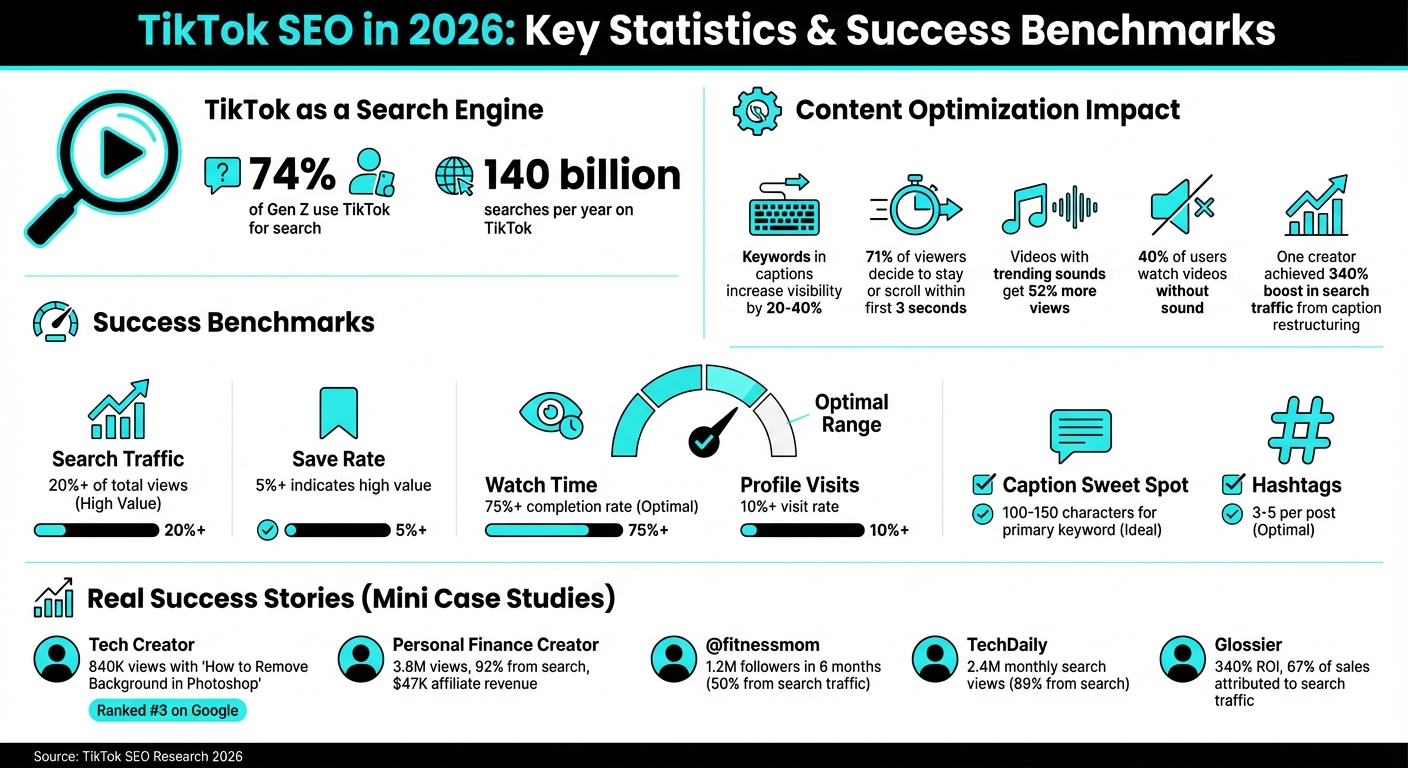
TikTok isn’t just for viral dances anymore - it’s now one of the fastest-growing search engines, especially for Gen Z. By 2026, 74% of Gen Z use TikTok for search, even preferring it to Google in some cases. This shift means understanding TikTok SEO is critical if you want your content to be discovered.
Here’s what you need to know to rank in TikTok search:
- Keywords matter everywhere: Use your target keyword in captions, on-screen text, and voiceovers. TikTok’s algorithm relies on AI to index all these elements.
- Captions boost reach: Including keywords naturally in your captions can increase visibility by 20–40%. Focus on conversational language and avoid keyword stuffing.
- First 3 seconds are key: Grab attention immediately with bold on-screen text and spoken keywords. This helps both viewers and the algorithm understand your content.
- Long-tail keywords win: Use TikTok’s autosuggest to find specific, less competitive search terms that match user intent.
- Profile optimization counts: Add keywords to your bio, username, and video playlists to improve your overall search visibility.
TikTok’s search algorithm doesn’t favor follower count, so even new creators can rank if their content is relevant and optimized. Keep tweaking your strategy based on metrics like search traffic, saves, and watch time to stay ahead.
TikTok SEO Statistics and Benchmarks 2026
TikTok SEO Tutorial - Optimize your Business Page (10 Simple Tricks!)
How to Research Keywords for TikTok Search
TikTok handles an astounding 140 billion searches every year. Among these, 67% start with words like "how", "what", "why", or "best", which clearly shows that users are looking for visual answers to their questions, not just text-based information.
Interestingly, 43% of the top TikTok search results come from creators with fewer than 10,000 followers. This proves that what matters most is the relevance of your content, not the size of your audience. To stand out, you need to pinpoint the exact phrases users are searching for and incorporate that language into your videos.
Finding Long-Tail Keywords with TikTok Autosuggest
Keyword research is the backbone of creating content that aligns with TikTok's evolving search trends. A great starting point? TikTok’s autosuggest feature.
When you type a broad keyword, or "seed" keyword, into TikTok’s search bar (without hitting enter), you’ll see a dropdown of autocomplete suggestions. These suggestions reflect real-time, high-volume searches users are actively typing. For instance, typing "budget travel" might bring up options like top travel influencers sharing tips for Europe, "budget travel hacks 2026", or "budget travel vs luxury travel." These are long-tail keywords - specific phrases that match user intent and often face less competition than broader terms.
To go further, try adding question modifiers to your seed keyword. Phrases like "vs", "for beginners", "is [keyword] worth it", or "tutorial" can generate even more targeted suggestions. Since TikTok doesn’t offer a way to save these suggestions directly, make a habit of recording 20–30 variations for each seed keyword in a spreadsheet. This will help you build a detailed topic map.
Don’t stop there. Scroll to TikTok’s "Others searched for" section to uncover related queries and hidden long-tail opportunities. These adjacent searches often highlight content gaps where there’s little competition, giving you a chance to create videos that stand out.
Analyzing Competitor Keywords
To refine your keyword strategy, take a close look at the top 10 videos ranking for your target keyword. Pay attention to the specific phrases used in their captions, on-screen text, and even the first spoken line. These are the keywords TikTok’s algorithm is already favoring.
"TikTok SEO is about capturing that in-app intent... If your videos do not carry clear topical markers in the spoken audio, text, and metadata, TikTok gives that demand to other creators and brands that have optimized." - Chad Wyatt
Patterns matter. Are creators using original audio to emphasize keywords? Which hashtags keep popping up? For example, one creator boosted their search traffic by 340% simply by restructuring their captions to prioritize keywords. It’s proof that even small tweaks can lead to big results.
Don’t overlook the comment sections of your competitors’ top-performing videos. These are gold mines for finding unanswered questions. Comments like "How do I do this on a budget?" or "Does this work for beginners?" highlight real user needs. If you see these types of questions repeatedly, they’re perfect topics for your next video.
Lastly, take advantage of TikTok’s "Creator Search Insights" tool. This feature helps you identify content gaps - areas where there’s high search demand but a lack of quality videos. By focusing on these underserved topics, you can establish yourself as an authority before others catch on.
Use these strategies to not only refine your keywords but also improve your captions and hooks as you develop your content further.
How to Optimize Captions for Search Rankings
Your caption is more than just text under your video - it’s a key signal TikTok’s algorithm uses to understand and categorize your content. Think of it as metadata, helping the platform determine how relevant your video is to users' searches. Done correctly, captions can boost your reach by 20% to 40%, making them a powerful tool for improving visibility.
The trick is finding the right balance. Captions should include keywords naturally, without feeling forced or robotic. While it’s tempting to cram in as many keywords as possible, TikTok’s algorithm detects keyword stuffing. Instead, focus on writing for people first. Use conversational language that mirrors how users search - it’s more effective and engaging.
Using Keyword Variations in Captions
TikTok’s semantic search is smart enough to recognize synonyms and related terms. This means you can include keyword variations in your captions to broaden your reach.
"TikTok's semantic search understands synonyms and related terms. If you're targeting 'budget travel,' also include phrases like 'cheap flights,' 'travel deals,' and 'affordable vacation.' The algorithm connects these dots." - Drew Madore, Founder & CEO, Synergist Digital Media
To maximize impact, place your primary keyword within the first 100–150 characters of your caption. TikTok’s algorithm gives more weight to the beginning of the text. For example, instead of starting with something vague like "You won’t believe this hack", try "Budget travel tips for Europe: Here’s how to save $500 on flights."
Using long-tail keyword variations can also help you rank for more specific searches. For example, fitness creator @fitnessmom grew her following to 1.2 million in just six months by targeting phrases like "workout for busy moms" and "postpartum workout safe." Half of her growth came directly from search traffic. Long-tail keywords often face less competition and attract users with clear intent.
You can also incorporate intent-based questions into your captions. Phrases like "Want to know how to meal prep for the week?" or "Looking for iPhone tips?" not only align with how users search but also encourage engagement, like comments - a ranking signal TikTok values.
Caption Length and Structure Guidelines
While TikTok now allows captions up to 2,200 characters, you don’t need to use all that space. The sweet spot for search optimization is between 100 and 150 characters. However, longer captions can work if they’re well-structured and engaging.
A proven structure includes three elements: Hook + Context + Call to Action. Start with a strong hook that includes your primary keyword. Use the middle section to weave in semantic keyword variations and tell a quick story. Wrap up with a question or a call to action, like "Save this for later" or "Tag a friend who needs this", to drive engagement.
| Caption Element | SEO Impact | Best Practice |
|---|---|---|
| First Sentence | High (Indexing weight) | Place your primary keyword and a strong hook here. |
| Core Content | Medium (Context) | Use semantic variations and tell a short story. |
| Conclusion | High (Engagement) | Include a question or clear call to action. |
| Hashtags | Medium (Categorization) | Use 3–5 hashtags; mix broad and niche tags. |
When it comes to hashtags, stick to 3–5 that are highly relevant. A good mix includes one broad tag (e.g., #Marketing), one niche tag (e.g., #TikTokSEO), and one branded or purpose-driven tag.
"Write short and engaging captions that naturally incorporate some of your top keywords. TikTok only shows a small amount of text, so make it count!" - Sara Nielsen, Head of Social Strategy, We Make Footballers
And don’t forget accessibility. Around 40% of users watch videos without sound, so captions are crucial for ensuring your content reaches everyone. Up next, we’ll explore how these optimized captions can work hand-in-hand with compelling hooks to grab your audience’s attention.
Creating Hooks with Keywords and Voiceovers
Once you've optimized your captions, the next step is to craft a hook that grabs attention immediately and signals relevance. This is crucial because the first three seconds of your video determine whether 71% of viewers stick around or scroll away. TikTok's algorithm uses this brief window to categorize your content, so your hook needs to multitask: it should stop viewers in their tracks while also making your video's topic clear to the algorithm.
To achieve this, combine visual text and spoken keywords. TikTok relies on Optical Character Recognition (OCR) to scan on-screen text and a speech-to-text engine to transcribe your voiceover. These tools help index your video for search. By including your primary keyword in both the on-screen text and voiceover within the first 2–3 seconds, you send a strong signal to TikTok's algorithm. This strategy ensures your content is optimized for both search visibility and viewer engagement.
First 3 Seconds: Hook Strategies with On-Screen Text
Start by placing your primary keyword in bold, on-screen text within the first few seconds of your video. Use large, high-contrast text (like white on black or yellow on dark backgrounds) to make it pop. This ensures your message is clear and easy to read at a glance.
Avoid vague or generic hooks like "Wait for it..." Instead, use a search-focused title that matches how users type queries. For example, a tech creator in 2025 used the title "How to Remove Background in Photoshop - 3 Methods" for a tutorial. This approach aligned perfectly with the search term "remove background photoshop", helping the video achieve 840,000 views on TikTok and rank #3 in Google's video carousel for a term with 33,100 monthly searches.
Pair your keyword-rich text with a pattern interrupt to stop the endless scroll. This could be a sudden zoom, a unique camera angle, or bold colors like red or yellow. The goal is to create visual interest instantly while reinforcing your video's topic. Keep the text visible for at least two seconds so both viewers and the algorithm have time to process it.
| Hook Type | Example Phrase | Purpose |
|---|---|---|
| Direct Call-Out | "If you run a [niche] business..." | Helps your target audience identify instantly |
| Numerical/Results | "3 secrets to [outcome] in [timeframe]" | Sets clear expectations for the viewer |
| Contradiction | "Everything you know about [topic] is wrong" | Positions you as an authority |
| Pattern Interrupt | "You're doing this wrong" | Stops viewers from scrolling |
While on-screen text grabs attention, your voiceover plays a key role in reinforcing your message.
Using Voiceover Keywords for Algorithm Recognition
TikTok automatically transcribes your voiceover and uses that data to categorize your video. So, what you say is just as important as what you show.
"Saying your target keyword out loud or displaying it visually tells the AI, 'Hey, this is what this content is about.' ... That way, the algorithm connects your video to users actively searching for that term." - SEO Sherpa
To make your voiceover effective, use natural, conversational language when introducing keywords. If a phrase feels awkward to say, it's probably not how users search. For instance, instead of forcing "keto diet plan", you might say, "Here's the keto diet plan I used to lose 15 pounds in 30 days." TikTok's Natural Language Processing (NLP) can understand context, so your video will still match relevant searches.
For stronger topical focus, include your primary keyword and related long-tail variations multiple times throughout your script. A personal finance creator demonstrated this in 2025 by using the title "Best high-yield savings accounts 2025" in a video. By repeating the exact keyword in both the on-screen text and the opening voiceover, the video ranked #1 for the query and amassed 3.8 million views in six months - 92% of which came from Search. This success translated into $47,000 in affiliate revenue.
To ensure TikTok accurately transcribes your voiceover, record in a quiet space and keep background music lower than your voice. Use TikTok's native tools for voiceovers and auto-captioning, as these are more effective for indexing than third-party edits.
sbb-itb-3b12fba
Optimizing Your Profile for Search Visibility
Getting your TikTok profile in top shape is a key move to improve your SEO performance on the platform. Your profile is often the first impression users get when they land on your page through search results. If your bio and username don’t clearly reflect your niche, you might lose potential followers before they even check out your content. TikTok’s algorithm uses your profile details as metadata to categorize your account and decide which search queries you should rank for, contributing to what TikTok refers to as "Account Authority".
With 40% of Gen Z now turning to TikTok and Instagram for searches instead of Google Search or Maps, optimizing your profile has never been more crucial for visibility.
Adding Keywords to Your Username and Bio
Your username and bio are the backbone of your profile’s searchability. When it comes to your username, aim for one that either matches your brand name or incorporates a key term relevant to your niche. For example, Miranda Anderson Photography included "photo" in her username and added "wedding photography, Calgary" to her bio. This helped her profile show up for searches like "wedding photographers in Calgary".
"Try to choose a username that is either an exact match for your brand name or as close to it as you can come in case users are searching for your brand." - Sara Nielsen, Head of Social Strategy, We Make Footballers
In your bio, use the first 150 characters wisely. Clearly state who you are, the problems you solve, and add location details if you’re targeting a local audience. For instance, a bio like "Wedding Photographer in Calgary | Capturing Your Perfect Day" leaves no doubt about what you do and where you operate, making it easy for both users and the algorithm to understand your niche.
Beyond your bio, organize your content into playlists named after popular search terms. For instance, a fitness creator might use playlist titles like "10-Minute Home Workouts" or "Beginner Strength Training" instead of vague names like "Fitness Tips." Additionally, pin 2–3 videos that focus on your most important keywords at the top of your profile. Pinned videos tend to rank 50–100% higher in search results because TikTok interprets pinning as a sign of content importance.
To further enhance your profile’s discoverability, make smart use of hashtags and trending sounds.
Using Hashtags and Sounds in Your Profile
Hashtags and sounds play a big role in boosting your visibility. The ideal number of hashtags per post is 3–5. Use one broad hashtag paired with 2–3 specific ones. Overloading your post with hashtags can confuse TikTok’s algorithm, while using too few might limit your reach.
"Using too many hashtags can not only make your caption look cluttered, but more importantly, it can confuse TikTok about your post's focus." - Sara Nielsen, Head of Social Strategy, We Make Footballers
Trending sounds are just as impactful. Videos with trending sounds get, on average, 52% more views compared to those with original audio. For example, in 2026, the Laramie County Library System used a trending BookTok sound ("She's the kind of girl they write books about") to highlight their children’s collection. By pairing a trending sound with content relevant to their niche, they effectively showcased their resources to a wider audience.
Sounds also act as metadata. Users often search for content by specific audio clips, so if you’re creating original sounds, give them keyword-rich titles to attract more traffic. Consistency in posting is equally important - it helps TikTok identify your niche and ensures your content reaches the right audience.
Using Outfame for TikTok Growth Analytics
Managing TikTok SEO without data is like trying to navigate without a map. To make informed decisions, you need real-time insights into keyword performance and how your content measures up against competitors. That’s where Outfame’s analytics dashboard steps in, offering a clear snapshot of your TikTok performance. It tracks keyword rankings and compares them to your competitors, giving you the tools to identify where you stand in search results and where you can climb higher.
This data-first approach strengthens earlier strategies, allowing you to make precise, real-time adjustments. Outfame pinpoints high-intent keywords - like “keto diet for diabetic dogs” - that are easier to rank for and more likely to convert viewers into followers or customers. By analyzing engagement signals such as watch time, completion rates, and rewatch rates, it provides actionable insights into which keywords and content formats resonate most with your audience. This eliminates guesswork, helping you focus on strategies that are proven to work.
Tracking Keyword Performance with Outfame Real-Time Analytics
Outfame builds on your keyword research and caption strategies by refining how you track performance. With 24/7 real-time growth monitoring, the platform shows how your videos rank for specific keywords in real time. You can see which terms drive the most profile visits, follows, and engagement. This is especially important since TikTok’s 2026 algorithm prioritizes metrics like watch time, completion rates, and rewatches as key indicators of content value. For instance, if a video ranks well for a keyword but has low completion rates, it’s a clear sign your hook or content needs tweaking.
Outfame also helps you monitor your keyword strategy’s effectiveness. Its analytics reveal how TikTok interprets your content, showing which keyword variations and related terms are driving traffic. This lets you refine your approach based on actual performance data instead of relying on assumptions.
Optimizing Captions and Hooks with Outfame AI Tools
Outfame’s AI-powered tools take the guesswork out of crafting captions and hooks. By analyzing trending content in your niche, the platform suggests caption structures that align with what’s currently performing well in TikTok search. Since TikTok uses artificial intelligence and natural language processing to analyze on-screen text and auto-generate captions from spoken audio, Outfame ensures your captions are optimized for the algorithm to easily index and categorize.
The platform also tracks saves, a critical ranking signal for 2026. By studying which caption styles and hooks lead to the most saves in your niche, Outfame recommends formats that encourage viewers to bookmark your content. Saves are a strong indicator of content value and relevance in TikTok’s algorithm, and leveraging this insight can directly improve your search rankings. These analytics are essential for fine-tuning your strategy as TikTok’s algorithm continues to evolve in 2026.
Monitoring and Adjusting Your Strategy
Once you've optimized your keywords, captions, and hooks, the next step is to keep a close eye on your strategy's performance. TikTok SEO isn't something you can set up and forget about. The platform's algorithm is always evolving, which means what works today might need tweaking tomorrow. Regularly tracking your metrics and making adjustments is what separates creators who stay visible from those who fade into the background.
Tracking Search Rankings and Engagement Metrics
The first step is figuring out where your views are coming from. Head over to TikTok Analytics, navigate to the Content tab, and check the breakdown of views from "Search" versus the "For You" page. Ideally, at least 20% of your total video views should come from search. If you're not hitting that mark, it might be time to revisit your keywords or rethink how you structure your content.
Saves are a powerful indicator of your content's value in search. A save rate of 5% or higher tells TikTok that your video is worth prioritizing in search results. Similarly, a watch time of over 75% and a low bounce rate within the first three seconds signal strong relevance to the algorithm.
Since TikTok doesn't offer a built-in keyword ranking tool, you'll need to track this manually. Search your target keywords weekly and record your video's position in a spreadsheet. Keep an eye on profile visits and follower growth from search-optimized videos - content that performs well often leads to a 10% profile visit rate.
| Metric | Why It Matters | Success Benchmark |
|---|---|---|
| Traffic Source: Search | Direct measure of SEO effectiveness | 20%+ of total views |
| Saves | Indicates high value to the algorithm | 5%+ save rate |
| Watch Time | Reflects relevance and retention | 75%+ completion |
| Profile Visits | Builds authority and engagement | 10%+ visit rate |
These benchmarks aren't just theoretical - they drive real outcomes. For example, Glossier used search-optimized tutorials like "how to use cloud paint" to rank in the top three for product-related searches. This approach led to a 340% return on investment for TikTok content and attributed 67% of sales to search traffic.
"Test out different content, different SEO strategies, different captions, and never stop testing. Monitor metrics closely to see what's working and what isn't."
- Sara Nielsen, Head of Social Strategy, We Make Footballers
Once you've gathered insights from your metrics, it's time to adapt as TikTok's algorithm continues to change.
Staying Updated with 2026 Algorithm Changes
Metrics can show you where you're excelling - and where you're falling short - but staying ahead of TikTok's algorithm updates is equally important. The platform's algorithm evolves frequently, so keeping up with the latest changes is a must. Use tools like TikTok Creator Search Insights and the TikTok Creative Center to identify trending search terms before they peak. These tools help you align your content with what users are actively searching for.
TikTok's algorithm now uses Natural Language Processing (NLP) to analyze spoken audio and on-screen text. This shift means you should focus on natural, conversational language instead of stuffing keywords. Make sure your main keywords appear in the first sentence of your caption and within the first three seconds of on-screen text. This gives the algorithm clear context right away.
To establish search authority, consider creating topic clusters by making 8–10 videos around a single core topic. Since the algorithm favors newer content, revisit and update high-performing videos every 4–6 months to maintain their rankings. A great example is TechDaily, a tech review channel that grew to 2.4 million monthly search views, with 89% of its traffic coming from search. Their success came from focusing on search-optimized reviews and comparison videos.
When testing changes, focus on one variable at a time - like caption style, hook format, or keyword clusters - and allow two weeks to measure its impact. Engage with user comments using your target keywords naturally to reinforce your video's context. Even renaming your video files with descriptive, keyword-rich titles can help with early indexing.
"The more consistently you post, the easier it will be for TikTok to understand what your page is about and push it to the right audience."
- Sara Nielsen, Head of Social Strategy, We Make Footballers
Conclusion
TikTok has grown beyond being just a social platform - it's now a visual search engine in its own right. To stand out and attract views, followers, and even revenue, you need a focused, strategic approach to your content.
Here’s the game plan: pack the first three seconds of your video with attention-grabbing keywords, both in on-screen text and voice. Pair that with concise, engaging captions that resonate with your audience. Crafting a compelling hook is key to keeping viewers locked in. And don’t forget, adding relevant keywords to captions and descriptions can boost your reach by an impressive 20–40%.
"TikTok SEO isn't about gaming the system - it's about making sure your content is discoverable by the people searching for it."
- TikTok Tactics
FAQs
What’s the best way to use long-tail keywords on TikTok?
To get the most out of long-tail keywords on TikTok, focus on using specific, detailed phrases that align with what people in your niche are actively searching for. These types of keywords make your content appear in highly targeted search results, helping you connect with the right viewers more effectively.
Start by exploring TikTok’s search bar to uncover trending long-tail keywords. Look at the suggested phrases or check out popular videos in your niche to see what’s working. Once you’ve identified these keywords, weave them naturally into your captions, video descriptions, and hashtags. This approach boosts your content’s relevance and makes it easier for users to discover.
It’s also important to create videos that match user intent. Address specific questions or needs tied to these keywords. TikTok’s algorithm favors content that engages users and aligns with their search intent, which increases your chances of ranking higher and expanding your reach.
Why are captions important for TikTok SEO?
Captions play an important role in TikTok SEO by making your content easier to find in search results. When you include relevant keywords and phrases in your captions, you align your video with the terms users are actively searching for, which increases the likelihood of your video being discovered.
But captions do more than just improve discoverability. They give context to your video, helping TikTok's algorithm understand your content and match it to what users want to see. Plus, engaging captions can encourage more interaction - like comments and shares - which are key factors for ranking on TikTok’s For You Page (FYP) and in search results.
To get the most out of your captions, make them clear, packed with relevant keywords, and include a strong call-to-action. This approach not only boosts your visibility but also invites meaningful engagement from your audience.
How does TikTok decide which videos show up in search results?
TikTok’s algorithm ranks search results by prioritizing relevance, engagement, and recency. It carefully evaluates keywords in captions, on-screen text, hashtags, audio, and even spoken words. That means choosing the right keywords isn’t just helpful - it’s essential.
Metrics like watch time, completion rate, shares, and likes also carry weight. These factors show how engaging your content is to viewers. On top of that, newer videos often receive a temporary boost, and creators who consistently deliver quality content in specific areas tend to rank higher.
To stand out, focus on writing captions packed with relevant keywords, creating attention-grabbing hooks, and producing content that truly connects with your audience.


