
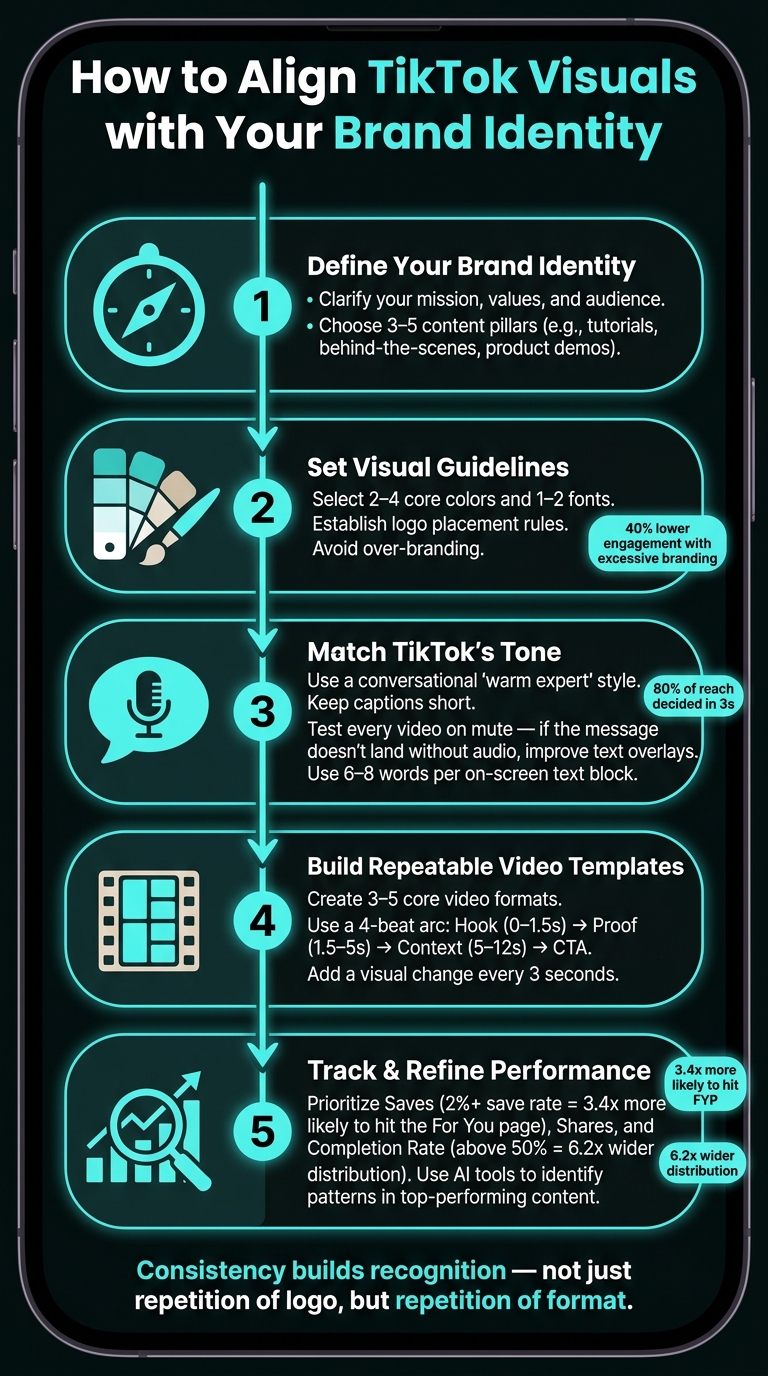
TikTok users decide in less than a second whether to engage with your content. Consistent visuals help your brand stand out, build trust, and boost engagement. Here's how to align your TikTok visuals with your brand identity:
- Define your brand identity: Clarify your mission, values, and audience. Choose 3–5 content themes to guide your videos.
- Set visual guidelines: Pick 2–4 core colors, 1–2 fonts, and rules for logo use. Avoid over-branding to keep content approachable.
- Match TikTok’s tone: Use a conversational style, short captions, and test videos without sound for clarity.
- Leverage video templates: Create 3–5 repeatable formats like tutorials or product demos to maintain consistency.
- Track performance: Focus on metrics like saves, shares, and completion rates to refine your strategy.
Consistency doesn’t mean rigidity - it’s about making your brand instantly recognizable while staying relevant to TikTok’s fast-paced culture.
How to Align TikTok Visuals with Your Brand Identity
Understanding Your Brand Identity for TikTok
Defining Your Core Brand Elements
Start by understanding what your brand truly represents. Clarify your mission, values, target audience, and personality - these are the foundation for all your visual and creative decisions.
For instance, a bold, energetic brand might lean on high-contrast colors and fast-paced editing, while a brand focused on calm expertise might use neutral tones and steady, deliberate cuts. Your visual style should feel like a natural reflection of your brand’s identity, not an afterthought.
A practical way to bring this to life is by defining 3–5 content pillars - themes you’ll revisit regularly. These could include educational tips, behind-the-scenes glimpses, or product highlights. These pillars help keep your content cohesive while leaving room for creativity. With these elements in place, you’ll have a strong starting point for shaping your TikTok presence.
Adapting Your Brand Voice for TikTok
TikTok has its own vibe, and it doesn’t mesh well with formal, corporate tones. Instead, the platform thrives on a conversational, approachable style - often described as the "warm expert" approach: confident but relatable, knowledgeable but never stiff.
"TikTok punishes traditional corporate branding and rewards authenticity." - Vik Chadha, Founder & CEO, Magnt
To connect with TikTok users, rewrite captions in a casual, natural tone. Use short, clear sentences and add concise on-screen text for viewers who scroll with the sound off. In fact, test every video on mute. If your message doesn’t land without audio, tweak your text overlays until it does.
Another way to make your brand stand out is by creating a mini emoji palette - pick 2–3 emojis that reflect your brand’s energy and use them consistently in captions and text overlays. These small touches can act as visual anchors, tying your content together.
Setting Non-Negotiable Visual Rules
To maintain a consistent look, every TikTok presence needs a set of fixed visual guidelines. These non-negotiables might include a primary color (or a palette of 2–4 colors), one or two specific typefaces, and clear rules for text placement to stay within TikTok’s safe zones (avoiding the top 150px and bottom 270px).
You should also decide on a "logo threshold" - a guideline for how often your logo appears in your videos. Overusing it can make your content feel like an ad, which often hurts engagement. Instead, build recognition through consistent formats and styles, not by plastering your logo everywhere.
"The brands that build recognition on TikTok do it through repetition of format, not just repetition of logo." - Splash Creative
Keep these non-negotiables separate from adaptable elements like video pacing, caption length, or the use of trending audio. While your adaptable elements can shift to match TikTok’s culture, the non-negotiables ensure your brand stays visually consistent and recognizable.
Building Visual Elements That Match Your Brand
Choosing Your Color Palette and Fonts
When it comes to defining your brand visually, simplicity is key. Stick to two to four core colors and one or two typefaces - one for headlines and another for body text. Going beyond this can overwhelm your audience with too much visual clutter.
As Stefan Avram of Avramify puts it, “aesthetic drives first impressions.” You only have about 0.3 seconds to make that initial visual impact before viewers start processing your actual message. That means your choice of fonts and colors needs to instantly convey your brand’s personality. For example, a sans-serif font like Montserrat gives off a reliable, corporate vibe, while Neue Montreal feels modern and edgy. Color choices matter just as much: navy and gold exude sophistication, while white, black, and beige suggest a clean, editorial look.
Here’s a practical tip: always ensure there’s high contrast between your text and background. Dark text on light backgrounds (or the reverse) is especially crucial for readability on smaller mobile screens. And if you’re aiming for credibility or a premium feel, avoid TikTok’s default “bubble” caption font - it can come across as too playful and might erode trust.
Once your colors and fonts are set, the next step is integrating your logo thoughtfully to reinforce brand recognition.
Logo Placement and How Often to Use It
Your logo doesn’t need to dominate every frame to make an impact. In fact, over-branding can hurt you - content with excessive branding sees 40% lower engagement rates. TikTok users tend to favor content that feels authentic and approachable over something that screams “corporate.”
When you do include your logo, placement matters. Keep it within TikTok’s central safe zone to avoid interference from the app’s UI. If you place it near the right edge, shift it slightly inward to avoid clashing with the like and comment icons.
Timing also plays a role. For subtle brand recall, fade your logo in within the first two seconds. Alternatively, delaying its appearance until after the five-second mark can make your content feel more organic, like something created by an independent creator. Either way, let your colors, fonts, and editing style do the heavy lifting for brand recognition.
Once these elements are in place, you can further refine your brand’s identity through your filming and lighting choices.
Camera Styles and Lighting That Reflect Your Brand
Your filming approach says a lot about your brand. Consistent camera styles help reinforce the visual identity you’ve already established. On TikTok, handheld footage with slight natural movement feels authentic and relatable. Pairing this with a recognizable backdrop can help train viewers to associate that specific setting with your brand . Interestingly, content with a lo-fi production style often performs better - engagement rates are 2.4 times higher compared to high-production videos. So, keeping it simple isn’t just okay - it’s effective.
Lighting is another critical detail. Your setup should be bright and have enough contrast to look good on a phone screen, even in a well-lit room. While a ring light can work, an LED panel with a diffusion modifier set at a 45-degree angle provides a more polished and natural look. Avoid mixing natural window light with warm indoor lighting, as it can create uneven skin tones that appear inconsistent on camera.
Designing TikTok Video Templates and Formats
Creating Consistent Video Formats
Once you've nailed down your visual elements and brand guidelines, it's time to create repeatable video templates that reinforce your identity on TikTok. Aim for 3–5 core video series, such as educational how-tos, behind-the-scenes clips, product demonstrations, or community Q&As. Each series should have a clear structure: a defined hook, key points, and a strong closing CTA. To stay organized, use a script grid with dedicated columns for the hook (1–2 lines), main points (3–5 bullets), CTA, and visual cues. This ensures every video in the series feels cohesive while still offering some variety.
Batch filming and editing 7–15 videos at a time can help maintain a consistent style while reducing the need to constantly switch between tasks. This approach also allows you to focus on quality without getting bogged down by daily production.
After setting up your templates, take advantage of TikTok's native tools to enhance your videos while staying true to your brand.
Using TikTok's Built-In Features Without Losing Your Brand Look
TikTok offers a variety of tools - like text overlays, stickers, filters, and text-to-speech - that can either strengthen or weaken your brand, depending on how they're used. The secret? Be selective and intentional, rather than jumping on every trend.
To keep your brand identity intact, incorporate your HEX colors into text backgrounds and accents. This ties TikTok's native features to your branding without feeling overly corporate. For text-to-speech, stick to one consistent voice across all videos, making it a recognizable part of your audio branding. When it comes to filters and effects, steer clear of overly artificial options like AI "cartoon" or Pixar-style effects - viewers can spot these as fake in just 600 milliseconds. Instead, opt for cinematic or editorial-style filters, which feel more polished and intentional.
"TikTok punishes traditional corporate branding and rewards authenticity." - Vik Chadha, Founder & CEO, Magnt
Since many users watch videos without sound, your text overlays play a critical role in communication. Keep on-screen text concise - 6 to 8 words per screen - to ensure it's easy to read at scrolling speed. Always test your videos on mute before posting to make sure your message is clear .
With your formats and tools working in harmony, the next step is to fine-tune your editing for smooth pacing and visual flow.
Editing for Pacing and Visual Flow
The way you edit your videos - how you cut, pace, and layer visuals - speaks volumes about your brand's personality. Whether you want to come across as energetic, calm, premium, or playful, editing rhythm is a subtle but powerful signal.
Stick to a four-beat video arc: hook (0–1.5 sec), proof (1.5–5 sec), context (5–12 sec), and CTA. This structure keeps viewers engaged and moving through your content with purpose. To maintain attention, add a visual change - like a zoom, hard cut, or text overlay - every 3 seconds. These quick shifts keep things dynamic without disrupting the overall flow.
The first 3 seconds are critical; they determine 80% of a video's potential reach. A sub-1-second visual hook immediately signals what your video is about, preventing viewers from scrolling away before your message even begins. Finally, export your videos in 1080p using H.264 compression at 60fps or lower to ensure quality remains intact after TikTok applies its own compression.
Measuring and Refining Your Visual Strategy
Building a TikTok Visual Style Guide
Once you've nailed down your video formats and editing rhythm, it's time to put everything into a visual style guide - essentially a rulebook for your TikTok brand. This guide ensures consistency and serves as a go-to reference for anyone creating content for your account.
Your style guide should cover the essentials: precise HEX color codes, approved fonts and their sizes, favorite filters, logo placement rules, and the 3–5 video series formats you've developed. Including side-by-side screenshots of "do's and don'ts" for visuals can save a lot of guesswork. If you're working with editors, collaborators, or a social media manager, this document helps everyone stay on the same page. Store it in a shared location like Google Drive or Notion, and make sure to update it whenever you experiment with and adopt new formats. From there, you can start analyzing these elements through performance metrics to see what’s working.
Tracking Visual Performance Metrics
TikTok’s algorithm now values Saves and off-platform Shares more than likes and views. A Save indicates your content is valuable enough for viewers to revisit, while a Share shows your visuals are engaging enough for people to recommend them.
In addition to these, watch time and completion rate are critical indicators. Videos with completion rates above 50% are 6.2x more likely to be distributed widely compared to those below 30%. TikTok’s native analytics tool can help you dive into your retention graph, pinpointing where viewers drop off. These drop-off points often reveal which visual elements or transitions might need tweaking.
Here’s a quick breakdown of key metrics and what they tell you:
| Metric | What It Tells You |
|---|---|
| Completion Rate | Whether your hook and pacing keep viewers engaged |
| Loop Rate | Whether your content inspires rewatching |
| Saves | Whether your content is useful or educational enough to revisit |
| Shares | Whether your visuals resonate enough to be shared |
| Search Traffic % | Whether your on-screen text aids discoverability |
One important benchmark: a save rate above 2% makes a video 3.4x more likely to land on the For You page. On the flip side, if your save rate consistently falls below 1.2% - the average for brand accounts - it might mean your visuals aren’t delivering enough standalone value. By leveraging data and AI tools, you can fine-tune your strategy even further.
Using AI Tools to Improve Your Visual Strategy
Relying purely on instinct isn’t enough. AI-powered tools can help you go beyond just watching metrics - they can uncover the why behind a video’s performance. Instead of guessing which visual format resonates most with your audience, AI tools analyze patterns in your top-performing videos. They can highlight common elements like hook styles, color schemes, or pacing rhythms that drive higher retention. This data-driven insight strengthens the visual guidelines you’ve already established.
Platforms like Outfame offer real-time analytics and growth tracking to help brands distinguish between content that attracts truly engaged followers versus casual viewers. Their proprietary AI tool, Outfame Max™, takes it a step further by identifying growth trends and helping you adjust your visual strategy to focus on what’s converting viewers into loyal followers - without the need to manually sift through endless data.
"AI can crank out content, but it can't create context. Strategy and human editorial oversight remain important... In 2026 and beyond, standout brands use AI to quickly identify patterns while applying human expertise." - Carmen Collins, Director of Social Media, Generac
The idea isn’t to let AI take over your creative process entirely. Instead, use it to flag underperforming areas early, so you can step in with your expertise to make smarter, faster improvements.
Conclusion: Growing Your Brand While Staying True to It
Building a recognizable brand on TikTok hinges on maintaining a consistent and genuine presence. As Vik Chadha, Founder & CEO of Magnt, puts it:
"The brands winning on TikTok aren't the ones with the biggest production budgets - they're the ones who understand how to maintain brand consistency while embracing TikTok's raw, authentic culture."
To achieve this, focus on your core visual elements, develop 3–5 repeatable content formats, and rely on your style guide to ensure every video feels like a cohesive part of your brand. This approach is backed by real-world success. For instance, in 2025, postpartum wear brand Misty Phases hit $3.6 million in revenue after shifting from influencer-led content to value-driven TikTok videos featuring the founder herself. These results highlight the power of data-backed consistency.
Consumers notice this too - 73% say they trust brands more when messaging across social platforms is consistent. The key is creating content that feels familiar and trustworthy without coming across as overly promotional.
Tools like Outfame can help you stay on track. With features like real-time analytics and the Outfame Max™ AI tool, you can quickly identify growth opportunities and refine your visual strategy before small dips turn into larger challenges.
Consistency pays off. By aligning your videos with your brand identity, posting regularly, and using data to fine-tune your strategy, you’ll build recognition and trust over time - without needing to reinvent the wheel.
FAQs
How do I turn my brand identity into 3–5 TikTok content pillars?
To craft 3–5 TikTok content pillars that truly reflect your brand, start by identifying the themes that resonate most with your audience. These could include:
- Educational content: Share tips, tricks, or insights that your audience will find useful.
- Behind-the-scenes glimpses: Offer a peek into your processes, team, or daily operations, adding a personal touch.
- Trending topics: Stay relevant by jumping on trends that align with your brand's voice.
- User-generated content: Highlight content created by your fans or customers to build trust and community.
- Product showcases: Feature your offerings in creative, engaging ways.
To keep your content consistent and attention-grabbing, try using a simple framework like Hook, Story, Offer. This approach helps you grab attention, tell a compelling story, and provide a clear call-to-action.
For tracking the success of your content pillars, tools like Outfame’s real-time analytics can be a game-changer. They allow you to monitor performance, ensuring your content aligns with audience preferences and drives steady growth.
What’s the best way to use my logo without hurting engagement?
To keep engagement high, use your logo in a subtle and strategic way. Go for a clean design with strong contrast, and make sure it’s positioned within TikTok’s safe zones - away from interface elements. Add it early in the video with gentle motion, like a fade-in, so it feels natural. Keep some clear space around the logo, and stick to consistent visuals, such as colors or formats, to strengthen brand recognition.
Which TikTok metrics matter most for improving my visuals?
Pay close attention to watch time and completion rate - these metrics reveal how well your content resonates with viewers. High completion rates signal that your visuals are holding attention and keeping people engaged.
Another important metric to track is the Save-to-View Ratio (SVR), which can give you a sense of how useful or well-produced your content is. Additionally, monitoring loop rates helps you understand how often viewers are rewatching, which can hint at strong interest or value in your content.
Tools like Outfame offer real-time data to help you fine-tune your visuals while reinforcing your brand identity.


