
Short answer: Yes, but not how they used to. In 2026, hashtags on Instagram Reels are more about helping the algorithm classify your content than driving traffic. Instagram now limits posts and Reels to 5 hashtags, so choosing the right ones is key. Here’s what you need to know:
- Hashtags are classification tools: They help Instagram understand your content's niche but won’t directly boost views.
- Engagement matters more: Metrics like DM shares, watch time, and saves are the real drivers of Reel performance.
- Use 3–5 focused hashtags: Avoid generic or overly competitive tags. Niche and topic-specific hashtags work best.
- Place hashtags in captions: This improves searchability and ensures proper classification.
While hashtags still play a role, creating engaging content is far more important for growth. Focus on hooks, shareable moments, and strong completion rates to maximize your reach.
The Best Hashtags To Use on Instagram Reels in 2026 (Go Viral FAST) #shorts
sbb-itb-3b12fba
Do Hashtags Still Work for Reels in 2026?
Yes - but probably not in the way you're thinking. Hashtags still serve a purpose, but it’s more of a supporting role. They won’t automatically catapult your Reel to thousands of viewers. Instead, they help Instagram’s algorithm understand your content’s niche.
How Instagram Ranks Reels
Instagram’s algorithm in 2026 is driven by what’s called an interest graph. This system prioritizes user behaviors like watching, sharing, and saving content, rather than follower count. That means even an account with just 200 followers can see a Reel reach over a million viewers - if the engagement metrics are strong enough.
The most influential factors for ranking Reels today are DM shares, watch time, and saves. While likes still matter, they’ve taken a backseat in importance.
| Ranking Signal | Impact Level |
|---|---|
| DM Shares | Critical |
| Watch Time / Completion Rate | High |
| Saves | High |
| Keywords / SEO | Medium-High |
| Hashtags | Low |
| Likes | Low |
When you post a Reel, Instagram tests it with a small group of 200–500 people. The reaction during the first 30–60 minutes is crucial. If the engagement metrics (like shares and watch time) are strong, Instagram will push the Reel to a wider audience. While these engagement signals are the main drivers, hashtags still play a smaller but meaningful role.
Hashtags as a Supporting Signal
Hashtags now act as classification tools rather than traffic drivers. Since Instagram removed the dedicated hashtag feed in December 2024, their primary function is to help the algorithm categorize your content.
"Hashtags now function as content classification signals for Instagram's algorithm, not standalone reach drivers; content quality, watch time, and engagement behavior carry more weight." - Talar Mazloumian, Later
How to Use Hashtags on Reels in 2026
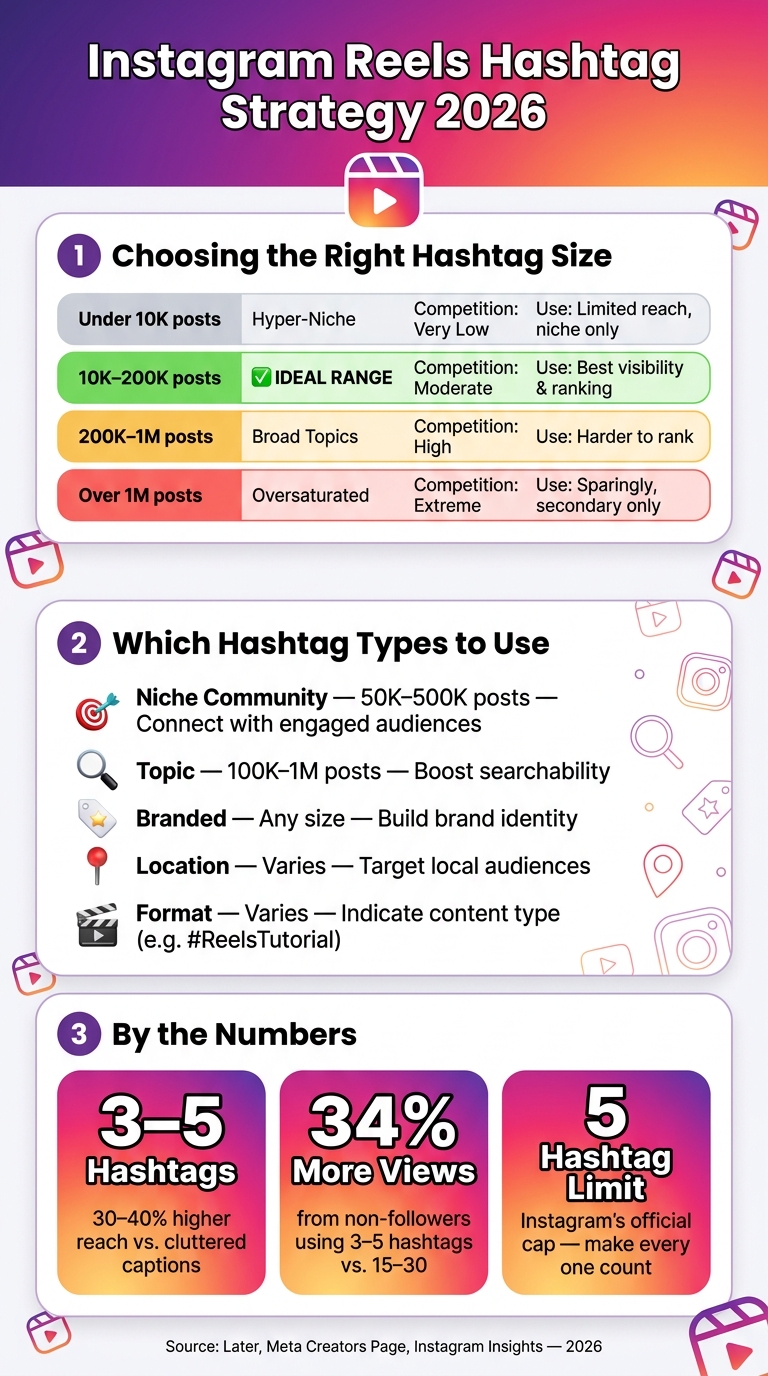
Instagram Reels Hashtag Strategy 2026: What Works & What Doesn't
With Instagram limiting Reels to just 5 hashtags, every single one needs to pull its weight. The days of stuffing captions with dozens of hashtags are long gone, and the shift to a more selective approach is proving far more effective.
How Many Hashtags Should You Use?
The sweet spot for hashtags is 3 to 5, backed by research. Posts with this range of hashtags outperform cluttered captions by 30% to 40% in reach metrics. Similarly, Reels with 3–5 hashtags see a 34% increase in average views from users who don’t already follow you. With a strict 5-hashtag limit, it’s essential to make each one count.
Talar Mazloumian, Content Marketing Manager at Later, sums it up perfectly:
"The era of hashtag stuffing is over, and frankly, the accounts that are winning right now aren't mourning it."
The key is choosing the right types of hashtags to maximize visibility and relevance.
Which Types of Hashtags Work Best
A balanced mix of niche, topic, and branded hashtags works best. Here’s how to structure your selection:
| Hashtag Type | Purpose | Optimal Range |
|---|---|---|
| Niche Community | Connect with smaller, highly engaged audiences | 50K–500K posts |
| Topic | Accurately describe your content for searchability | 100K–1M posts |
| Branded | Build brand identity and aggregate user content | Any size |
| Location | Target local audiences for geographic relevance | Varies by city |
| Format | Indicate content type (e.g., #ReelsTutorial) | Varies |
Niche community hashtags in the 50K–500K range are particularly effective. These smaller pools allow your content to stand out, unlike massive tags like #love or #fitness, which have over 100 million posts and can reduce your reach by about 5% due to intense competition. Instagram’s AI also penalizes mismatched hashtags, making irrelevant ones 40% less effective.
For example, in April 2026, Sweaty Betty, a fitness apparel brand, combined a search-friendly hashtag like #GlobalRunningDay with their branded tag, #IAmASweatyBetty. This pairing of niche relevance and brand identity helped their posts consistently surpass 2,000 likes.
Once you’ve nailed your hashtag selection, where you place them matters just as much.
Where to Put Hashtags: Caption or Comments?
Hashtags work best when placed in the caption. Instagram’s algorithm prioritizes hashtags in captions over those in comments for search and SEO indexing. This ensures your Reel is properly classified the moment it’s published.
Keep in mind, the 5-hashtag limit applies across all placements, so splitting hashtags between captions and comments doesn’t give you extra slots. Instead, include all your hashtags at the bottom of your caption. Use the first 125 characters for natural keywords that enhance discoverability. This approach ensures your hashtags are both effective and well-positioned for maximum impact.
How to Find and Test Hashtags for Reels
Finding Relevant and Trending Hashtags
Start your search with Instagram's search bar. Type in a keyword related to your niche, and take note of the autocomplete suggestions - these are based on what users are actively searching for. Then, head over to the Explore page and check out the hashtags being used on top-performing posts in your niche.
You can also spot trending audio by looking for the rising arrow icon on Reels. Tracks with 1,000–50,000 Reels are a good indicator of relevance without being overly saturated.
Choosing Hashtags With the Right Competition Level
Not all hashtags are created equal. For instance, tagging your post with a high-traffic hashtag like #fitness (which might have over 100 million posts) means your content could disappear from the "Recent" tab in 3–5 seconds. On the other hand, a more niche hashtag like #sourdoughbakers may keep your post visible for hours.
The ideal range for hashtags is 10,000–200,000 posts. These tags strike a balance between active traffic and moderate competition, increasing your chances of ranking in the "Top" tab. Hashtags with fewer than 10,000 posts may not drive much traffic, while those with over 1 million posts should be used sparingly as they tend to be oversaturated.
| Hashtag Volume | Strategic Use | Competition |
|---|---|---|
| Under 10K | Great for hyper-niche content but limited reach | Very Low |
| 10K–200K | Ideal range for visibility and ranking | Moderate |
| 200K–1M | Good for broader topics but harder to rank | High |
| Over 1M | Use sparingly as a secondary tag | Extreme |
Once you've selected hashtags in the right range, keep an eye on how they perform and tweak your approach as needed.
Tracking Hashtag Performance
After posting your Reels, dive into Instagram Insights to track their impact. Look at metrics like "Reach from Hashtags" and "Reach from Explore" to see how well your tags are bringing in non-followers.
Here’s a quick diagnostic tip: if your Reel has high watch time but low reach, it might mean your hashtags are miscategorizing the content. On the flip side, low watch time suggests the content itself needs improvement rather than the hashtags. To test hashtag effectiveness, try Instagram's Trial Reels feature. This tool exclusively shows your content to non-followers, allowing you to experiment with different hashtag sets without affecting your main audience. This way, you can pinpoint which combinations drive the most discovery.
A good practice is to build a library of 10–15 hashtags for each content pillar and rotate sets of five with your posts. This prevents the algorithm from flagging repetitive patterns and gives you a clearer idea of which combinations consistently attract new viewers.
What Matters More Than Hashtags for Reels Growth
When Hashtags Do Not Make a Difference
No matter how perfect your hashtags are, they can't save a Reel with a low completion rate. Instagram’s algorithm is far more advanced now - it evaluates your visuals, audio, and captions to figure out your content’s theme before even looking at your hashtags. In fact, Instagram prioritizes content engagement over the number of hashtags you use. This means your focus should shift to creating content that captures attention and keeps viewers engaged, rather than relying on hashtags to do the heavy lifting.
Why Content Quality and Engagement Come First
Metrics like watch time, completion rate, and DM shares are the real drivers behind a Reel’s success. Hashtags simply can't compete with these engagement signals. Instagram’s Head, Adam Mosseri, has made this clear:
"For Reels, sends via DM are the most heavily weighted signal for distribution."
When someone shares your Reel in a DM, it tells the algorithm that your content is worth spreading - something hashtags alone can’t achieve.
The key to success lies in the details: A powerful hook in the first half-second grabs attention. A seamless loop encourages replays and boosts momentum. And content that feels shareable - whether it’s a useful tip, a relatable moment, or a bold opinion - will always outperform a Reel that’s just well-tagged.
"A strong hashtag alone cannot rescue a post with weak retention, and strong retention barely needs hashtags at all." - Elena Marchetti, 1kreach
Tools That Help You Grow on Reels
While great content is essential, reaching the right audience ensures your efforts pay off. That’s where tools like Outfame come in. Outfame uses AI-powered targeting to connect your Reels with viewers already interested in your niche. These are the people most likely to watch, save, and share your content, strengthening the engagement signals that matter most.
Plus, its real-time analytics provide insights into what’s working, so you can focus on strategies that deliver results instead of wasting time on guesswork. For creators looking to grow efficiently, this mix of smart targeting and live performance tracking can make all the difference.
Conclusion: Are Hashtags Still Worth Using for Reels?
Hashtags are still relevant in 2026 - but only if you use them wisely. With Instagram's 5-hashtag limit, it's all about quality over quantity. Choosing 3–5 focused, relevant tags can help categorize your content effectively. However, even the best hashtags won't save a Reel that doesn't spark engagement. In fact, data shows that Reels with 3–5 hashtags see 34% higher average views from non-followers compared to those overloaded with 15–30 tags. The takeaway? Thoughtful hashtag use beats mass tagging every time.
That said, hashtags are just one piece of the puzzle. The real drivers of growth are elements like a captivating hook in the first half-second, content that encourages DM shares, and a seamless loop that keeps viewers watching. Hashtags help organize your content, but they can't replace the power of an engaging Reel.
"Using fewer (up to 5), more targeted hashtags rather than many generic ones can improve both your content's performance and people's experience." - Meta Creators Page
To take your Reels to the next level, consider pairing targeted hashtags with tools designed to boost your reach. For example, Outfame uses AI to match your content with viewers who are already interested in your niche. With features like real-time analytics and automated audience targeting, it helps you grow your presence on Instagram while you focus on creating content that truly connects.
FAQs
How do I pick my 5 best Reel hashtags?
When picking your top 5 hashtags for Reels, the key is quality over quantity. Instead of stuffing your post with random tags, focus on ones that are highly relevant and targeted.
Here’s a smart approach:
- Mix it up: Use a combination of niche community tags, branded tags, topic-specific tags, and format-based tags. This ensures your content reaches the right audience.
- Skip the generic ones: Tags like #fyp might seem tempting, but they don’t add any real value. They’re overused and unlikely to boost engagement.
- Do your homework: Research keywords and hashtags that are performing well for top accounts in your niche.
- Experiment and refine: Test new hashtag sets every 4–6 weeks. This keeps your strategy fresh and helps you figure out what resonates best with your audience.
By focusing on relevance and testing regularly, you’ll be able to fine-tune your hashtag strategy for maximum impact.
Do hashtags help Reels reach non-followers anymore?
Yes, hashtags can still help Reels reach users who don’t follow you, but their purpose has evolved. Rather than being a primary driver of reach, they now serve as a classification tool. Adding up to five well-chosen, relevant hashtags helps Instagram understand and categorize your content, increasing the chances it appears for users interested in that particular topic. Tools like Outfame can help creators refine their strategies to better connect with their intended audience.
How can I tell if my hashtags are hurting reach?
In 2026, hashtags serve more as classification signals than tools for directly boosting your reach. Using them the wrong way - like opting for generic or irrelevant tags, or stuffing keywords - can actually hurt your growth.
Instead, stick to 1-2 specific, niche-relevant hashtags. This helps Instagram understand and properly categorize your content, ensuring it reaches the right audience. On the flip side, misusing hashtags can confuse the algorithm, making it harder for your content to gain traction.
For better results, tools like Outfame provide real-time analytics to refine your hashtag strategy. They’re a great way to support steady, organic growth without relying on guesswork.


