
Instagram and TikTok are two dominant social media platforms, but their algorithms, audience behaviors, and content strategies differ significantly. Understanding these differences is critical for effective competitor analysis.
Key Takeaways:
- Instagram prioritizes connection: Metrics like saves, DM shares, and relationship-driven engagement dominate. It's ideal for building deeper audience relationships and driving conversions.
- TikTok focuses on discovery: Metrics like video completion rates and watch time determine visibility. It's perfect for identifying trends and rapid audience growth.
- Content lifespan varies: Instagram peaks within 48 hours, while TikTok content can gain traction weeks later.
- Analytics tools differ: TikTok’s Creative Center offers real-time trend insights, while Instagram’s analytics emphasize follower-based metrics.
- Cross-platform strategy: TikTok works as a discovery engine, while Instagram helps convert viral reach into loyal followers.
Quick Comparison:
| Factor | TikTok | |
|---|---|---|
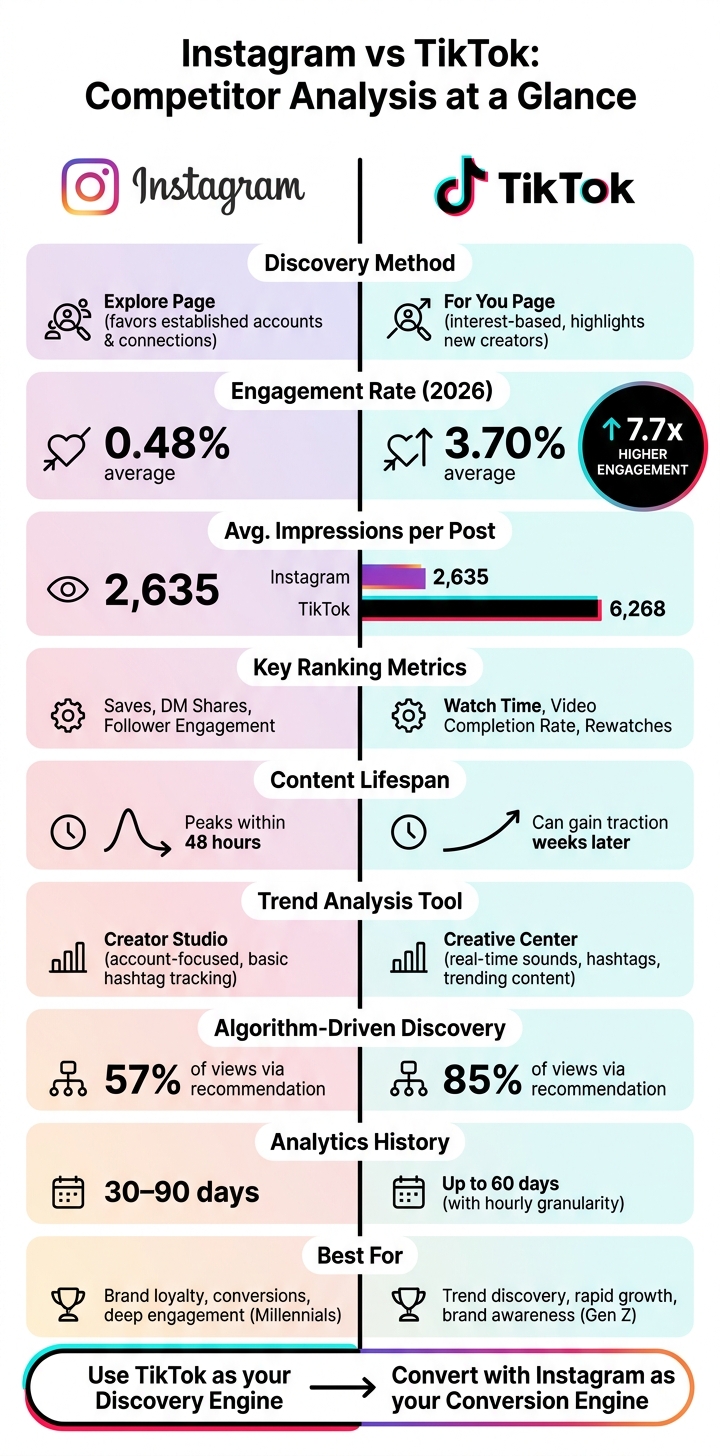
| Discovery Method | Explore Page (favors connections) | For You Page (interest-based) |
| Key Metrics | Saves, DMs, follower engagement | Completion rate, watch time |
| Trend Analysis | Basic hashtag tracking | Real-time trending sounds, hashtags |
| Content Lifespan | Peaks within 48 hours | Can gain traction weeks later |
| Engagement Rate | ~0.48% | ~3.70% |
Both platforms require tailored strategies. Use TikTok to spot trends and Instagram to foster deeper audience engagement. Together, they cover the entire marketing funnel, from discovery to conversion.
Instagram vs TikTok: Key Metrics & Competitor Analysis Comparison 2026
TIKTOK vs INSTAGRAM which should you choose? Is Instagram dead ? Is Instagram better than TikTok? |
sbb-itb-3b12fba
Key Differences Between Instagram and TikTok
Understanding the differences between Instagram and TikTok is essential for crafting a strong competitor analysis strategy. These differences influence how content is discovered, how audiences engage, and the kind of data you can access.
Content Formats and Algorithms
Instagram offers a variety of content formats, including Reels, Stories, carousels, and static posts. Its algorithm tends to favor visually polished and consistent content. For example, carousels with up to 20 frames achieve an average engagement rate of 10.15%. Instagram Reels, which now allow videos of up to 20 minutes, provide additional opportunities for creators.
TikTok, on the other hand, revolves almost entirely around short-form videos. The platform rewards casual, authentic content that feels natural to its audience. Key performance signals include video completion rate and watch time. TikTok’s algorithm is particularly aggressive, driving 85% of views through its recommendation system, compared to Instagram’s 57%.
"TikTok rewards strangers finishing your video. Instagram rewards known users saving it. Those are two different content jobs." - Marcus Lane, Influencers Time
Audience Behavior and Discovery
Instagram’s algorithm leans heavily on existing relationships, prioritizing content from accounts users already engage with. That said, 55% of Reels views now come from non-followers, indicating some expansion in discovery mechanisms. The platform is also moving toward SEO-driven discovery, with keyword-rich captions and alt-text increasing reach by 30% compared to traditional hashtag strategies. Saves, direct message (DM) shares, and meaningful comments remain key drivers of discovery.
TikTok takes a different approach, functioning as a cold-start engine. Content is distributed to strangers based on metrics like watch time and completion rates, regardless of follower count. This setup makes it easier for new accounts to go viral and for emerging competitors to gain visibility quickly. However, TikTok penalizes accounts that stray too far from their niche - posting across more than three unrelated topics can reduce reach by an average of 45%.
These audience behaviors directly impact the type of analytics each platform offers for tracking competitors.
Analytics and Data Access
The differences in content and audience behavior are reflected in the analytics each platform provides. Here's a side-by-side comparison of their key features:
| Feature | Instagram Analytics | TikTok Analytics |
|---|---|---|
| Top Ranking Signal | DM Shares, Saves, Watch Time | Watch Time, Completion Rate |
| Metric Granularity | Daily, Weekly, Monthly | Hourly, Daily, Weekly, Monthly |
| Historical Data | 30–90 days | Up to 60 days |
| Sound/Music Data | Limited | Comprehensive trend analytics |
| Trend Discovery Tool | Creator Studio (account-focused) | Creative Center (real-time trends) |
TikTok’s Creative Center stands out by providing real-time insights into trending sounds and hashtags, making it a powerful tool for identifying trends and competitors. Meanwhile, Instagram’s analytics, available through Meta Business Suite, focus more on relationship-driven metrics like profile visits and close-friend shares. Neither platform offers built-in competitor benchmarking, so long-term tracking often requires third-party tools.
Competitor Analysis Strategies for Instagram
Instagram thrives on connection and engagement, making it essential to understand how competitors interact with their audiences. These strategies can help you uncover what works and why.
How to Find Competitors on Instagram
Start by searching niche-specific hashtags to identify top-performing competitor profiles. Pay attention to those consistently appearing in the "Top" posts section - these accounts are already favored by Instagram's algorithm.
If you have a Business or Creator account, Instagram's Competitive Insights tool (available in the Professional Dashboard as of 2026) allows you to compare up to 10 competitors side by side. To make the most of this feature, categorize competitors into three groups: direct competitors, aspirational brands, and indirect players.
Once you've identified and sorted your competitors, the next step is to track the metrics that reveal their growth strategies.
Metrics to Track on Instagram
Focus on metrics that show audience engagement and content strategy. For example:
- Follower growth rate: Spikes in growth can indicate a viral post or a successful campaign.
- Posting frequency: This shows how much time and effort competitors are dedicating to Instagram.
- Boosted posts: These reveal which content competitors are willing to invest in through ads.
However, Instagram's native tool won't provide data on engagement rates, saves, or shares for competitor accounts. To fill this gap, consider using third-party tools or manually tracking these metrics in a spreadsheet. This can help you determine whether a competitor's growth stems from genuine audience loyalty or simply high visibility.
"Posting consistently without knowing what your competitors are doing is like driving blindfolded." - Jason Miller, Chief Growth Officer, Aibrify
Analyzing Competitor Content on Instagram
After gathering data, dive into competitor content to spot winning strategies. For instance, study the first 1–3 seconds of their top Reels. Look for hooks like questions or bold statements - these often reveal what resonates with your niche and what the algorithm prioritizes.
Examine visual elements like color palettes, caption styles, and production quality to identify trends. The comments section can also be a treasure trove of insights. Unanswered questions or repeated requests in competitor posts may highlight content gaps you could address.
Additionally, pay attention to their partnerships. Collaborations with influencers or brands can amplify reach. For example, in 2025, Duolingo's collaboration with K-pop group Stray Kids across five Reels reached approximately 64 million users, earning 1.3 million likes and generating 13,000 comments. This illustrates the power of culturally relevant partnerships.
"The goal is not to copy competitors. You are looking for patterns in what the algorithm rewards in your niche." - ContentCreators.com
Competitor Analysis Strategies for TikTok
TikTok operates at a much faster pace than Instagram, requiring real-time monitoring to stay ahead. Trends on TikTok can rise and fall in a matter of hours, so keeping tabs on competitors means observing their actions as they happen.
How to Find Competitors on TikTok
Start by exploring your For You Page (FYP) within your niche. Use niche-specific hashtags and trending sounds to identify accounts that consistently appear in these searches - they’re likely capturing attention from TikTok’s algorithm. Additionally, watch for competitors using trending audio. Sounds play a key role on TikTok: while trending audio helps boost visibility, original voiceovers often indicate efforts to establish brand authority.
To better understand competitors, group them by their video strategies. Are they focusing on product demos, educational content, trending challenges, or behind-the-scenes looks? This categorization can help you identify where they fit in the customer journey, whether they’re aiming to build awareness or drive conversions.
"TikTok doesn't show you content from people you follow - it shows you content it predicts you'll watch." - Jamie Partridge, Founder & CEO, PostEverywhere
Another important signal is posting frequency. For instance, if a competitor increases their posting from three times a week to daily, it could indicate a shift in their strategy or increased investment in the platform.
Metrics to Track on TikTok
Raw view counts can be misleading. Instead, focus on the engagement-to-view ratio. This metric - calculated by dividing total likes, comments, and shares by total views - reveals how well a video connects with its audience.
"A video with 10,000 views and 800 engagements (8% rate) performed better than one with 100,000 views and 2,000 engagements (2% rate). The first one resonated with its audience. The second one got pushed by the algorithm to people who didn't care." - Ibby Syed, Founder, Cotera
Video length also matters. A study by Content Labs covering June 2025 to April 2026 found that videos over 90 seconds averaged 170,228 views - 31 times more than videos under 15 seconds, which only averaged 5,406 views. If competitors consistently see better results with longer videos, it’s a clear indication of where viewer interest lies.
The emotional tone of content can also influence performance. Different emotional triggers correlate with specific outcomes, as shown below:
| Emotional Trigger | Avg. Views | Primary Outcome |
|---|---|---|
| Fear | 264,031 | Raw views / awareness |
| Empathy | 170,369 | Shares |
| Outrage | 168,502 | Comments / watch time |
| Trust | 42,149 | Saves |
Analyzing Competitor Content on TikTok
Just like Instagram, TikTok demands immediate attention. The first 1.5 seconds of a video are critical for capturing interest. When analyzing competitor content, ask yourself: What’s their hook?
"The algorithm decides within the first 1.5 seconds whether to keep pushing the video out. Start in the middle of the take, not at the beginning of the story." - The Content Labs
Competitor hooks often fall into archetypes like Hot Take (a bold opinion), Investigator (building suspense), or Proof Drop (showing data or evidence). For example, Hot Take and Investigator hooks average around 140,000 views, while Proof Drop hooks tend to generate the most saves - about 1,761 per video. Identifying the type of hook can give you insight into what outcome the creator is targeting.
Format is another crucial factor. Videos using the Greenscreen format - where creators overlay themselves on screenshots, articles, or charts - average over 150,000 views, compared to just 56,000 for plain talking-head videos. That’s a 2.6× advantage, reflecting the algorithm’s preference for content with high information density. Consistently using Greenscreen can also improve watch time, which helps drive wider distribution.
These TikTok-specific strategies provide a strong foundation for comparing how the platform’s dynamics differ from Instagram’s approach.
Instagram vs TikTok: Side-by-Side Comparison
Now that we've looked at individual strategies, it's time to compare Instagram and TikTok directly. The differences between these platforms can help you decide which one aligns better with your goals.
Competitor Analysis Comparison Table
Here's a breakdown of how Instagram and TikTok differ when it comes to tracking competitors:
| Factor | TikTok | |
|---|---|---|
| Discovery Method | Explore Page (favors established accounts) | For You Page (interest-based, highlights new creators) |
| Content Lifespan | Performance peaks within the first 48 hours | Content can gain traction weeks later |
| Key Metrics | Saves, DMs, and follower engagement | Video completion rate, rewatches, and view-based engagement |
| Trend Analysis | Basic hashtag tracking | Real-time insights into sounds, music, and hashtags |
| Data Granularity | Daily, weekly, monthly | Hourly, daily, weekly, monthly |
| Analytics History | 30–90 days | Up to 60 days with more real-time updates |
| Engagement Rate (2026) | ~0.48% average | ~3.70% average |
| Avg. Impressions per Post | 2,635 | 6,268 |
In 2025, TikTok posts averaged 6,268 impressions, while Instagram's average was 2,635. This difference highlights TikTok's advantage in reach, especially for spotting and analyzing competitor content trends.
Which Platform Works Best for Each Goal
The table above provides a solid comparison, but how do these platforms stack up for specific marketing goals?
"On Instagram, your content's fate is usually decided in the first 48 hours." - Andreea Udescu, Socialinsider
If you're focused on long-term brand positioning - tracking how competitors maintain loyalty, build identity, and convert followers - Instagram is the better option. Its engagement metrics like saves, DMs, and detailed comments give a clearer picture of audience investment.
On the flip side, TikTok is unmatched for trendspotting. Its algorithm emphasizes video completion rates over follower count, allowing even smaller accounts to achieve broad reach with engaging content. This makes TikTok ideal for identifying rising players and monitoring emerging content trends.
| Marketing Goal | Best Platform | Key Metric to Watch |
|---|---|---|
| Rapid audience growth | TikTok | Completion rate and follower growth rate |
| Direct sales / e-commerce | Save rate and DM conversion workflows | |
| Brand awareness (Gen Z) | TikTok | Reshare velocity and trend participation |
| Brand loyalty (Millennials) | Story interaction and comment depth |
In short, TikTok shines for spotting trends and growing quickly, while Instagram is the go-to for sustained engagement and deeper audience insights.
Building a Competitor Analysis Framework for Both Platforms
Keeping track of competitors on Instagram and TikTok might feel overwhelming, but it’s manageable with a structured system. A repeatable process with consistent metrics and formulas can simplify your workflow, making it easy to update weekly without starting from scratch.
Standardizing Metrics and Tracking
Instagram and TikTok require different engagement measurement approaches: Instagram engagement is measured against followers, while TikTok engagement is based on video views.
Here are two formulas to help you standardize tracking:
- Instagram: (Likes + Comments + Saves + Shares) ÷ Followers × 100
- TikTok: (Likes + Comments + Shares) ÷ Video Views × 100
Your tracking sheet should include three key areas:
- Account overview: Metrics like followers and profile visits
- Engagement: Data such as likes, comments, and shares
- Video performance: Insights like average watch time and retention rate
Additionally, include platform-specific metrics - like Saves on Instagram and Favorites on TikTok - to capture unique engagement trends.
Pay special attention to share velocity. Reshares can amplify reach by 2–3 times more than likes. Tracking this weekly lets you spot content with viral potential before you invest further resources into similar ideas.
Once you’ve standardized your metrics, you’ll be able to extract actionable insights from both platforms.
Using Insights from One Platform to Inform the Other
The best competitor analysis doesn’t just stick to one platform - it uses insights from one to improve strategies on the other. This cross-platform approach allows you to align TikTok and Instagram strategies, treating TikTok as a discovery engine and Instagram as a conversion engine.
For instance, if you notice a competitor’s TikTok video gaining rapid shares, it’s a clue that the topic resonates with audiences. As Elissa Wardrop, Social Media Specialist at IKEA, puts it:
"If marketers want to drive more shares, they need to focus on content people genuinely want to send to their group chats."
You could take that insight and turn it into an Instagram carousel or Reel that encourages Saves. On the flip side, if you see a competitor’s Instagram post generating deep comment threads, these could reveal buyer objections or questions. Use that feedback to create TikTok videos showing product texture, fit, or practical use.
When repurposing content across platforms, make sure to remove TikTok watermarks before posting to Instagram Reels. Instagram’s algorithm deprioritizes watermarked content, which could hurt the reach of your best-performing ideas.
Using Outfame to Support Competitive Growth
Manually tracking competitors on two platforms can be time-consuming, but tools like Outfame can fill in the gaps. Outfame provides real-time analytics, AI-driven insights, and competitor benchmarking for Instagram and TikTok, saving you hours of manual work.
Instead of guessing when to post, Outfame analyzes competitor audience activity to pinpoint the best times to publish. Its Outfame Max™ AI tool takes it a step further by targeting audiences already engaging with similar content in your niche. Growth plans start at $39/month and even come with a growth guarantee - if you don’t grow, you get your money back.
With real-time insights, you can act quickly on competitor trends before they peak.
Conclusion
After breaking down specific strategies and metrics, it's clear that Instagram and TikTok require distinct approaches to achieve competitive success.
TikTok thrives on metrics like completion rates, hook performance, and reshare velocity, which emphasize capturing attention and driving viral reach. On the other hand, Instagram leans heavily on save rates, comment depth, and relationship-driven engagement, making it a platform for building deeper, ongoing connections.
These platforms, while different, work together to cover the entire marketing funnel. TikTok excels at introducing your content to new audiences - an impressive 90% of its content discovery is algorithm-driven, not follower-based. Instagram, in turn, helps you convert that exposure into a loyal, engaged community.
The brands achieving meaningful results aren't just copying what competitors post - they're analyzing why certain strategies succeed on each platform. By standardizing metrics, cross-referencing insights, and staying consistent, you can make smarter, more informed content decisions.
Ultimately, growth doesn't hinge on having the largest budget. It comes from paying close attention to the data and adapting accordingly. When used together, Instagram and TikTok can power a competitive, data-focused strategy that keeps you ahead of the curve.
FAQs
How do I compare competitors fairly across Instagram and TikTok?
To evaluate competitors effectively, it's essential to consider metrics and strategies unique to each platform. TikTok thrives on discovery and viral content, largely influenced by engagement signals like watch time and participation in trends. On the other hand, Instagram shines in fostering deeper connections, supporting relationship-building and driving conversions through features like direct messages (DMs) and shopping tools.
When comparing platforms, look at key metrics like engagement rates, the lifespan of content, and audience demographics. This helps you tailor your strategy to each platform's strengths - TikTok for fast-paced growth and visibility, and Instagram for building brand loyalty and long-term connections.
What competitor signals matter most on Instagram vs TikTok?
Instagram places a strong emphasis on relationship-driven signals. This includes actions like DM shares, saves, profile clicks, and in-depth comments. Essentially, the platform rewards content that sparks meaningful interactions and builds connections.
TikTok, on the other hand, leans heavily on performance metrics such as watch time, completion rates, and how quickly content gets reshared. The focus here is on rapid engagement and the potential for content to go viral.
By understanding these differences, creators and brands can fine-tune their strategies to align with each platform’s algorithm and the way their audiences interact.
How can I turn TikTok trend wins into Instagram conversions?
TikTok’s viral nature makes it a perfect platform for grabbing attention quickly. But to turn that attention into meaningful engagement or sales, Instagram can play a key role. Here’s how you can make the most of both platforms:
- Start with TikTok: Post trend-inspired videos that catch viewers’ eyes. Include clear calls-to-action (CTAs) encouraging them to check out your Instagram for more content or exclusive offers.
- Engage on Instagram: Once users land on your Instagram, take advantage of features like shopping tags, automated DMs, and exclusive posts to keep them engaged and drive conversions.
- Repurpose Content Smartly: Don’t let your TikTok videos go to waste. Reuse them as Instagram Reels, but make sure to remove TikTok watermarks and tweak captions to fit Instagram’s vibe. This ensures your content feels fresh and relevant on both platforms.
By combining TikTok’s reach with Instagram’s advanced tools, you can create a seamless journey that turns casual viewers into loyal customers.


