
TikTok search now matters a lot. As of early 2026, 49% of U.S. consumers use TikTok as a search engine, and that jumps to 65% for Gen Z. If I want my videos to rank, I need to focus on two things first: clear keyword matching and strong watch behavior.
Here’s the short version:
- Say the main keyword early, often in the first 3 seconds
- Put that same keyword in on-screen text and in the caption
- Place the main keyword near the start of the caption, especially in the first 50 characters
- Use 2 to 4 specific hashtags, not piles of generic tags like
#fyp - Back up the topic with profile fields, especially the Name field
- Aim for 70%+ completion rate
- Push for shares, rewatches, and saves
In plain terms: TikTok search leans on text and audio match, while the For You feed leans more on watch time and interaction. The article shows that keyword alignment across spoken audio, captions, and on-screen text has the strongest support, and that engagement signals help videos keep their spot in search.
| Area | What seems to matter most |
|---|---|
| Keywords | Spoken words, on-screen text, caption start |
| Hashtags | Small number of niche, topic-specific tags |
| Profile | Name field, then bio and username |
| Engagement | Completion rate, shares, rewatches, saves |
| Lower-weight signals | File name and generic trend tags |
If I had to boil the whole article down to one line, it would be this: make the topic obvious fast, then make the video worth watching to the end.
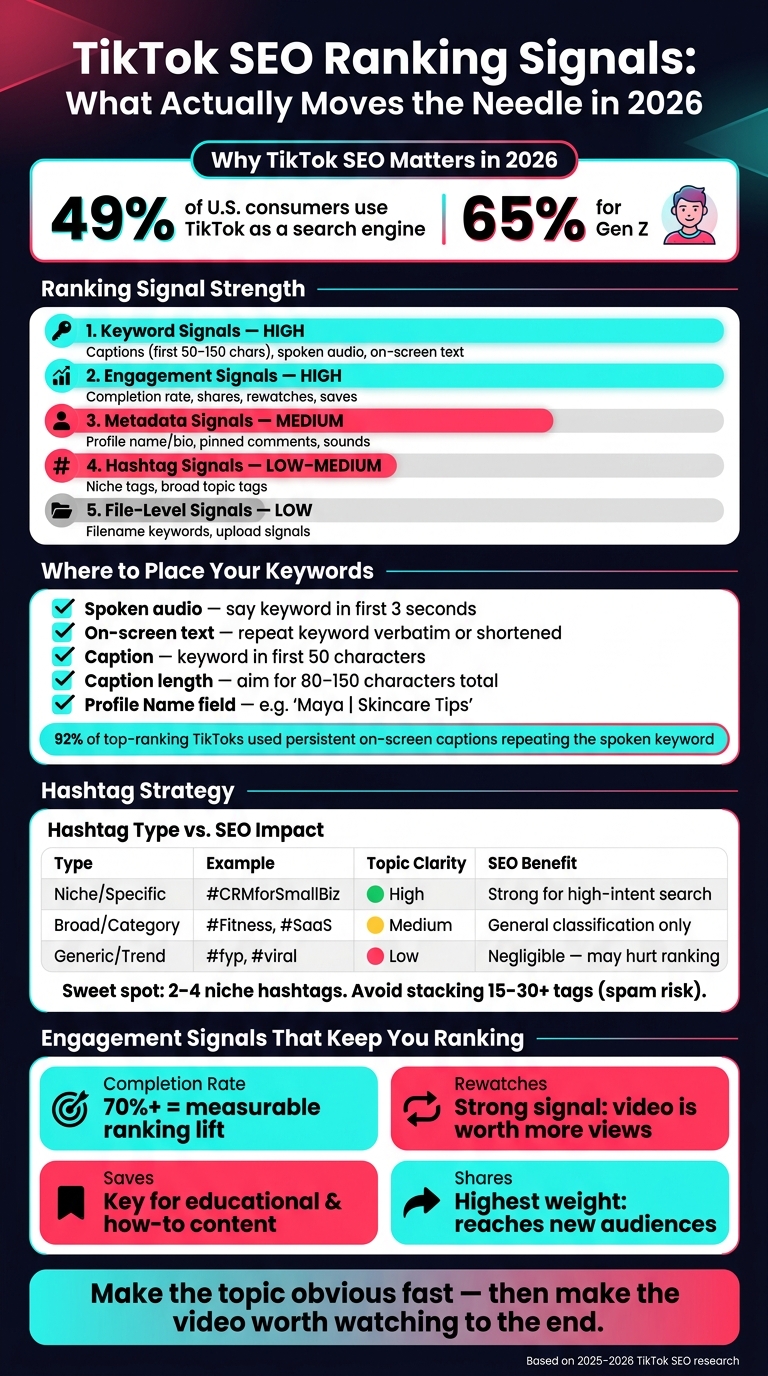
TikTok SEO Ranking Signals: What Actually Moves the Needle in 2026
How TikTok SEO Works (And How to Rank Higher in 2026)
sbb-itb-3b12fba
Keyword Signals: Captions, Spoken Audio, On-Screen Text, and Profile Fields
The strongest research support points to keywords in spoken audio, captions, and on-screen text. TikTok reads all three together, not in isolation. When the same keyword shows up across speech, captions, and text on screen, topic matching gets stronger - a pattern often called reinforced signals.
TikTok handles each input a little differently. It uses speech transcription for spoken audio, text reading for on-screen text, and standard text parsing for captions. One analysis of 100 top-ranking TikToks found that 92% used persistent on-screen captions that repeated the spoken keyword verbatim or in a shortened version. Research also suggests that on-screen text and spoken keywords matter more than captions by themselves. So this isn’t just about picking the right keyword. It’s also about where that keyword shows up.
Why Early Keyword Placement May Matter
Timing seems to play a big role. In one study, all 100 videos included the primary keyword in speech or on-screen text within the first three seconds. That early placement may help TikTok figure out the topic faster, which matters for search indexing, not just general optimization.
Captions show a similar pattern. The first 50 characters appear to carry more weight than the rest of the caption. A simple way to handle this:
- Put the primary keyword in the first 50 characters
- Keep captions around 80 to 150 characters
When your video-level keywords are in place, your profile can back up that same topic signal.
Profile Keywords as a Secondary Search Signal
Profile fields - username, name, and bio - work as secondary search signals. They can support discoverability, but they don’t replace keyword-rich video content. Among these fields, the Name field appears to matter most for search discoverability because TikTok indexes it separately from individual videos.
Adding a primary keyword to the Name field can help with profile-level searches. For example, "Maya | Skincare Tips" ties the account to a clear topic.
Next, hashtags add one more layer of topic labeling, but they appear to carry less weight than text-based signals.
Hashtags: Topic Labels, Relevance, and Research Limits
After keyword signals, hashtags add a lighter layer of topic labeling. They can help TikTok sort a video's subject and support discovery, but they matter less than captions, spoken audio, on-screen text, and engagement signals. The simple way to think about them: hashtags are labels, not ranking tools. Their main job is to help TikTok understand what topic bucket the video fits into.
Niche Hashtags vs. Broad and Generic Tags
The strongest hashtags make the topic narrower, not broader. That difference matters.
| Hashtag Type | Typical Usage | Impact on Topic Clarity | Observed SEO Benefit | Risks or Limitations |
|---|---|---|---|---|
| Niche / Specific | #CRMforSmallBiz, #CleanBeauty |
High: Precisely labels content for a sub-category. | Strong for specific, high-intent search queries | Smaller total audience reach than trend tags |
| Broad / Category | #SaaS, #Fitness, #Cooking |
Medium: Places video in a general bucket. | Useful for general classification and authority building | High competition; too broad to stand alone |
| Generic / Trend | #fyp, #viral, #trending |
Low: Provides no useful information about the video topic. | Negligible for search | Can weaken topic clarity; risk of spam classification; using unrelated popular tags confuses the algorithm and hurts search ranking |
A review of 100 top-ranking commercial TikToks found a clear split: stronger videos used more specific tags like #saas or #smallbusiness, while lower-performing videos leaned on generic tag stacks such as #fyp, #viral, and #trending.
What Studies Say About Hashtag Quantity
Research points to a pretty tight range. Top-ranking commercial TikToks averaged 2 to 4 hashtags, while CapCut guidance suggests 3 to 5. In plain English, a small set of specific tags gives TikTok a cleaner topic signal.
More tags don't mean more reach. In fact, big stacks can backfire. Once you get into high-volume use, around 15–30+ hashtags, you may trigger spam classification.
Placement matters too. Put hashtags in the main caption, not the comments, because TikTok indexes the caption first.
Use a small number of precise tags. More volume doesn't improve indexing.
Metadata and Engagement Signals That Affect Visibility
Once TikTok knows what a video is about, the next filter is simple: do people keep watching and interact with it? That’s what determines whether the platform keeps pushing the video out.
Metadata TikTok Can Read
TikTok can read captions, spoken audio, on-screen text, profile fields, pinned creator comments, and sounds. Caption length matters most at the beginning, where TikTok seems to put more weight on the first 50 to 150 characters. It also tends to favor content it can fully read and sort, including native audio, text, and effects.
The strongest setup is when the same topic shows up across the caption, the spoken words, and the visuals. That kind of alignment gives TikTok a cleaner read on what the video covers.
Profile fields are still indexable, and the Name field still seems to carry the most weight. Audio choice can shape distribution and audio search. File names are still a weak signal.
Watch Time, Completion Rate, Rewatches, and Shares
Getting classified helps a video enter search. Retention and sharing help it stay there.
Completion rate is the strongest signal for both search and the For You feed in 2026. Videos that hit a 70%+ completion rate get a measurable lift in search and FYP placement. Rewatches push this even further. If people watch again, TikTok reads that as a strong sign the video is worth showing to more users.
Saves matter too, especially for educational or how-to content, because they suggest the video has long-term informational use. And when it comes to interaction types, shares carry the most weight because they put the video in front of new audiences.
Search results also tend to last longer than FYP placement. The FYP leans hard into freshness and fast engagement, but a well-optimized video can keep a search ranking for weeks or even months.
Signal Strength by Category
Not all signals carry the same weight.
| Signal Group | Direct SEO Impact | Evidence Strength | Common Source Types |
|---|---|---|---|
| Keyword Signals | High | Very Strong | Captions (first 50–150 characters), spoken audio (ASR), on-screen text (OCR) |
| Engagement Signals | High | Very Strong | Completion rate, watch time, shares, rewatches, saves |
| Metadata Signals | Medium | Strong | Profile name/bio, pinned comments, sounds |
| Hashtag Signals | Low to Medium | Moderate | Niche tags, broad topic tags |
| File-Level Signals | Low | Weak | Filename keywords, device and upload signals |
Across these groups, keywords and engagement signals have the strongest support.
Next, measurement shows which signals are actually moving search performance.
Recent Shifts, Measurement, and Key Takeaways
What Newer Research Points To
After the signal breakdown, the next step is figuring out what changed in 2025–2026 and how to track results.
Recent research suggests TikTok now reads captions, spoken audio, and on-screen text together. That means keyword alignment across formats matters more than stuffing one field and hoping for the best. Search behavior is also splitting across platforms. TikTok is growing as a search engine, but it isn't replacing Google. At the same time, TikTok's Creator Rewards Program now includes search performance as a payout factor.
How to Measure Search Performance on TikTok
This is where TikTok's own search tools become more useful than gut instinct. Use TikTok Studio's Search Performance and Creator Search Insights to see which queries bring in traffic and where demand is higher than supply.
Those query-level reports help you spot the signals that seem to matter most.
Conclusion: The Ranking Signals That Matter Most
Across 2025–2026 research, the picture is fairly clear. Three signals stand out most: keyword alignment across spoken audio, on-screen text, and captions, completion rate above 70%, and strong engagement velocity in the first 24 hours.
Hashtags still help with classification, but they play a secondary role. The Name field and pinned comments can add support, while follower count shows weak or no evidence as a ranking factor.
What we still don't know is the exact weight TikTok gives each signal, because that isn't public. And TikTok's ranking behavior can still change as the system updates. The practical move is simple: treat TikTok SEO as a testing process. Get the basics right, watch what TikTok's own tools show you, and adjust based on actual query data instead of guesses.
FAQs
How do I know which TikTok keywords to target?
Start with TikTok’s own search tools. Look at autocomplete, related queries, and “Others searched for” to find long-tail keywords that line up with what people mean when they search.
Then check the top-ranking videos for those terms. Pay attention to their captions, on-screen text, and spoken audio. Use Creator Search Insights too. It can help you spot popular topics, content gaps, and the phrases users are searching for right now.
What should I fix first if my TikToks aren’t ranking in search?
First, fix keyword placement. Put your target keyword in the first 50 characters of the caption, say it in the first 3–5 seconds, and show it as on-screen text in the opening frame.
Then keep the caption natural. Don’t jam the keyword in over and over. Add 3–5 targeted hashtags, and make sure your main keyword appears as a hashtag.
Does TikTok SEO work differently for search and the For You page?
Yes. TikTok SEO works differently for search and the For You page.
Search leans more on keyword relevance across several parts of your content. The For You page, on the other hand, leans more on engagement velocity and personal recommendations.


