
Instagram DMs and real Instagram followers are transforming how businesses drive sales. Here's why they work so well:
- 90% open rates and 60% reply rates outperform email marketing by a wide margin.
- Timing matters - responding to a DM within 1 minute can increase conversions by 391%.
- DM-to-sale conversion rates range from 7% to 20%, compared to just 1–3% for standard Instagram ads.
- Direct messaging simplifies the buying process, reducing steps and friction for users.
- Conversations that go beyond 11 messages are 160× more likely to result in bookings or sales.
Brands using strategies like click-to-DM ads, keyword triggers, and automation are seeing impressive results. For example, a mindset coach generated over $12,000 in revenue from a 14-day DM campaign, while a fashion brand achieved a 400% ROI in 30 days.
The key is responding quickly, engaging deeply, and tracking performance metrics like open rates, reply rates, and DM-to-sale conversion rates. Instagram DMs aren't just a communication tool - they're a powerful sales channel.
How to Turn Instagram DMs Into Sales Calls (Step-by-Step DM Strategy)
Research Insights: What the Data Says About DMs and Conversions
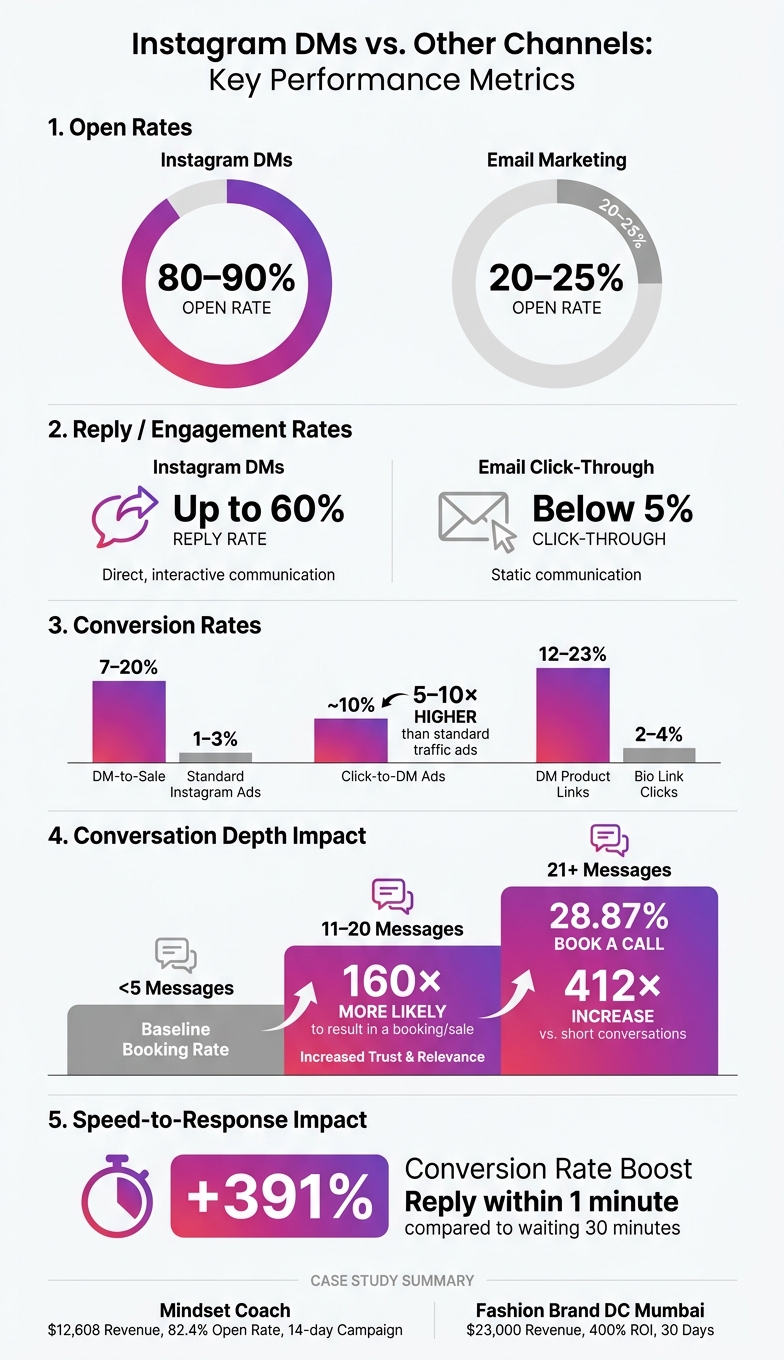
Instagram DMs vs. Other Channels: Conversion Rate Comparison
The data paints a compelling picture of how direct messages (DMs) on Instagram can significantly outperform other channels when it comes to engagement and conversions.
Higher Open and Engagement Rates Than Other Channels
Instagram DMs boast 80–90% open rates and reply rates as high as 60%. Compare that to email, where open rates hover around 20–25% and click-through rates fall below 5%. This stark difference highlights the potential of DMs to drive stronger engagement and, ultimately, better conversion results.
3–10× Higher Conversion Rates Through DM Funnels
When structured properly, DM funnels can take conversion rates to the next level. Typical DM-to-sale rates range from 7–20%, far exceeding the 1–3% conversion rates seen with standard Instagram ads. Click-to-DM ads are particularly effective, converting around 10% of users into customers - a rate 5–10× higher than standard traffic ads.
The structure of the funnel is key. For example, product links shared within DMs convert at 12–23%, compared to just 2–4% for bio link clicks. The depth of the conversation also plays a crucial role. Engaging in 11–20 messages with a lead increases the likelihood of securing a booking by an astonishing 160× compared to conversations with fewer than five messages.
"53% of Instagram conversations die before message 3. The good news? Past message 11, your booking rate jumps 160x." - SetSmart
These figures highlight the importance of persistence and thoughtful funnel design in achieving higher conversions.
Case Study Examples: Click-to-DM and DM Automation Results
Real-world examples provide even more clarity on the power of DMs. In 2026, mindset coach Priya launched a 14-day campaign using a simple keyword trigger - "MORNING" - on a carousel post. The results? 847 comments, 698 DM opens (an 82.4% open rate), and 64 enrollments for a $197 challenge. This effort brought in $12,608 in revenue without requiring any manual DM work.
Another success story comes from fashion brand DC Mumbai. Over a 30-day period in 2026, the brand used automated Instagram comment-to-DM funnels to generate approximately $23,000 in revenue, achieving a 400% ROI.
These examples show how combining high open rates, quick responses, and well-structured follow-ups can create a powerful formula for success in DM marketing.
Why DMs Work: The Mechanics Behind Higher Conversions
Recent research reveals a powerful truth: DMs consistently outperform other channels. But why? The secret lies in three key factors - how DMs create a personal connection, streamline the buying process, and build trust over time.
One-to-One Communication That Feels Personal
The magic of DMs starts with their setting. Instagram's DM inbox is where users interact with friends and family, making it feel like a natural space for conversations - even with brands. This familiarity transforms a brand message into something more conversational and less like a sales pitch. In fact, 75% of consumers say they prefer messaging businesses the same way they chat with friends.
When a DM references a specific action - like responding to a comment or Story - it feels tailored to the individual, rather than a generic broadcast. Content strategist Avery Rivers puts it best:
"People respond to people - not scripts." - Avery Rivers, Content Strategist, CreatorFlow
DMs also allow for real-time exchanges. Whether it's answering questions about product sizing, shipping, or pricing, brands can address concerns instantly, removing hesitation and making the buying experience smoother. This direct interaction not only engages customers but also reduces barriers in the path to purchase.
Fewer Steps, Less Drop-Off
The fewer steps between interest and purchase, the better. Every additional step increases the chance of losing potential buyers. Since Meta discontinued its native in-app checkout in August 2025, Instagram's product tags now redirect users to external sites - a process that can involve up to seven steps before completing a purchase. Unsurprisingly, 91% of Instagram shoppers abandon their carts due to this friction.
DMs eliminate much of this hassle. For instance, a comment-to-DM trigger allows brands to send a direct product link straight to the user's inbox. This reduces the buying process to just 2–3 steps, resulting in conversion rates of 12–23% for DM-delivered links compared to only 2–4% for bio links.
How Direct Conversations Build Brand Trust
DMs aren't just about efficiency - they're about building relationships. Direct conversations create trust over time, especially when they go beyond a single exchange. Data shows that when a conversation reaches 21 or more messages, nearly 1 in 3 leads (28.87%) book a call - a staggering 412× increase compared to interactions that end after just a few messages.
This sustained dialogue is essential. Seventy-two percent of consumers are more likely to buy from a brand that offers a messaging option, while 73% say they'll turn to a competitor if a brand doesn't respond on social media.
"In 2026, trust is currency - and personalization builds it." - ViaDM
Ultimately, the brands thriving on Instagram aren't necessarily the ones with the largest followings. Instead, they're the ones that consistently show up in DMs, reply promptly, and nurture meaningful conversations. These mechanics - personal connection, streamlined processes, and trust-building - are the driving forces behind the impressive conversion rates seen with DMs.
DM Strategies That Increase Conversion Rates
Instagram DMs can be a powerful tool for driving conversions, but success depends on using the right strategies. While understanding the basics of DM conversion is important, it's the execution that truly makes the difference.
Running Click-to-DM Ad Campaigns
Click-to-DM ads are effective because they keep users within Instagram, avoiding the friction of redirecting to external landing pages. This seamless experience matters - users who tap "Send Message" on an ad are 2–3 times more likely to make a purchase compared to those filling out standard lead forms.
The key is to use the opening conversation to qualify leads rather than immediately pushing for an email or a product link. A smart approach involves using AI to guide the conversation through 3–5 qualifying questions over 8–12 messages. This method helps assess intent and budget before involving a human. Interestingly, conversations that surpass the 11-message mark see booking rates skyrocket - up to 160 times higher than those that end prematurely.
"Speed and depth of conversation eat reach for breakfast - the lead response time data is brutal on slow accounts." - SetSmart
Click-to-DM ads also deliver impressive results, converting at an average rate of 10%, compared to just 1–2% for standard traffic ads.
Using Automation to Respond Faster and More Consistently
Quick responses can make or break conversions. Replying to a DM within 1 minute can boost conversion rates by a staggering 391% compared to waiting 30 minutes. Automation tools play a critical role here, especially trigger-based systems where users receive instant replies after commenting a keyword like "GUIDE" or "LINK." These systems eliminate delays and manual effort, significantly improving enrollment rates.
Another smart strategy is automating follow-up messages at +4 hours and +23 hours for users who stop responding. Without these nudges, 53% of conversations drop off before reaching the third message. Even a simple two-message follow-up sequence can drive 35% more responses compared to sending just one.
For those just starting, it's best to begin with 20 DMs per day and gradually increase to 80–100 over 30 days to stay within Instagram's usage limits. Always stick to tools built on the official Meta Messenger API to avoid risks like account bans from using unauthorized mass-DM tools.
Once automation is in place, tracking performance becomes the next critical step.
Tracking and Improving DM Performance Over Time
Monitoring your DM campaigns is as important as tracking ads with a pixel. Without it, you're missing opportunities to refine and improve. Four metrics are essential for analyzing your DM funnel: trigger rate (how many users start a conversation), reply rate to the first message, link click-through rate, and final conversion rate (purchases, bookings, or qualified leads).
| Metric | Good Benchmark | Excellent Benchmark |
|---|---|---|
| DM Open Rate | 70–85% | 90%+ |
| DM Reply Rate | 25–40% | 50%+ |
| Link Click Rate | 18–35% | 40%+ |
| DM-to-Sale Conversion | 7–12% | 15–20% |
Tagging conversations based on intent - like pricing inquiries, support needs, or purchase readiness - can help identify which segments are most likely to convert. Additionally, using UTM parameters (e.g., utm_medium=dm) on product links allows you to track revenue directly in platforms like GA4 or Shopify.
A/B testing is another valuable tactic. Test one variable at a time - such as trigger keywords ("SHOP" vs. "LINK"), message length, or follow-up timing - and run each version for at least two weeks before making decisions. For instance, a fitness apparel brand in early 2026 tested a "SHOP" keyword campaign over 90 days. They sent 12,400 automated DMs, achieved a 68% open rate, a 14.2% purchase conversion rate, and saw a 380% increase in Instagram-attributed revenue.
"A DM funnel is not about 'bots.' It is about removing delay and inconsistency from the moment someone shows intent." - Inrō
How to Measure Conversions From Instagram DMs
If you want to know whether your DM strategy is actually driving sales, you need data. Without tracking, it's impossible to pinpoint which conversations are turning into revenue.
Setting Up Tracking for DM Campaigns
The best way to track sales from DMs is by using UTM-tagged links with every URL you share. Adding parameters like utm_source=instagram&utm_medium=dm&utm_campaign=product_name allows tools like Google Analytics 4 or Shopify to attribute purchases directly to your DMs.
For e-commerce, you can also use DM-exclusive coupon codes (e.g., "INSTAGRAM10") alongside UTM links. This makes it easier to tie purchases back to specific conversations. Another option is sending pre-loaded cart links that include the product variant and quantity, simplifying the attribution process.
If you're managing larger campaigns, consider integrating your DM tool with a CRM like HubSpot or Shopify. This lets you tag leads by their source (e.g., "comment-to-DM") and track their journey through the sales funnel - not just their initial interaction.
Key Metrics to Monitor
Once you've set up tracking, focus on these metrics to gauge how well your DMs are performing:
- Revenue per conversation: This is a must-track metric. To calculate, multiply your engaged DMs by your DM conversion rate and your average order value. The result gives you a dollar amount for each conversation, helping you assess whether it's worth investing in better tools or increasing ad spend.
- Message depth: This measures the average number of back-and-forth messages per lead. Research shows that conversations with 11 or more messages dramatically boost booking rates. If your threads are ending after just 3–4 messages, it might mean your follow-up sequences or opening messages need improvement.
| Metric | What It Tells You | Healthy Benchmark |
|---|---|---|
| Trigger-to-DM Rate | % of commenters who open the DM | 60–80% |
| Qualification Rate | % of leads marked as ready to buy | 15–25% |
| Follow-up Recovery Rate | % of non-buyers who convert after a follow-up | 15–25% |
| Revenue per Conversation | Dollar value of each DM thread | Varies by AOV |
A/B Testing and Time-Bound Experiments
Using these metrics, you can refine your approach with controlled experiments and testing.
For instance, A/B testing keyword triggers like "SHOP" versus "DEAL" can help you determine which performs better. Keep everything else consistent - same post, same DM copy, same follow-up timing - to isolate the impact of the trigger word.
Time-bound experiments also provide clear insights. Try running a 30- or 60-day campaign with one variable changed, such as the length of your opening message or the placement of your CTA. In February 2026, Jenna Kutcher, a digital product creator, used a structured DM automation campaign to collect 38,490 email addresses. She achieved an 85% comment-to-registration conversion rate, far surpassing the typical 30–40% seen with standard landing pages. Results like this come from testing and refining what works.
"DM funnels = landing pages + email sequences inside your Instagram DMs." - Natasha Willis, Co-founder, School of Bots
When testing, don't just measure conversion rates - track your trigger-to-DM rate as well. A keyword that generates a lot of comments but fewer DM opens might not be as effective as it seems. These strategies give you the tools to fine-tune your DM campaigns and increase your Instagram conversions.
Conclusion: Making Instagram DMs a Core Part of Your Conversion Strategy
Studies reveal that Instagram DMs have become a powerful tool for driving sales, often surpassing the effectiveness of email and traditional advertising. With unmatched open, reply, and conversion rates, it's clear that DMs offer an edge that's tough to overlook.
The key difference between brands that excel and those that don't lies in a few simple practices: responding promptly, engaging in deeper conversations (beyond 11 messages), and re-engaging leads who have gone silent. The examples highlighted throughout this article demonstrate how these tactics can lead to notable increases in Instagram-driven revenue.
The process itself is straightforward. Using keyword triggers to engage prospects at the right moment, asking a single qualifying question before sharing a link (which can increase conversions by 30–50%), and setting up automated follow-ups at 4 and 23 hours are all strategies that deliver results. These methods are effective for teams of any size.
"The businesses that win in 2026 will be the ones that treat Instagram DMs as their primary sales channel." - LeadResponse
FAQs
What should I say in the first DM to increase sales?
To increase sales through your first Instagram DM, focus on keeping the tone friendly and conversational. Avoid diving straight into selling. Instead, mention a recent interaction - maybe they followed your account or commented on a post - to establish a connection. From there, ask an easy, relevant question, like what their goals or challenges are. The idea is to spark a real conversation, not to push for a sale right away.
How can I automate Instagram DMs safely without getting banned?
To automate Instagram DMs safely, stick to tools that use Meta’s official Instagram Graph API. These tools follow Instagram’s guidelines, unlike browser-based automation tools, which can violate platform rules and pose risks.
Effective automation should focus on responding to specific user actions - like when someone comments with a keyword or replies to a Story. For example, platforms like Outfame let you automate these interactions securely without needing to share your account password. However, steer clear of mass broadcasts or sending unsolicited DMs, as these practices can lead to account problems.
How do I track DM-driven sales in GA4 or Shopify?
To monitor sales generated through direct messages (DMs) in Google Analytics 4 (GA4) or Shopify, use links with unique UTM tags for every conversation. These tags should include parameters like:
utm_source=instagram_dmutm_medium=socialutm_campaign=[campaign_name]
When these tagged links are included in checkout URLs, Shopify automatically tracks and stores the UTM data at the time of purchase. This lets you analyze conversions based on their source.
For even greater accuracy, you can create specific links tailored to particular triggers - like a certain Reel or an influencer campaign - so you know exactly what’s driving your sales.


