
Instagram in 2026 is less about followers and more about interest, watch time, and shares. If I had to boil the update down fast, it’s this: likes lost ground, DM shares and retention gained ground, and each part of Instagram now ranks posts in its own way.
Here’s the short version:
- Feed now leans more on saves, comments, profile visits, and time spent than on likes.
- Reels still drive most discovery, with strong weight on watch time, rewatches, early skip rate, and DM shares per reach.
- Stories still depend mostly on relationship signals like replies, views, and past interaction.
- Explore is driven more by topic match, post performance, and what users already engage with.
- Instagram’s “Your Algorithm” controls give users more power to tune topics they want more or less of.
- Instagram now reads captions, on-screen text, and audio more closely, so topic clarity matters more than hashtag volume.
- Reposted content and watermarked posts are getting hit harder, and accounts with too many reposts can lose recommendation access.
- Early 2026 data points to an ~18% drop in average organic reach, while suggested content now makes up about 48% of feed impressions.
- Reels still lead discovery, with an average total reach rate near 22.6%, versus 9.6% for static image posts.
- A 1%–2% sends-per-reach rate looks solid, and 3%+ can lead to much more non-follower distribution.
In other words: if I want more reach in 2026, I should focus less on chasing likes and more on making posts people watch longer, save, and send to friends.
A simple way to think about it: Feed rewards interest from people who know you, Reels rewards attention from people who don’t, Stories rewards closeness, and Explore rewards topic fit.
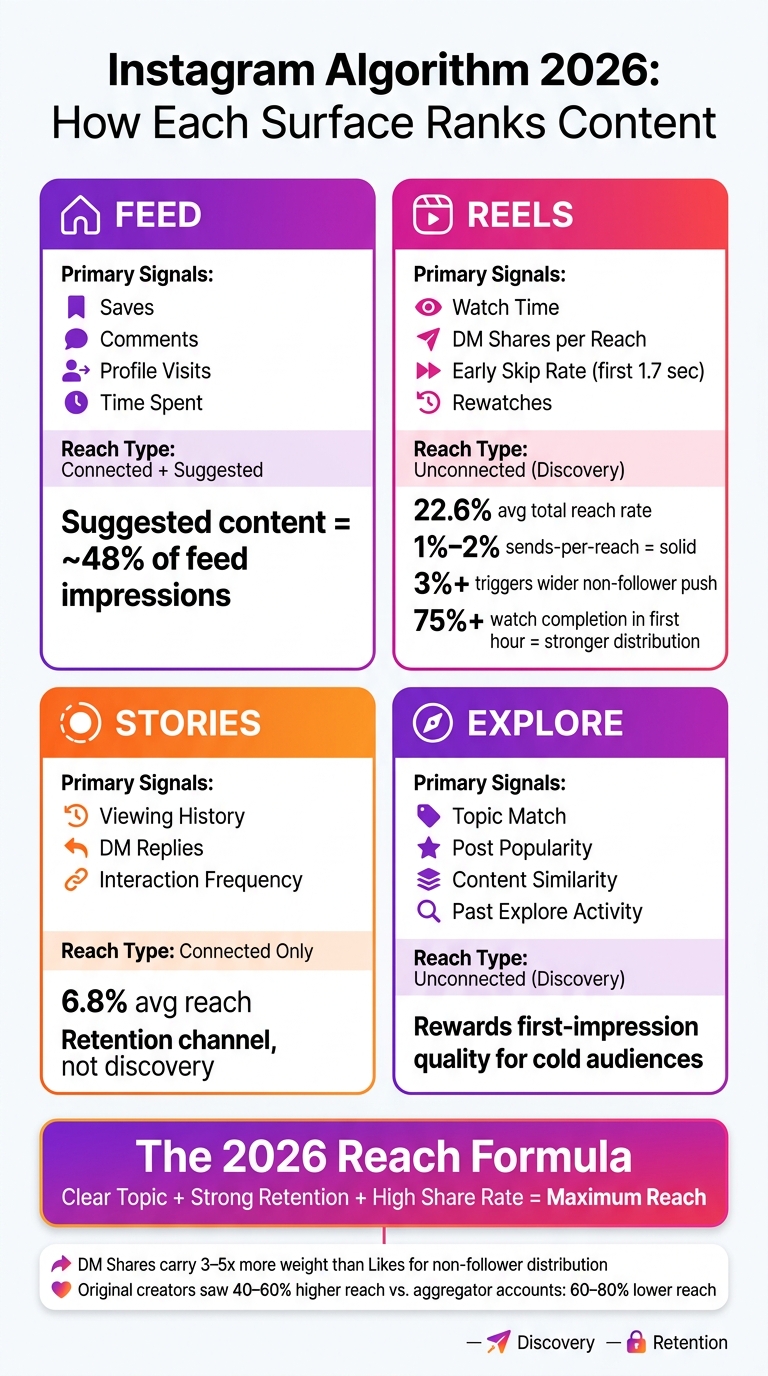
Instagram Algorithm 2026: Key Metrics by Surface
Instagram Algorithm 2026: How It REALLY Works (New Updates Explained)
sbb-itb-3b12fba
Quick comparison
| Surface | What matters most | Main job |
|---|---|---|
| Feed | Saves, comments, profile visits, time spent | Reach followers plus suggested viewers |
| Reels | Watch time, rewatches, sends per reach, low early skips | Reach non-followers |
| Stories | Replies, view history, interaction frequency | Keep current audience engaged |
| Explore | Topic match, popularity, similarity, past interest | Topic-based discovery |
If I’m reading these changes the practical way, the message is simple: clear topic + strong retention + high share rate is now the combo that gives posts the best shot at reach.
What Changed in Feed, Reels, Stories, and Explore
In 2026, each surface rewards a different mix of engagement, retention, and interest signals. Put simply, Instagram no longer treats every format the same. Feed, Reels, Stories, and Explore now play by slightly different rules.
Feed and Home: More Weight on Meaningful Engagement and Recommendations
The Home Feed still leans toward accounts you already follow. But now, saves, comments, profile visits, and time spent on a post carry more weight than likes.
"In feed, the five interactions we look at most closely are how likely you are to spend a few seconds on a post, comment on it, like it, share it, and tap on the profile photo." - Adam Mosseri, Head of Instagram
That shift matters. A like is easy. A save or profile visit usually shows stronger interest.
Feed also pulls in more Suggested Posts from accounts you don't follow. Those posts are ranked based on predicted interest and closeness signals, not just your follower graph. So even if someone has never seen your account before, your post can still land in their Feed if Instagram thinks there's a good match.
Reels: Watch Time, Rewatches, and Early Skip Rate Now Count More
Reels still powers most non-follower discovery. And the ranking system leans hard on retention, DM shares per reach, and what happens in the first 1.7 seconds.
That opening moment is a big deal. If people swipe away fast, distribution can slow down almost immediately. If they stay, rewatch, or share, the Reel has a better shot at reaching people outside your audience.
A DM shares-per-reach ratio above 2% is seen as a strong viral signal. Once it gets above 3%, Instagram will often push that Reel much harder to non-followers.
"Shares are the strongest signal Instagram has ever had. Stronger than watch time, stronger than saves, stronger than engagement rate." - Adam Mosseri, Head of Instagram
Shorter Reels in the 30- to 90-second range tend to work best for discovery. Clips up to 3 minutes can also appear in Explore.
Stories and Explore didn't shift as much, but Instagram made their ranking inputs a lot clearer.
Stories and Explore: Relationship Signals Meet Interest-Based Discovery
Stories leans on closeness. Explore leans on interest.
For Stories, Instagram looks at signals tied to your relationship with the viewer, like viewing history, DM replies, and how often they interact with you. Interactive stickers such as polls, question prompts, and Add Yours can help keep your account near the front of the Stories tray.
Explore works differently. It focuses more on topic match, post popularity, content similarity, and what someone has engaged with in Explore before. So while Stories is about who knows you, Explore is more about who might like this topic.
Use this breakdown to line up each format with the signal it rewards most.
| Surface | Primary Ranking Signals | Reach Type |
|---|---|---|
| Feed | Relationship history, saves, comments, profile visits | Connected + Suggested |
| Reels | Watch time, DM shares per reach, retention | Unconnected (Discovery) |
| Stories | Viewing history, DM replies, interaction frequency | Connected Only |
| Explore | Post popularity, content similarity, past Explore activity | Unconnected (Discovery) |
These ranking changes sit alongside new controls and AI systems that affect reach quality.
New Controls, AI Systems, and Trust Measures in 2026
Instagram changed more than ranking signals in 2026. It also updated user controls, AI classification, and recommendation rules. The big shift is simple: users now have more say over what they see, while Instagram applies stricter filters before content can qualify for discovery.
"Your Algorithm" and User Preference Controls
In June 2026, Instagram expanded its "Your Algorithm" feature to the main Feed after first rolling it out in Reels and Explore. You can find it under Settings → Content Preferences. There, users can view the topics and categories Instagram's AI connects to their interests, add topics they want more of, and remove topics they don't want anymore.
For creators, that changes the game a bit. A tighter niche matters more now. If an account jumps between unrelated topics, it's easier for users to filter it out. So content clarity and topic consistency matter more in this next layer of ranking.
Better AI Understanding of Content, Language, and Context
Instagram now matches content based on meaning, not just tags. It looks at captions, on-screen text, and audio transcripts to understand what a post is about. Hashtags still play a role, but far less than before. Instagram now treats five hashtags as the practical limit, since stuffing in more keywords doesn't do much anymore.
"LLMs can look at clusters of content and describe them in language people understand, which gives Instagram a way to show people what the system thinks they're interested in, and a way for them to tell the system what they actually want." - Adam Mosseri, Head of Instagram
Instagram has also rolled out automatic AI translation for Reels captions and audio. That gives posts in other languages a better shot at surfacing to U.S. audiences, and it works the other way too.
Authenticity and Integrity Updates That Affect Reach Quality
Once Instagram gets better at classifying content, it also gets better at filtering out copied posts. The platform now uses visual fingerprinting to spot reposted content and cut its distribution. Posts with watermarks from other apps or editing tools are also deprioritized.
There's also a stricter recommendation rule in place. Accounts that post 10 or more reposts within a rolling 30-day window are excluded from recommendations, including Explore and Reels. These are eligibility filters, not ranking signals. In plain English: if you pass them, your content can still compete for discovery. If you don't, your reach is much more likely to stay limited to current followers.
The gap is pretty stark:
- Original creators saw 40%–60% higher reach
- Aggregator accounts saw 60%–80% lower reach
The Account Status tool now gives creators a clearer view of whether content has been flagged for recommendation limits. That helps explain those sudden visibility drops that can otherwise feel like they came out of nowhere.
What Early Data Shows About Reach and Engagement
Signals That Appear to Carry More Weight in 2026
The clearest signs of ranking changes show up in reach, not in what platforms say out loud. And right now, three metrics stand out most: shares, retention, and non-follower reach.
DM shares per reach now matter more than likes when it comes to non-follower distribution. In plain English, DM shares (sends per reach) carry about 3 to 5 times more weight than likes for pushing content to people who don’t already follow you. A sends-per-reach rate of 1% to 2% is seen as solid. Once you get above 3%, that’s a strong sign the algorithm may push the post farther.
Saves and meaningful comments matter more now too. Why? Because they hint that the post has staying power, not just a split-second reaction.
Early skip rate is another big one. People make up their minds fast, often in about 1.7 seconds. If too many viewers bail early, distribution can drop off almost at once.
How Performance Patterns Differ by Format
These signals don’t hit every surface the same way. Each format plays a different role.
Reels are still the main source of non-follower reach. Their average total reach rate is 22.6%, far above the 9.6% average for static images. Carousels also keep beating single-image posts. One analysis of more than 4 million posts found that carousels are 23% more likely to be recommended and drive 3.1x higher engagement. Stories average 6.8% reach and work more as a retention channel than a discovery channel.
| Surface | What Matters Most | Reach Role |
|---|---|---|
| Feed | Shares, saves, meaningful engagement | Suggested content now accounts for ~48% of impressions |
| Reels | Sends per reach, completion rate (75%+) | Primary discovery engine; 22.6% avg total reach |
| Stories | DM frequency, closeness, replies | 6.8% reach; retention channel |
| Explore | Watch completion, shares, topic alignment | High volatility; rewards first-impression quality for cold audiences |
Reels that reach 75%+ average watch time in the first hour often get stronger non-follower distribution. That helps explain why two Reels on similar topics can end up with very different results. One holds attention, gets shared, and spreads. The other stalls out early.
How Analytics Tools Help Interpret Algorithm Shifts
Because these patterns move fast, likes and total views don’t tell the whole story anymore. Creators need a closer read on how people interact, not just how many people saw the post.
Tools like Outfame can help track retention curves, send rates, and follower vs. non-follower reach in real time.
Conclusion: Key Takeaways from Instagram's 2026 Updates
In 2026, Instagram works less like a follower-first feed and more like a discovery engine. That means relevance and engagement quality matter just as much as audience size across the app. As a result, topic clarity has become a ranking edge.
"Your Algorithm" gives users more say over what they see. When your topic is clear, Instagram has an easier time placing your content in the right Feed, Reel, or Explore audience. That makes niche consistency more important. Clear topics are easier for Instagram to sort and recommend.
But topic clarity by itself won't drive reach. Retention and shares still do the heavy lifting.
The biggest reach drivers are still watch time and sends per reach. Likes still matter, just not as much.
It's also smarter to read performance in clusters instead of getting hung up on one post that pops off. Look at patterns across multiple posts and over at least two weeks, not just one Reel. Those are the signals that matter as Instagram keeps changing.
If you're tracking performance, focus on watch time, retention, and sends per reach.
FAQs
How can I improve sends per reach?
Focus on content people will want to send to someone else.
That usually means posts with specific tips, niche memes, or clear takeaways that stick in someone’s head for more than five seconds. If a person can read your post and think, “I need to DM this to my friend,” you’re on the right track.
It also helps to make each post easy to paraphrase. The simpler the idea, the easier it is to pass along. Think punchy advice, sharp observations, and lines people can repeat without effort.
Why does that matter so much right now? Because sends are now the strongest signal for reaching new audiences.
What hurts Instagram reach the most in 2026?
The biggest reach killers in 2026 are watermarked content, recycled posts, engagement bait, and low-quality visuals. Instagram’s algorithm directly penalizes these practices, which can cut your content distribution in a big way.
How do I know which Instagram surface to prioritize?
Pick your format based on who you want to reach.
For people who already follow you, put more effort into Feed and Stories. Those surfaces lean more on relationship signals and connected reach.
If your goal is to get in front of new people, focus on Reels and Explore. Reels is the main discovery engine. Explore can also help your content spread when it gets strong early saves and shares.


