
Feedback-driven content strategies use audience interactions - comments, DMs, watch time, saves, and shares - to shape content that resonates. By analyzing explicit feedback (what people say directly) and behavioral feedback (how they interact), creators can refine topics, formats, and posting schedules for better performance. This approach is especially effective on platforms like Instagram and TikTok, where algorithms favor engaging content.
Key Takeaways:
- Feedback Types: Explicit (comments, polls) vs. Behavioral (watch time, saves).
- Top Metrics: TikTok prioritizes completion rates (65%+ is ideal), while Instagram values saves and DM shares.
- Actionable Insights: Use polls, Q&As, and AI tools to collect feedback. Analyze patterns to adjust hooks, pacing, or formats.
- Results: Creators using feedback see 22% more engagement and 34% higher audience retention.
The guide emphasizes testing small changes, like hooks or video length, and using tools like Outfame for streamlined analytics. A structured feedback system ensures consistent improvement and stronger audience connections.
How to Handle Feedback as a Content Creator (Beginner Guide)
Understanding Feedback on Instagram and TikTok
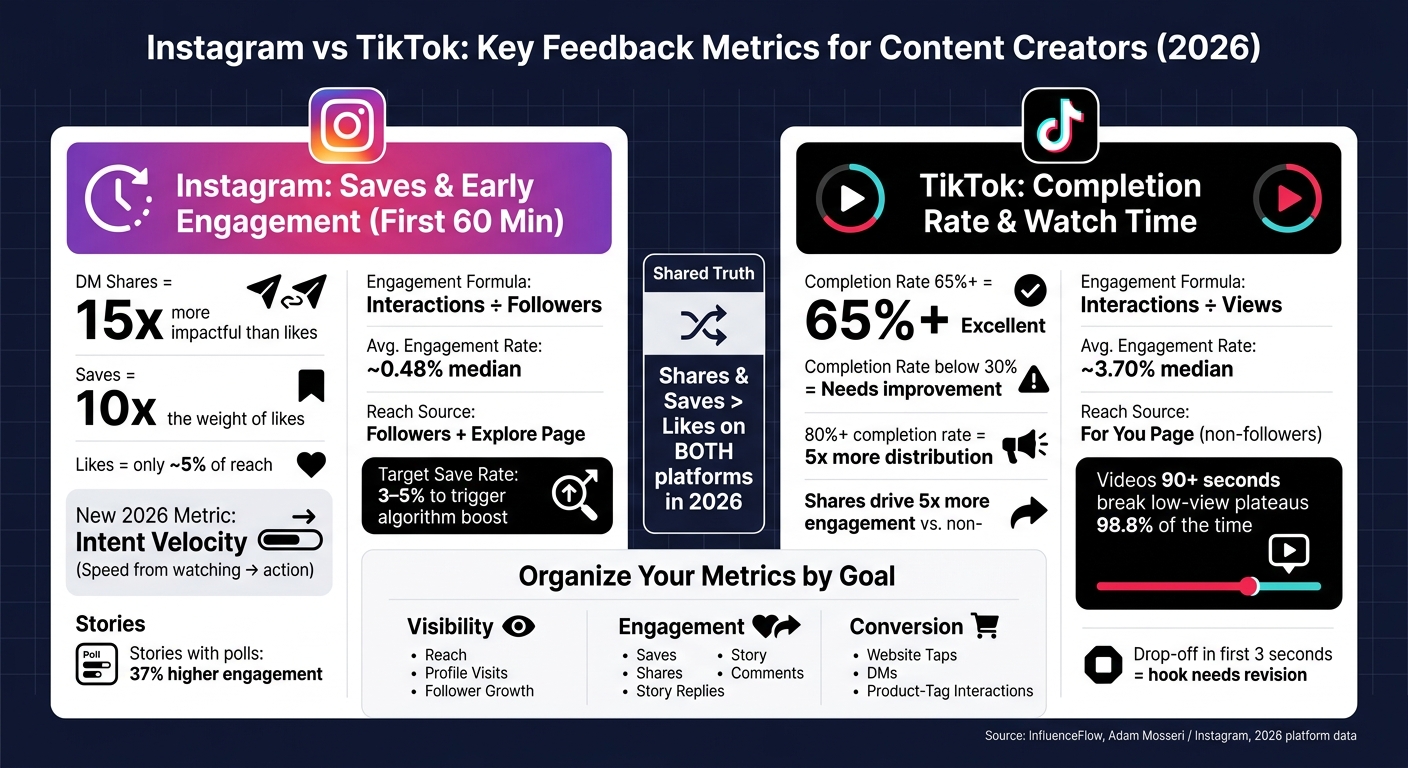
Instagram vs TikTok: Key Feedback Metrics for Content Creators (2026)
Feedback signals aren't all created equal. Both Instagram and TikTok have their own systems for rewarding content, and understanding these differences can help you focus on the metrics that truly matter.
Key Feedback Metrics for Instagram
On Instagram, purposeful engagement is king. The algorithm places more importance on actions that show deliberate interest rather than passive scrolling. Metrics like saves, shares, profile visits, and website taps carry significantly more weight than likes.
In fact, as of 2026, DM shares are about 15x more impactful than likes, while saves carry 10x the weight. Meanwhile, likes contribute to only about 5% of your reach. This marks a big shift in how creators need to think about engagement.
Here are a few Instagram metrics worth paying attention to:
- Saves: These indicate long-term value. Tutorials, checklists, and how-to posts often perform well here.
- Story exits: A spike in exits on a specific frame can signal issues like too much text, overly salesy content, or a confusing message.
- Profile visits: These show curiosity - people are interested enough to want to learn more about you.
Instagram also introduced a new metric in 2026 called "Intent Velocity", which measures how quickly someone moves from watching to taking an action, like saving or sharing. A high velocity tells the algorithm your content is resonating.
"Shares carry more weight than ever. Instagram has confirmed that sends and shares are now among the most important ranking signals across all surfaces." - Adam Mosseri, Head of Instagram
TikTok, on the other hand, has its own unique way of measuring engagement and reach.
Key Feedback Metrics for TikTok
TikTok's algorithm is all about testing your content with new viewers. The main question it asks: Did people watch?
The most important signals here are watch time and completion rate. A completion rate of 65% or higher is excellent, while anything below 30% often points to a need for improvement. Videos with an 80%+ completion rate get 5x more distribution. If viewers drop off in the first three seconds, it’s a sign your hook needs work.
Beyond completion rates, shares are TikTok’s most valuable signal, driving 5x more engagement compared to content that isn’t shared. While comments and rewatches also matter, shares show that viewers found your content worth recommending.
| Metric | What It Tells You |
|---|---|
| Completion Rate | Whether your content keeps attention start to finish |
| Rewatches | Whether your content is engaging enough to revisit |
| Shares | Whether viewers feel it’s worth recommending to others |
| Comments | Whether the content sparks questions or conversation |
How to Group Audience Feedback
Metrics can be overwhelming, so organizing them by business goals can make analysis more actionable. A simple three-bucket framework works well:
- Visibility: Metrics like reach, profile visits, and follower growth.
- Engagement: Actions like saves, shares, story replies, and comments.
- Conversion: High-value actions like website taps, DMs, and product-tag interactions.
Hasan Cagli of PostPlanify suggests this approach to simplify your analytics:
"The useful shift is simple. Stop reading Instagram analytics like a scoreboard. Start reading them like behavior signals."
In addition to grouping by goals, it’s helpful to segment by intent level. For example, likes are low-intent, while saves and story replies show higher intent. DMs are the highest-intent signal, representing someone who wants a direct conversation. Treating repeat engagers - those who interact with your content three or more times in 30 days - as a high-value audience can provide better insights for refining your strategy and testing early launches.
These groupings lay the groundwork for smarter content decisions, which we’ll explore in more detail in the next sections.
How to Collect Feedback for Your Content Strategy
Now that you understand which metrics matter, the next step is creating a reliable system to gather feedback. To get the full picture, combine explicit feedback (direct responses) with behavioral feedback (interaction patterns).
Using Built-In Platform Features to Gather Feedback
Instagram Stories offer a surprisingly effective way to collect audience feedback. With around 500 million people engaging with Stories every day, the built-in stickers provide an easy way to tap into your audience’s preferences.
The trick? Pair the right sticker with the right goal:
| Sticker | Best For | Effort Required |
|---|---|---|
| Poll | Quick A/B decisions (e.g., "Topic A or B?") | Very low |
| Question | Gathering ideas, pain points, or AMAs | Higher |
| Quiz | Audience segmentation or education | Low |
| Emoji Slider | Measuring excitement or sentiment | Very low |
Start with a Question sticker to gather input, then create content based on those responses, and finish with a Poll to measure how well it resonated. This approach transforms passive viewers into active participants.
"A static story is just a billboard. An interactive sticker turns a story into a two-way conversation." - ViewIGStory
On TikTok, the Q&A feature works particularly well for Gen Z (ages 16–24), who favor real-time feedback formats. Hosting a live session on Instagram or TikTok is another way to test ideas and get immediate audience reactions before fully committing to a concept.
Here’s a stat to keep in mind: Stories with polls see 37% higher engagement than those without. That makes interactive stickers an easy choice for any feedback-driven strategy.
And don’t stop at stickers - take time to review audience messages and comments for additional insights.
Reviewing Comments, DMs, and Story Interactions
Your comments section and DMs are treasure troves of feedback - if you know how to look. Instead of casually browsing, focus on identifying patterns.
Set aside time each week to review comments on recent posts, flagging recurring questions, complaints, or phrases. If multiple people are asking the same thing, you’ve just found a topic worth exploring in future content.
DMs are especially valuable because they reflect private, detailed engagement. Research shows 56% of customers prefer messaging a business via DM rather than calling or emailing. Plus, DM surveys often achieve 30–50% higher response rates than email surveys. A short, targeted survey (5–7 questions) sent via DM can yield honest, actionable feedback.
Story interactions, like replies or emoji reactions, also offer clues. A surge in replies to a specific Story slide often signals that the topic resonated. Track these moments and build on them.
When the sheer volume of feedback becomes overwhelming, automation tools can help.
Using AI Tools to Automate Feedback Collection
As your audience grows, manually reviewing every comment, DM, and mention becomes impractical. AI tools can handle the heavy lifting, letting you focus on what really matters: applying the insights.
Platforms like Outfame provide real-time analytics and audience targeting, turning raw feedback into actionable data. With its live performance dashboard, you can spot opportunities or issues as they happen, rather than waiting for a weekly review. For creators managing both Instagram and TikTok, this kind of continuous monitoring simplifies feedback collection.
For managing comments and DMs at scale, tools that use official platform APIs (not unauthorized bots) can automatically respond to keywords, flag important feedback, and sync interactions with a CRM for deeper analysis. For example, in early 2026, Capital University adopted Sprinklr’s social listening platform to centralize Instagram interactions. Within two months, they saw an 8.23% increase in post engagement and a 2.04% follower growth, thanks to more informed scheduling decisions based on real-time audience behavior.
Automation doesn’t replace your judgment - it simply makes feedback collection easier to manage.
How to Analyze Feedback for Content Decisions
Once you've gathered feedback, the real work begins: analyzing it in a way that helps you make smarter content decisions.
Finding Patterns and Setting Priorities
Don't get caught up in addressing every single comment or direct message as a standalone issue. Instead, look for recurring themes. For example, if you notice comments like "this felt rushed" or "I had to rewatch this twice", both point to a pacing problem.
Organize feedback by tagging it with categories like topic, pain point, or format. This helps you spot trends more easily. Once you've identified these patterns, rank them based on their frequency, intensity, and how much they align with your business goals. Focus on the areas that score the highest.
"A sustainable system treats feedback as evidence, not instruction. The difference is subtle but important: evidence shapes priorities, while instructions can send you into endless one-off fulfillment." - Jordan Avery, Senior Content Strategist, Beneficial.site
With clear patterns in hand, you can make targeted adjustments to your content.
Turning Metrics Into Actionable Content Changes
Sometimes, actions speak louder than words - especially when it comes to behavioral metrics. These numbers provide some of the most honest feedback because they reflect what your audience actually does, not just what they say. Use these signals to guide specific content tweaks:
| Signal | Action |
|---|---|
| Drop-off at 3–5 seconds | Revise the hook |
| High saves, low shares | Add a strong opinion or an easy-to-share list |
| High reach, low saves | Dive deeper into the topic in a follow-up post |
| Comments showing confusion | Simplify the first on-screen text or caption |
DM shares and saves are especially valuable indicators of what resonates with your audience and can significantly boost your reach.
Balancing Quick Fixes and Long-Term Changes
Not all feedback requires the same urgency. Some issues - like a confusing caption, a broken link, or a weak hook - can and should be addressed quickly. Others, such as revamping your content strategy or adjusting your posting schedule, need more time and data to evaluate.
| Quick Fixes (Reactive) | Strategic Shifts (Proactive) | |
|---|---|---|
| Timeline | 1–7 days | 30–90 days |
| Examples | Hook edits, pacing cuts, caption rewrites | Changing editorial pillars, launching a new format series |
| Pros | Immediate engagement boost; shows you're responsive | Supports long-term growth; avoids burnout from chasing trends |
| Cons | Risks overreacting to isolated opinions | Requires patience and more data to validate |
A practical tip: test one variable at a time. If a post doesn't perform well, don't overhaul everything. Start by tweaking just the hook or trimming the intro, then measure the results. This approach helps you pinpoint what actually works.
Creators who adopt a structured feedback system tend to see 22% higher engagement on average compared to those who create content without audience input. By analyzing feedback effectively, you can close the loop and consistently deliver content that connects with your audience.
Adding Feedback-Driven Strategies to Your Workflow
Building a Feedback-Driven Content Cycle
Understanding feedback is just the beginning. The real challenge lies in creating a system that turns these insights into action.
One approach to try is the 30-Day Content Sprint. Here's how it works: dedicate the first two weeks to posting different content formats, use the third week to analyze the data and identify what resonated most with your audience, and spend the final week refining and recreating those top-performing formats. This method ensures your content evolves based on actual audience preferences, not just guesses.
To make this process seamless, follow a simple five-step cycle: Collect → Analyze → Prioritize → Test → Refine. Assign each step a dedicated time slot in your calendar. For example, spend 30 minutes every Monday reviewing last week’s metrics, identifying patterns, and planning what to test next. Over time, this habit pays off - creators who actively use feedback strategies report 34% higher audience retention compared to those who don't. Tools like Outfame's analytics and AI-driven insights can make it easier to incorporate audience feedback into your weekly routine.
"A modern feedback system is far more than a comment section. It means combining multiple input channels into one cohesive operation." - InfluenceFlow
Another key step? Close the loop with your audience. When you make a change based on their feedback - like adding captions or tweaking your video intros - let them know. A simple message like, "You asked for this, so we made it happen", builds trust and encourages more engagement.
Once your system is in place, it's time to focus on testing and refining your content.
Testing and Refining Content Based on Feedback
When experimenting with content, the biggest mistake is trying to change too many things at once. If a post doesn’t perform well, it’s tempting to tweak the hook, format, and caption all at the same time. But doing so makes it impossible to pinpoint what actually worked - or didn’t.
Instead, stick to changing one variable per test. This could be the hook style, video length, posting time, or visual format. Keeping everything else consistent ensures your results are easy to interpret and directly tied to the feedback you’ve received .
"Testing beats guessing: A Reels testing system means running small controlled experiments instead of posting random content and hoping." - Vytas, Founder, CreatorFlow
If you’re on Instagram, take advantage of the Trial Reels feature. It allows you to test new formats with non-followers, so you can gather performance data without affecting your main audience or cluttering your grid. For those using paid promotion, a modest budget of $10–$20 per day over seven days can help you determine if an organic hit has the potential to perform on a larger scale.
For quicker iterations, try the 10-Day Testing Loop. Devote 3–4 days to planning and creating content, another 3–4 days to collect data, and reserve the final day to analyze results and decide on your next move. This tighter cycle is especially useful when you need to adapt quickly.
Adjusting Content Formats Based on Feedback
After testing, use your audience’s feedback to fine-tune your content formats. Adjust elements like pacing, tone, hooks, or visual style, but make sure these changes align with your brand identity.
A helpful strategy is the "One Problem, Three Formats" method. Take a common audience challenge and create three short-form videos addressing it in different styles. For example, you might try a talking-head story, a POV micro-habit clip, and an in-the-moment take. Post them at the same time each day and track which format gets the most saves and shares. This not only shows you what topics resonate but also how your audience prefers to consume content.
Pay special attention to your hook. Reels with a storytelling hook in the first three seconds are 72% more likely to achieve viral reach. If your retention data shows viewers dropping off early, try a "Proof Drop" hook - start with a quantifiable result or a compelling visual to grab attention immediately. On TikTok, videos over 90 seconds tend to break free from low-view plateaus 98.8% of the time, so if your audience is asking for more depth, consider leaning into longer formats.
Lastly, avoid directly cross-posting the same video between TikTok and Instagram. Content shared this way performs 32% worse on Instagram than native content. Adapt your style for each platform: polished and curated for Instagram, raw and spontaneous for TikTok. Even if the core message stays the same, tailoring your approach can make all the difference.
Measuring the Results of Feedback-Driven Strategies
Defining Success Metrics for Instagram and TikTok
By 2026, the metrics that matter most on Instagram and TikTok have shifted. High-intent signals like saves, shares, and watch time now far outweigh vanity metrics such as likes and follower counts. While these older metrics might look good on paper, they don’t necessarily drive meaningful growth. For Instagram, the algorithm favors saves and early engagement - especially within the first hour of posting. Over on TikTok, completion rate and watch time take center stage, with a strong completion rate considered to be 65% or higher.
"In 2026, completion rate has become the most important metric, replacing follower count as the primary algorithm signal." - InfluenceFlow
Two additional metrics provide deeper insight into performance. The follower conversion rate - calculated as new followers divided by total reach, multiplied by 100 - helps measure how well your content turns impressions into long-term interest. Meanwhile, on Instagram, a 3–5% save rate can trigger the algorithm to boost your content further.
It’s also worth noting how the platforms define engagement differently. Instagram calculates engagement as interactions divided by followers, while TikTok uses interactions divided by views. This reflects TikTok’s focus on surfacing content to non-followers.
| Metric | Instagram Focus | TikTok Focus |
|---|---|---|
| Primary Signal | Saves and early engagement | Completion rate and watch time |
| Engagement Formula | Interactions/Followers | Interactions/Views |
| Avg. Engagement Rate | ~0.48% median | ~3.70% median |
| Reach Source | Followers + Explore Page | For You Page (non-followers) |
To succeed, tracking these metrics consistently is essential, and dashboards can make this process seamless.
Setting Up Dashboards for Ongoing Tracking
While native analytics tools provide basic insights, third-party platforms like Outfame offer a more robust solution. These tools centralize data, enable historical tracking, and provide real-time updates. According to 64% of creators, such dashboards improve decision-making. By consolidating metrics for Instagram and TikTok, you can easily monitor high-intent signals and adjust your approach based on audience behavior. Outfame’s 24/7 tracking ensures you’re always up-to-date without needing to juggle multiple tools.
To stay on top of your strategy, consider a structured review schedule:
- Daily (5 minutes): Quick pulse check on performance.
- Weekly (30 minutes): Analyze trends and patterns.
- Monthly (90 minutes): Deep dive into strategy adjustments.
As Catherine Sullivan, Founder of Dizzy Bee Marketing, puts it:
"Content doesn't work because you constantly come up with new ideas. It works because you have a clearer way to decide what to post in the first place." - Catherine Sullivan
Common Mistakes to Avoid in Feedback-Driven Strategies
Even with the best tools and metrics, it’s easy to make mistakes. One common pitfall is overreacting to isolated data points. Instead of adjusting your strategy based on a single day’s performance, look for trends over 48–72 hours to identify real issues. Another mistake is chasing trending formats at the expense of staying true to your brand. On Instagram, DM shares carry 3–5 times more algorithmic weight than likes in 2026. This type of engagement often comes from content that feels genuine and aligns with your established voice.
"Tracking likes in 2026 is like tracking MySpace friends in 2010. The platforms moved on, and creators who track the new signals... recover faster." - Nathan Cole, Senior Tools Reviewer, Creator Tribune
Lastly, avoid comparing metrics across unrelated periods or content types. For instance, comparing January to February without accounting for seasonal trends - or using B2C benchmarks for B2B content - can lead to misleading conclusions. Instead, focus on relevant comparisons to get a clearer picture of what’s working.
Conclusion and Next Steps
Key Takeaways
A feedback-driven strategy is a continuous process - it’s not something you can set and forget. One of the biggest shifts heading into 2026 is that reach is no longer tied to follower count. Instead, it’s all about behavioral signals. Metrics like shares, saves, and watch time now carry far more weight than passive indicators like likes. If your strategy still leans on passive engagement, you’re likely missing out. And beware of cross-posting without adjustments - research shows TikTok content reposted directly to Instagram performs 32% worse.
Adam Mosseri, Head of Instagram, summed it up perfectly:
"Instagram used to be driven mostly by your social graph - the accounts you follow. Now it's increasingly driven by an interest graph - what you watch, engage with, and spend time on."
Another crucial element? Testing one variable at a time. Whether it’s the hook, video length, or format, isolating changes ensures you’re making decisions based on solid data. These insights are only useful if they’re put into action, which leads us to the next steps.
Next Steps for Creators and Brands
With these takeaways in mind, here’s how creators and brands can take action right now. These steps complete the feedback loop and help refine your strategy.
Start with a 30-day content sprint. Over the first two weeks, experiment with different hooks, formats, and video lengths. By week three, analyze which posts performed best based on shares and saves. In week four, focus on doubling down on what worked. Before posting, ask yourself: "Would someone share this with a friend?" If the answer is no, go back to the drawing board.
Use Instagram’s Trial Reels feature to test new content with non-followers before committing to a full rollout. This allows you to gather valuable audience feedback without risking your current engagement metrics. Also, take a moment to review your last 12 posts. Do they align with 2–3 core content pillars? The algorithm favors accounts with consistent topics. And don’t underestimate the power of engagement - responding to comments within the first 60 minutes can significantly boost your content’s visibility.
For ongoing growth and tracking, tools like Outfame can simplify the process. It offers real-time analytics and automated audience targeting tailored specifically for Instagram and TikTok. This means you can act on feedback faster without juggling multiple dashboards.
FAQs
Which feedback signals matter most on Instagram vs. TikTok?
On Instagram, some of the most important feedback signals are saves, shares through direct messages, and meaningful comments. These interactions show that your audience finds your content engaging and worthwhile. Over on TikTok, the algorithm focuses heavily on metrics like completion rate, watch time, and rewatches. Plus, when users quickly share your TikToks outside the platform, it can significantly boost your reach. To stay on top of these metrics and fine-tune your approach, tools like Outfame can provide real-time tracking and insights.
How can I turn retention drops into actionable content improvements?
When diving into Instagram Insights, retention curves and play-to-half percentages offer valuable clues about how your audience interacts with your content. If you notice consistent drops in engagement, focus on testing creative hooks and overall structure rather than tweaking schedules or hashtags.
- Low 3-second retention: This often signals that your hook isn't grabbing attention fast enough. Work on delivering immediate value or intrigue right at the start.
- Low completion rates: If viewers aren't sticking around until the end, take a closer look at the flow of your content. For carousels, ensure each slide builds on the previous one. For videos, check the pacing and make sure every moment fulfills the promise you made at the beginning.
For real-time insights and precise adjustments, tools like Outfame can help you track engagement trends effectively.
How often should I review feedback without overreacting?
To keep a level head and avoid overreacting, it helps to set up a clear schedule for reviewing feedback. Spend about 30 minutes each week organizing and tagging new input, and take time once a month to review everything more thoroughly. This way, you can spot patterns and adjust your approach strategically. Remember, feedback should guide your priorities - not act as a to-do list. For a steady flow of insights, tools like Outfame offer real-time analytics, making it easier to track and understand audience reactions.


