
In 2026, Instagram and TikTok are dominating the social media landscape with billions of users and rapidly evolving features like Instagram Reels and TikTok’s direct commerce tools. To stay ahead, brands and creators are turning to competitor analysis tools to monitor rivals’ strategies, improve engagement, and optimize content. These tools provide insights into posting habits, engagement rates, and trending content, giving users a data-driven edge over the competition.
Key Takeaways:
- Instagram engagement has surged by 67%, driven by Reels, while TikTok is reshaping e-commerce.
- Competitor analysis tools help track metrics like engagement rate (4–6% is a strong benchmark), audience growth, and posting trends.
- Tools like Outfame offer AI-powered analytics starting at $39/month, making them accessible to creators and businesses of all sizes.
How to Get Started:
- Identify 5–15 competitors (direct, indirect, and aspirational accounts) using hashtags or platform suggestions.
- Track key metrics over 30–90 days for meaningful insights.
- Use competitor data to refine your posting schedule, content formats, and engagement strategies.
Competitor analysis isn’t just about tracking - it’s about turning insights into action for measurable growth. Tools like Outfame, Rival IQ, and Social Status offer tailored solutions to help you stay competitive in 2026.
How To Make A Social Media Competitor Analysis 🔍 [+ FREE TEMPLATE]
Top Instagram and TikTok Competitor Analysis Tools for 2026
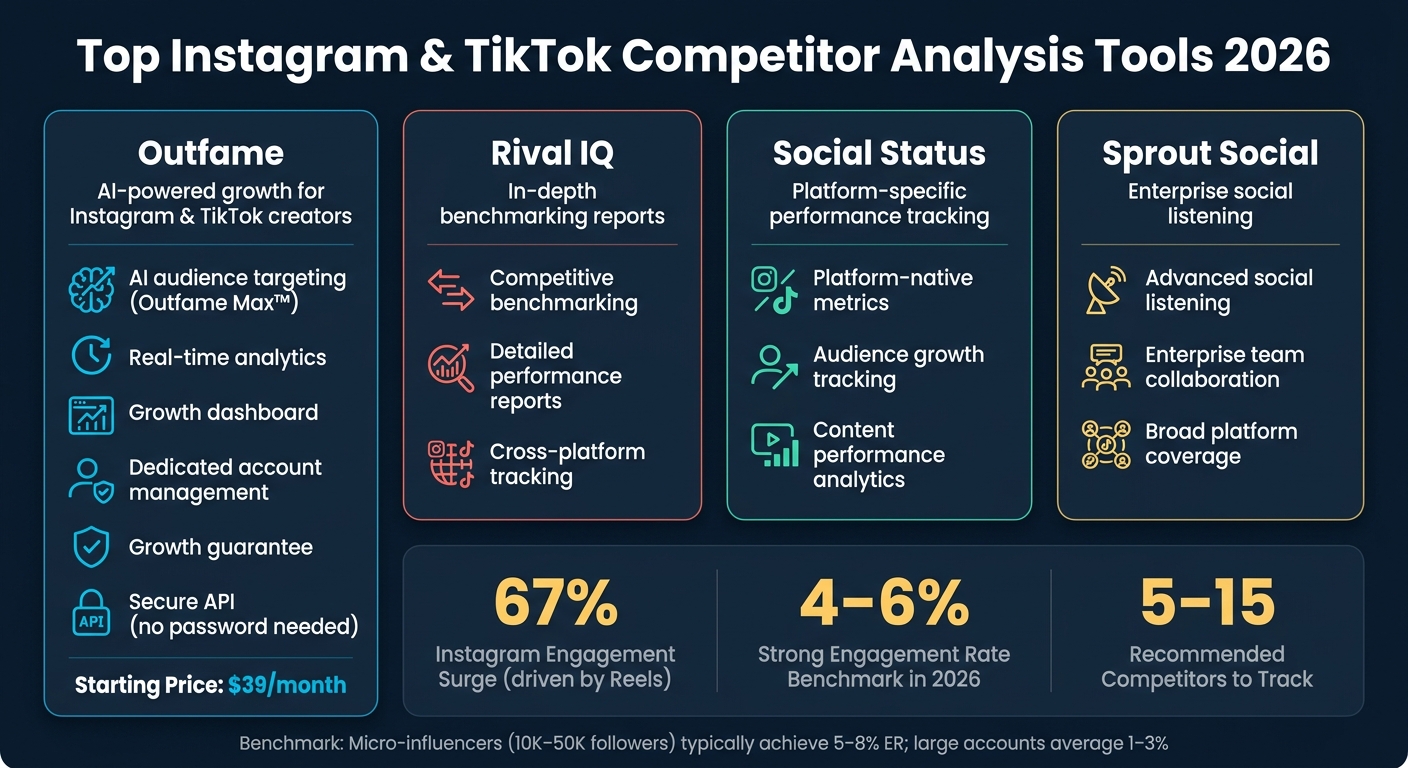
Top Instagram & TikTok Competitor Analysis Tools 2026: Feature & Pricing Comparison
Looking for a standout tool to analyze Instagram and TikTok competitors in 2026? Outfame is leading the pack, offering creators and brands a smart, AI-powered solution tailored for these platforms.
Outfame
Outfame is designed specifically for Instagram and TikTok, using AI to deliver real-time analytics and automated audience targeting. Its Outfame Max™ AI takes the reins by identifying and engaging with your target audience, all through a secure API connection - no account passwords required.
Key features include:
- A growth dashboard for continuous performance tracking.
- Dedicated account management and live chat support.
- Plans starting at $39/month, all with a growth guarantee.
With these tools, Outfame helps you turn competitor insights into actionable strategies, giving you everything you need to stay ahead in the game. Ready to dive deeper? Stay tuned for the next steps to build your winning content strategy.
How to Get the Most Out of Competitor Analysis Tools
Building Your Competitor List
Start by organizing your competitors into three categories: direct rivals, indirect rivals, and aspirational accounts. Aim to track 5–15 accounts total. You can identify these competitors by searching relevant hashtags on platforms like Instagram and TikTok, checking Instagram's "Similar Accounts" suggestions, or observing which accounts frequently pop up in your target audience's feeds. Keeping the list focused ensures your tracking stays manageable and the insights you gather remain actionable.
Setting Up Tools and Choosing Metrics to Track
Once you've added competitor profiles to your tools, set a tracking window of 30–90 days. This timeframe helps smooth out any anomalies and gives you a clearer picture of trends. Focus on tracking metrics that provide meaningful insights rather than overwhelming yourself with too much data. Here are some key metrics to monitor:
| Metric | What It Measures |
|---|---|
| Engagement Rate (ER) | (Likes + Comments + Shares + Saves) ÷ Followers × 100 |
| Video Completion Rate | Percentage of viewers who watched the full video |
| Reel Share | (Number of Reels ÷ Total Posts) × 100 |
| Audience Growth Rate | Percentage of new followers gained over 30–90 days |
| Hook Rate | Views in the first 2–3 seconds ÷ Total Views |
For context, a solid ER benchmark in 2026 is between 4–6%, with anything above 7% being exceptional. Micro-influencers (10K–50K followers) often hit ERs in the 5–8% range, while larger accounts typically land around 1–3%.
Reading Reports to Find Useful Patterns
After gathering your data, focus on analyzing reports for patterns and trends. Use medians instead of averages to avoid skewed data from viral posts.
Look beyond the numbers to understand why certain spikes in engagement or follower growth occurred. For example, a sudden surge could be tied to a viral Reel, a paid campaign, or even seasonal content. Identifying the cause helps you replicate their success in a meaningful way, rather than just copying surface-level tactics.
As Zaria Parvez, Senior Global Social Media Manager at Duolingo, explains:
"We've really seen that that is actually where some of the rawest creativity lives… And the best ideas usually start where the chaos lives. And that tends to be the comment section."
Dive into competitor comment sections to uncover recurring questions, feedback, or complaints. These often highlight gaps in their strategy - opportunities you can address to stand out with your own content.
Turning Competitor Data into Action
Now that you’ve set up competitor tracking, it’s time to put those insights to work. Competitor data should directly inform your strategy, helping you pinpoint content themes and tactics that can deliver real results.
Spotting High-Performing Content Themes and Formats
Focus on identifying posts that stand out - those that perform far better than average. As Shivank Goura, Co-founder and CEO of Octupie, explains:
"Popular posts on a large account tell you almost nothing useful... The signal is not the raw number. It is the ratio of performance to baseline."
Once you've spotted these outliers, break them down. Look at their structure: the hook, the setup, the payoff, and the call-to-action. These elements can guide your own content creation. Also, keep an eye on the save-to-like ratio - a higher ratio often indicates content with long-term or educational value. Don’t stop there. Look for gaps in your competitors’ content. Are there topics they’re ignoring? These gaps could be your opportunity to cover untapped subjects and stand out.
Refining Your Posting Schedule and Frequency
Competitor data isn’t just about what to post - it can also guide when to post. Use heatmaps from analytics tools to find the best times to post when competition is lower. Posting frequency is another key insight. For example:
- Reels: Perform well with 3–5 posts per week.
- TikTok videos: Often thrive with 3–7 posts per week.
- Stories: Benefit from daily updates, especially with interactive features like polls or stickers.
Make sure you’re benchmarking against accounts with a similar follower count. A micro-influencer’s posting rhythm will differ significantly from a large brand with millions of followers.
Testing and Adjusting Your Strategy Over Time
Armed with these insights, start testing. Use hypothesis-driven experiments to refine your approach. For instance, if competitors are succeeding with educational Reels, you might test: "Publishing 3 educational Reels weekly for 4 weeks will raise our engagement rate by 25%." Track your results and adjust accordingly.
To keep this process manageable, establish a weekly routine. At the start of the week, review your competitors’ activity. Midweek, analyze organic content trends. By the end of the week, brief your creative team with clear directions.
"The goal isn't a one-off static report gathering dust... It's transforming insights into concrete changes in your social media strategy." - Bogna Raszowska, Junior Content Specialist, Sotrender
Over time, this cycle of observation, testing, and refinement builds momentum. Small, data-driven tweaks - like adjusting posting times or experimenting with new hook formats - can lead to steady and meaningful growth.
Conclusion and Key Takeaways
Turning insights into action is only part of the equation. To truly succeed, you need to grasp how consistent competitor analysis can shape your Instagram and TikTok strategies over time.
Each tool we explored offers something different. Rival IQ excels in delivering in-depth benchmarking reports. Social Status focuses on tracking platform-specific performance. Sprout Social is ideal for enterprise teams needing advanced social listening. And Outfame stands out with its AI-driven growth monitoring tailored for Instagram and TikTok creators. The best tool for you ultimately depends on your specific goals, team size, and budget - not just the number of features.
Data-driven strategies give brands a measurable edge. The gap between those who leverage competitive intelligence and those who don’t is both clear and impactful.
"Competitor analysis transforms your Instagram strategy from 'let's try this and see' to 'we know this works because the data says so.'" - Shortimize
A key takeaway here is the need for regular review and adjustment. This cycle ensures your strategy stays relevant and effective in the fast-changing world of social media.
It’s time to move beyond vanity metrics like follower counts. Focus on meaningful signals - saves, shares, and engagement rates - that truly reflect content performance. This shift in focus, combined with consistent competitor tracking, lays the foundation for a repeatable and scalable growth system for Instagram and TikTok success in 2026.
FAQs
How do I choose the right competitors to track on Instagram and TikTok?
To identify competitors, categorize them into four groups:
- Direct competitors: Businesses offering the same products or services as you.
- Indirect competitors: Accounts sharing similar themes or content but not directly competing.
- Aspirational competitors: Leading brands outside your niche that inspire or set a benchmark.
- Emerging competitors: New players gaining traction quickly in your space.
Track between 5 and 10 profiles by exploring niche hashtags, relevant industry keywords, or standout posts. Focus on accounts that align with your growth objectives rather than trying to monitor every competitor in your industry.
Which metrics matter most for competitor analysis in 2026?
To analyze competitors effectively, it's crucial to tailor your approach to the platform you're evaluating. Here's how to break it down:
Instagram Metrics to Watch
- Engagement Rate: Calculate this by dividing likes, comments, saves, and shares by the total number of followers.
- Save Rates: Track how often users save posts, as it signals high-value content.
- Follower Growth: Monitor how quickly competitors are gaining followers over time.
- Posting Frequency: Note how often they post and whether they maintain consistency.
- Content Mix: Pay attention to the balance between Reels and other formats like carousels or static posts.
TikTok Metrics to Prioritize
- Completion Rates: Measure how often viewers watch videos all the way through.
- Watch Time: Longer watch times often indicate more engaging content.
- Posting Cadence: Observe how frequently competitors are posting and whether they stick to a pattern.
- Hashtag Usage: Analyze the hashtags they use and how those impact their reach.
- Feature Performance: Look at how well interactive features like Duets and Stitches perform for them.
For both platforms, use a 30-to-90-day window to gather enough data for reliable benchmarks. This timeframe ensures you're not basing conclusions on short-term anomalies.
How can I turn competitor insights into a better content plan?
Creating a solid content plan starts with spotting patterns in your competitors' strategies. Take a close look at their high-performing posts - what makes them work? Pay attention to the hooks they use, how they structure their content, and the types of calls-to-action that drive engagement.
Start by building a detailed inventory of your competitors' content. Tag each piece by format, theme, and hook to uncover trends and repeatable tactics. Once you’ve gathered this data, use it to create a "Stop-Start-Continue" list. This list helps you identify what you should stop doing, new approaches to try, and successful tactics to keep.
Don’t stop there - look for content gaps. These are topics or formats your competitors are missing. Filling these gaps can help you stand out and connect with untapped audiences, giving you an edge in the crowded content landscape.


