
Analyzing competitor audience demographics helps you understand who your competitors are reaching and how you can target similar or overlooked groups. By focusing on metrics like age, gender, location, and interests, you can refine your content and marketing strategies to better connect with your ideal audience. Here’s a quick breakdown:
- Identify Competitors: Focus on direct competitors in your niche with similar audience sizes. Use tools like Instagram’s “Similar Accounts” or TikTok’s “Similar Profiles” to build a list.
- Analyze Demographics: Key metrics include:
- Age & Gender: Tailor content style based on dominant age groups.
- Location: Use geographic data for targeted campaigns.
- Interests: Look at related brands and engagement behaviors.
- Behavioral Signals: Prioritize saves and shares over likes.
- Compare Data: Create a side-by-side comparison of competitors to spot trends, gaps, and opportunities.
- Apply Insights: Use the data to adjust your content strategy and audience targeting for better engagement and conversions.
Tools like Instagram Insights, TikTok Analytics, and platforms like Outfame can simplify this process. Focus on analyzing authentic engagement, not just follower counts, to make informed decisions that drive growth.
How to do a social media competitor analysis [FREE TEMPLATE!]
Define Your Competitor Set
Before diving into audience analysis, you need a clear understanding of who your competitors are. Without a defined list, you'll waste time and gather skewed insights.
Identify Direct Competitors
Direct competitors are brands or creators working in the same niche, with a similar audience size, and active on the same platforms as you. For instance, if you manage a sustainable skincare brand on Instagram, your direct competitors are other sustainable skincare accounts - not every beauty brand on the platform.
To identify them, use hashtag and keyword research (like #veganskincare or #sustainablebeauty) to spot frequently featured accounts. Instagram's "Similar Accounts" suggestions in the Explore tab or TikTok's "Similar Profiles" feature can also surface potential competitors.
Aim to compile a list of 10–20 potential rivals, then refine it to 5–15 that align with your follower count and content style. Avoid comparing yourself to accounts with millions of followers if you're just starting out - this sets unrealistic benchmarks.
Once you have your list, ensure these competitors are engaging the audience you want to reach.
Focus on Audience Overlap
The best competitors to analyze are those whose followers resemble your target audience. A competitor with 500,000 followers in the wrong demographic won’t provide useful insights, whereas one with 50,000 followers that closely match your ideal customer can be far more valuable.
A practical approach is to check the followers of 3–5 competitors you already know. If you notice the same users showing up across multiple accounts in your niche, you've likely found your core audience. Pay attention to factors like geographic location, age range, and engagement quality, rather than just follower numbers. Campaigns with a strong audience-brand match can generate up to three times more sales compared to those targeting mismatched demographics.
"Demographics measure quality differently than vanity metrics. A 2% engagement rate with 500,000 followers means very little. But a 12% engagement rate with 50,000 followers whose demographic profile matches your ideal customer perfectly? That's gold." - InfluenceFlow
Don’t overlook adjacent competitors - creators targeting a similar audience from a different perspective. For example, if you sell meal prep tools, a fitness influencer focused on nutrition might be a valuable competitor to track. These accounts can reveal trends and highlight potential content gaps.
Gather and Analyze Audience Demographic Data
Once you've identified your competitors, the next move is to dive into demographic data that will shape your strategy.
Key Metrics to Focus On
When analyzing your audience, focus on metrics that drive decisions: age, gender, geographic location, brand affinity, and behavioral signals.
- Age and Gender: These are must-haves for understanding your audience. For example, Instagram's largest user group is aged 25–34, with nearly 80% of users under 45. TikTok, while traditionally popular among 13–24-year-olds, has seen a growing presence of users aged 35–44 as of 2026. Knowing the dominant age range helps you tailor your content style to fit.
- Geographic Location: Location data can be a game-changer. Instagram Insights offers city-level data, while TikTok generally provides country-level insights. For instance, if 40% of a competitor's audience is concentrated in Chicago, you can craft hyper-targeted campaigns, which is far more effective than relying on broad stats like "80% US-based."
- Brand Affinity and Interests: Understanding the other brands your competitor's audience follows can reveal potential leads already interested in your niche. But ensure that at least 70% of followers are authentic - accounts with over 30% fake followers tend to see 58% lower conversion rates.
- Behavioral Signals: Don’t just look at likes. Saves and DM shares are much stronger indicators of engagement. For instance, Instagram's 2026 algorithm gives DM shares about 15 times more distribution weight than likes, and saves are weighted 10 times higher. These behaviors show what resonates most with the audience.
By concentrating on these metrics, you can build a sharper, more actionable analysis.
Using Analytics Tools
To gather data from your own accounts, platforms like Instagram Insights and TikTok Analytics provide first-party information on age, gender, and location. However, these tools are limited to your own audience.
For competitor analysis, tools like Outfame simplify the process. Outfame provides real-time insights, automated audience targeting, and even an AI-driven fake follower checker, all without needing access to competitor accounts.
"Understanding audience demographics isn't optional - it's the difference between a campaign that reaches the right people and one that generates impressions without conversion." - Prateek Panda, Phyllo
One helpful tip: Cross-check where a competitor’s followers are located with where their engagement (likes, comments) is coming from. If a US-based account has most of its engagement coming from countries like India or Turkey, it might indicate fraudulent activity.
This extra layer of scrutiny ensures you're working with reliable data.
Compare Audience Segments Across Competitors
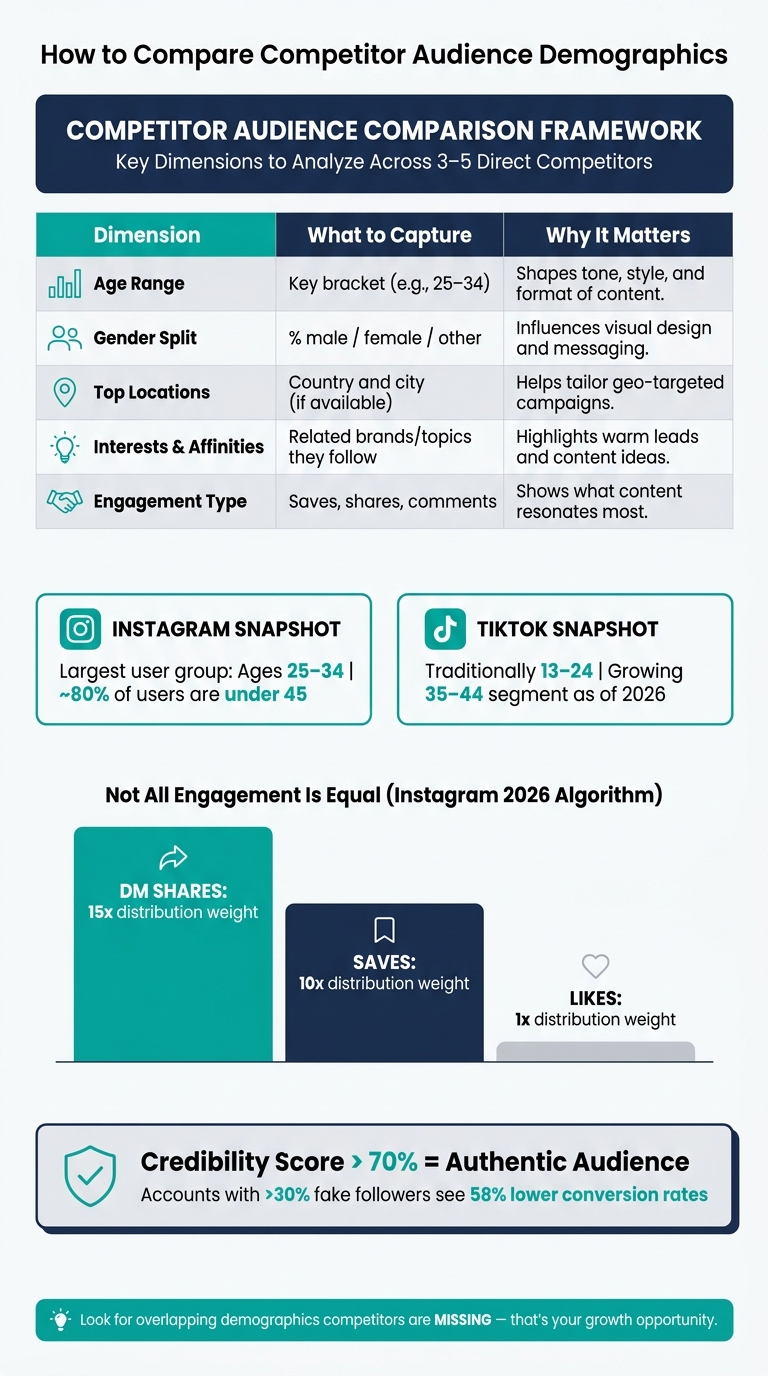
Competitor Audience Demographics: Key Metrics & Comparison Framework
Once you’ve gathered solid demographic data, the next step is to compare it side by side with your competitors. This helps you identify differences and uncover potential opportunities.
Build a Comparison Table
Select 3–5 direct competitors and analyze their audiences using the same key dimensions: core age groups, dominant gender, key geographic regions, and primary interests. Visualizing this data in a table makes trends and gaps much easier to spot than sifting through separate reports.
Here’s a framework to organize your analysis:
| Dimension | What to Capture | Why It Matters |
|---|---|---|
| Age Range | Key bracket (e.g., 25–34) | Shapes tone, style, and format of content |
| Gender Split | % male / female / other | Influences visual design and messaging |
| Top Locations | Country and city (if available) | Helps tailor geo-targeted campaigns |
| Interests & Affinities | Related brands/topics they follow | Highlights warm leads and content ideas |
| Engagement Type | Saves, shares, comments | Shows what content resonates most |
Note: Before relying on a competitor’s audience data, check its credibility. A credibility score above 70% is generally a good indicator of authentic engagement. If the numbers seem inflated, they may not provide an accurate picture of the real market.
Once your table is complete, analyze the data for overlapping audience segments and unexpected insights.
Spot Trends and Patterns
Look for intersections across age, location, and interests. For instance, if two competitors both attract 25–34-year-old women in Austin who are passionate about sustainable fashion, but neither is creating tailored content for that group, you’ve found an untapped opportunity.
Also, keep an eye out for platform-specific engagement gaps. For example, a competitor might dominate on Instagram but have little to no presence on TikTok, even though their target demographic is active there. By 2026, TikTok has seen significant growth among users aged 35–44, yet many brands still treat it as a Gen Z platform. This leaves room for you to step in and connect with an overlooked audience.
The goal isn’t just to see who your competitors are reaching - it’s to identify who they’re missing. This insight can give you a clear path to differentiate your approach.
Use Demographic Insights to Drive Growth
Spotting gaps in your strategy is one thing, but the real game-changer is turning those insights into actionable plans. The key lies in using demographic data to shape your content and refine your audience targeting.
Refine Your Content Strategy
Demographic insights can guide you on what type of content to create, who it should target, and how it should be presented. For instance, age is a major factor. Younger audiences, like Gen Z and younger Millennials, are drawn to short-form videos such as TikTok clips and Instagram Reels. On the other hand, those aged 35 and older often lean toward carousels, longer videos, and detailed written posts. If your research shows that the 35–44 age group is underrepresented in your niche, focusing on carousels could be a smart play. Why? Because carousels currently boast the highest engagement rate on Instagram at 0.55%.
Educational background and professional status also play a role in shaping your tone and content depth. A highly educated, professional audience expects detailed, expert-level language. Meanwhile, a broader consumer base responds better to straightforward, easy-to-digest explanations. Misjudging this can cost you engagement before your audience even gives your content a chance.
"Your competitors are constantly revealing who their audience really is through content, conversations, and visibility patterns." - Brand24
Here’s a real-world example: In December 2025, a home organization creator discovered through demographic analysis that 40% of her followers were business owners focused on productivity rather than general home organization. She shifted her content to focus on office organization and productivity tools. The result? A 60% increase in engagement and new sponsorships from software companies. This shift didn’t just refine her content; it completely redefined her niche. Once you’ve nailed your content strategy, the next challenge is ensuring it reaches the right audience at the right time.
Improve Audience Targeting
Tailoring your content is just the first step. The next is making sure it lands in front of the right people. Geographic data can be a goldmine here. If your audience is concentrated in a specific city or region, align your posting schedule with their peak activity times - ideally 30–60 minutes before their most active period. Without this level of precision, you risk competing for attention at the wrong time.
For paid campaigns, consider creating an Audience-Fit Matrix with three layers:
- "Must-have" criteria like a minimum geographic concentration.
- "Nice-to-have" traits such as overlapping brand affinities.
- "Deal-breakers" like mismatched income levels for your product or service.
This keeps your targeting sharp and avoids wasting resources on broad, unfocused efforts. For example, if Outfame’s analytics reveal that a competing brand’s audience is largely 25–34-year-old creators in major U.S. cities, that’s a clear signal on where to focus your growth efforts.
"The right question to ask is not 'What audience does this creator have?' but 'What audience do we actually need for this specific goal?'" - Elen, Product Officer, IQFluence
Also, don’t get too hung up on follower counts. Behavioral signals like saves, direct messages, and shares are far better indicators of an engaged, high-value audience. For example, if competitor content gets a lot of saves but few comments, it shows their audience is bookmarking the content for later - a behavior worth targeting directly.
Conclusion: Turning Insights into Action
Competitor audience analysis is a process that evolves over time, helping you refine and sharpen your strategy. Brands and creators who achieve consistent growth aren't relying on luck - they're analyzing the signals competitors provide and taking deliberate action based on those insights.
"Competitive analysis is the fastest way to stop guessing and start beating competitors with evidence – not vibes." - Taylor Reed, Paid Social Strategist
By keeping a close eye on these signals, you can ensure your strategy stays focused and aligned with growth opportunities. The process - from identifying competitors to leveraging demographic insights - works best when cross-referenced with your own analytics. If competitor audience data matches your own, it’s a strong indicator to act. If it doesn’t, it highlights potential areas to investigate further. Interestingly, 78% of successful influencers conduct regular competitive analysis to ensure their strategies remain rooted in data rather than assumptions.
To tackle these challenges effectively, automated tools can make a huge difference. Platforms like Outfame simplify the journey from insight to action. With real-time analytics and AI-driven audience targeting, you can quickly adapt your strategy to drive growth. Plans start at $39/month and come with a money-back guarantee if you don’t see results.
This approach allows you to refine your content and targeting strategies, ensuring your decisions are backed by data - not guesswork.
FAQs
How do I know which competitors to analyze?
To kick off, pinpoint your direct competitors - those providing similar solutions to the same target audience - and your indirect competitors, who may address the same problem but with a different approach or cater to overlapping audiences. Start small by selecting 3–5 direct competitors and 2–3 indirect ones. This keeps your analysis manageable and focused.
Make sure you prioritize businesses actively leveraging Instagram for growth. This way, you’ll get a clearer picture of audience behavior and engagement patterns that you can realistically benchmark against.
What demographic signals matter more than follower count?
Follower count gives an idea of potential reach, but it’s the demographic signals that show whether an audience can deliver results. Pay attention to these key factors:
- Geography and language: Ensure the audience aligns with the regions and languages where you can sell effectively.
- Age and gender: Match these demographics with your ideal customer profile.
- Interests and brand affinity: Look for shared interests and connections to brands that indicate purchase intent.
- Engagement signals: Focus on actions like comments and shares to spot active, engaged users rather than passive followers.
These details provide a clearer picture of an audience's potential impact.
How can I turn competitor demographics into content ideas?
To craft content that truly connects, start by building detailed personas based on your competitors’ audience. Look at key factors like age, gender, and location. Pay attention to comments, reviews, or feedback to spot gaps - like unanswered questions or recurring frustrations - that you can address.
Next, analyze the topics and formats that are driving engagement for your competitors. Are they excelling with video tutorials, in-depth guides, or quick tips? Use this insight to shape your own approach, focusing on areas they might be overlooking.
For an extra edge, tools like Outfame’s AI can help you fine-tune audience targeting and monitor growth. With this, you can ensure your content not only reaches the right people but also resonates in a meaningful way.


