
The short answer: don’t judge every beauty Instagram account by one engagement number. I’d benchmark by follower tier, then look past likes to saves, shares, DMs, Story taps, and Reel watch data.
Here’s the quick read:
- Nano (1,000–10,000): often the strongest for trust, replies, and sales
- Micro (10,000–100,000): often the best mix of reach and ROI
- Mid-tier (100,000–500,000): more scale, but engagement often softens
- Large (500,000+): built more for visibility than close audience response
A few numbers stand out:
- Nano: around 4%+ engagement for sponsorship checks
- Micro: around 3%–5% engagement
- Mid-tier: often around 3%–8%
- Reels: about 55% of views can come from non-followers
- Story polls/questions: often see 12%–18% interaction
- DM-to-sale conversion: can range from 7% to 20% for smaller, close-knit audiences
- Save-to-like ratio: about 1 save per 9 likes is a useful check
What I’d do: compare accounts only against others in the same size band, use the same engagement formula, and check for fake followers, spam comments, and sudden follower jumps before making any call.
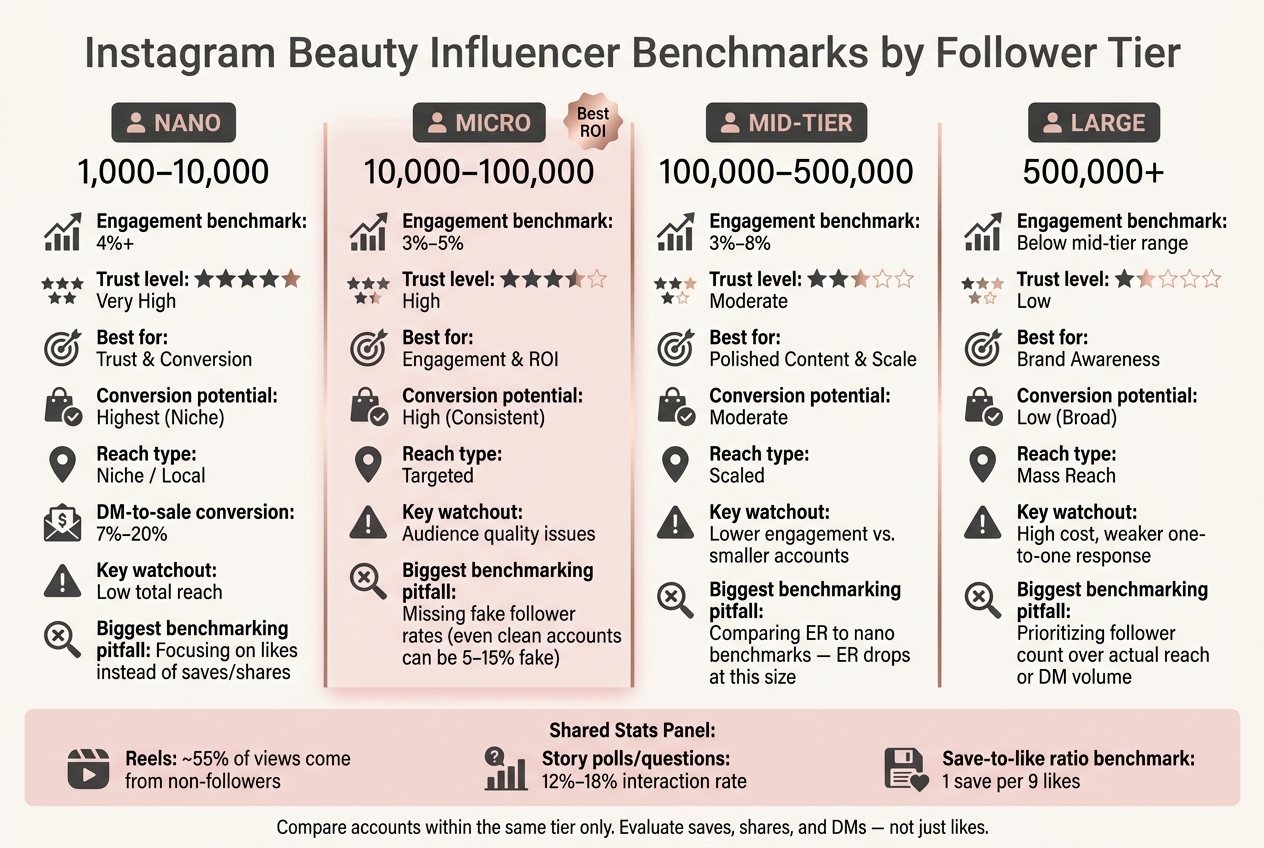
Instagram Beauty Influencer Benchmarks by Follower Tier
Quick Comparison
| Tier | Follower Range | What It’s Best For | Trust Level | Main Watchouts |
|---|---|---|---|---|
| Nano | 1,000–10,000 | Sales, trust, local or niche reach | Very high | Low total reach |
| Micro | 10,000–100,000 | ROI, steady engagement, balanced campaigns | High | Audience quality issues |
| Mid-tier | 100,000–500,000 | More scale and polished brand work | Moderate | Lower engagement vs. smaller accounts |
| Large | 500,000+ | Awareness and broad reach | Low | High cost, weaker one-to-one response |
If I were reviewing a beauty account today, I’d start with follower tier first, then check whether the audience is doing something useful with the content - not just tapping like.
sbb-itb-3b12fba
1. Nano Beauty Accounts (1,000–10,000 Followers)
Engagement Rate Range
Nano beauty accounts usually see the highest engagement. For sponsorships, 4%+ is a solid benchmark.
Reach and Scale
Their reach is still limited, but Reels can help more people find the account. That’s because 55% of Reel views come from non-followers. As follower counts go up, engagement tends to dip a bit. That’s why micro accounts usually work with a lower benchmark.
Audience Intimacy
For service-based beauty brands, the close connection with followers can turn into sales. DM-to-sale conversion rates can range from 7% to 20%.
Brand Evaluation Metrics
When you're judging brand fit, look past likes. Pay close attention to saves, shares, DM sends, and Story interaction rates. These signals often tell you more about buying intent.
Story features like polls and question stickers can hit interaction rates of 12–18%. And audience quality matters just as much as post performance. Accounts with 30%+ fake followers can see 58% lower conversion rates.
2. Micro Beauty Accounts (10,000–100,000 Followers)
Engagement Rate Range
Micro accounts usually give up a bit of engagement in exchange for more reach. In beauty, they sit in that sweet spot between closeness and scale. They can still keep a strong bond with followers while reaching enough people to make brand deals worth it.
Compared with nano accounts, micro accounts tend to post slightly lower engagement, but they make up for it with broader campaign reach. A 3%–5% engagement rate is the benchmark brands should look for when reviewing micro accounts. If an account lands in that range, it usually points to an audience that’s paying attention and responding.
Reach and Scale
This tier gives brands enough reach to plan campaigns with some confidence, without losing the follower trust that gives micro accounts their appeal.
Brand Evaluation Metrics
At this level, likes don’t tell the full story. Saves and shares matter more because they show that followers found the post useful enough to keep or worth sending to someone else. That’s a much stronger signal than a simple tap on the like button.
When reviewing a micro account, look closely for:
- sudden follower spikes
- spam-heavy comments
- random-number usernames
Poor audience quality can drag down the engagement benchmarks this tier is known for. For micro accounts, saves and shares matter more than raw like counts.
Above 100,000 followers, engagement usually starts to soften again as accounts move into the mid-tier range.
3. Mid-Tier Beauty Accounts (100,000–500,000 Followers)
Once a beauty account crosses 100,000 followers, engagement usually starts to dip. At that point, reach becomes the main goal.
Engagement Rate Range
Mid-tier beauty accounts usually fall in the 3%–8% engagement rate range. The tradeoff is pretty simple: as reach goes up, the close personal bond that tends to drive stronger engagement starts to fade.
Reach and Scale
At this size, Reels should handle most discovery. That shifts the focus away from raw like totals and toward the quality of engagement.
Audience Intimacy
As the audience gets bigger, it gets harder to keep that one-to-one trust. Brands should expect a weaker personal connection here than they’d get with smaller beauty creators.
Brand Evaluation Metrics
For brand review, saves, shares, and DM sends matter most. Likes matter least. In beauty content, tracking saves against likes can show whether a post is giving people real value.
DM volume also deserves close attention. Polls and quizzes usually drive 12%–18% interaction.
At this stage, scale matters more, but engagement keeps thinning.
4. Large Beauty Accounts (500,000+ Followers)
Compared with mid-tier accounts, large beauty accounts usually get more reach but less concentrated engagement. Once an account passes 500,000 followers, scale starts to beat closeness. At that point, engagement quality matters more than raw volume.
Engagement Rate Range
At 500,000+ followers, likes don't tell you much on their own. Saves, shares, DM conversations, and watch time give a better read on how people respond. Brands should expect engagement rates to land near the low end of the mid-tier range, or even below it, with more value tied to action-based signals than surface-level activity.
Reach and Scale
At this size, Reels are the main discovery engine. They help push content to more people, so brands should look at watch time and completion rate before signing a deal. Carousels can still bring in saves, but Reels tend to drive broader discovery.
That changes the conversation. Instead of fixating on follower count, it makes more sense to look at how people interact.
Audience Intimacy
Large accounts usually give up some intimacy as they grow. The upside is broader visibility. The downside is weaker one-to-one trust.
Brand Evaluation Metrics
For large accounts, saves, shares, and DM conversations matter most. Instagram puts a lot of weight on saves and shares, sometimes more than likes and comments. Watch time and completion rate are also major Reels signals, so brands should ask for that data before signing a deal.
For reach-focused campaigns, these signals are a better yardstick than follower count alone. They help brands judge distribution and response, not community depth.
How the Tiers Compare in Real Campaign Performance
Follower count affects engagement, but that’s only part of the story. Each tier tends to support a different campaign goal. The table below turns follower size into the outcome each group most often delivers.
| Metric | Nano (1K–10K) | Micro (10K–100K) | Mid-Tier (100K–500K) | Large (500K+) |
|---|---|---|---|---|
| Reach Type | Niche/local | Targeted | Scaled | Mass reach |
| Trust Level | Very High | High | Moderate | Low |
| Best For | Trust & Conversion | Engagement & ROI | Polished content | Brand Awareness |
| Conversion Potential | Highest (Niche) | High (Consistent) | Moderate | Low (Broad) |
In practice, nano and micro creators often do the heavy lifting when the goal is trust, clicks, or sales. Mid-tier creators usually give you more polished assets and more scale. Large creators are built for broad visibility, even if response rates tend to soften.
There’s another metric worth watching across every tier: the save-to-like ratio. It gives you a clearer read on how well the audience responds, not just how many people tapped like. A healthy benchmark sits at about 1 save per 9 likes.
And no matter the tier, vet the account before you sign the deal. Check for sudden follower spikes, ghost followers, and comment sections filled with generic or spammy replies, or use a service to get real Instagram followers to ensure your own growth remains high-quality. If the audience looks off, the campaign data usually will too.
Pros and Cons by Follower Tier
Now that the benchmark ranges are clear, the next step is picking the tier that lines up with the goal. The main gap between these tiers isn’t quality. It’s the trade-offs. The table below turns those engagement ranges into a more practical view, so you can match follower size to budget, trust, and campaign objective.
| Follower Tier | Pros | Cons | Biggest Benchmarking Pitfall |
|---|---|---|---|
| Nano (1K–10K) | High trust; low cost | Low raw reach; a lot of hands-on work to scale | Looking too hard at likes instead of saves or shares |
| Micro (10K–100K) | Best mix of reach and ROI; strong brand trust | Needs close vetting for audience quality; costs are going up | Missing fake follower rates - even clean accounts can sit at 5–15% fake |
| Mid-Tier (100K–500K) | More reach without fully losing niche authority | Higher fake-follower risk; engagement often dips here | Comparing engagement rates to nano benchmarks - ER drops at this size |
| Large (500K+) | Mass reach, broad visibility, and strong Reels discovery | Lowest engagement, highest cost, and lower trust | Prioritizing follower count over actual reach or DM volume |
A small account can look “better” on paper if you only check likes. But that can throw off the whole read. A nano creator may have a tight-knit audience, while a large creator may drive more total views and DMs even with a lower engagement rate.
That’s why it helps to judge each tier by saves, shares, and DM sends, then compare those signals against the engagement range for that follower size.
Conclusion
The takeaway is simple: judge beauty accounts by follower tier, not by one catch-all benchmark.
Tier-based benchmarks only make sense when you compare accounts in the same follower range. Each tier has its own expected range, and that range should be the standard. Using one number for every beauty account is a bad read.
Before you compare two accounts, check a few basics first. The engagement formula needs to match. Combined signals like likes, comments, saves, and shares give a more complete picture than likes alone. The content format should match too, because carousels tend to hold up best on engagement. On top of that, use the same reporting window, and make sure audience geography and account type line up.
And if you're deciding what to watch most closely, put saves and shares ahead of likes.
FAQs
How should I calculate engagement rate?
Choose the method that matches your goal.
If you want to compare performance against benchmarks, use Engagement Rate by Followers (ERF):
(Likes + Comments + Saves + Shares) / Followers x 100
If you want to measure how a single post performed, use Engagement Rate by Reach (ERR):
(Likes + Comments + Saves + Shares) / Reach x 100
For paid or boosted content, use impressions instead of reach.
What metrics matter most besides likes?
Beyond likes, the Instagram metrics that matter most are comments, saves, and shares. Those actions show that a post was worth stopping for, coming back to, or sending to someone else.
Saves are especially important for educational posts or anything people may want to bookmark for later. Shares, on the other hand, often point to strong resonance. And if you want a cleaner read on content quality, reach-based engagement can be more useful than follower-based formulas alone.
How can I quickly spot fake followers?
Look for low engagement on an account with a large follower count. That often points to lots of inactive followers or bot accounts.
A few other fast red flags:
- Very little interaction on posts
- Generic comments
- The same comments showing up again and again
A follower-audit or vetting tool can help you check audience quality and spot fraudulent accounts. Removing fake or inactive followers can improve your engagement rate and the overall health of the account.


