
Retargeting helps brands re-engage users who’ve already interacted with their content or website. Instagram and TikTok approach this differently, leveraging their unique strengths. Here's what you need to know:
- Instagram: Part of Meta's ecosystem, it uses tools like Meta Pixel, Conversions API, and advanced filters (frequency, recency) for precise audience segmentation. It's ideal for detailed targeting and converting high-intent users.
- TikTok: Relies on its algorithm and in-app behaviors like video watch time, shares, and profile visits. It’s great for discovery and engaging users at the top of the funnel, but less detailed for retargeting compared to Instagram.
Quick Comparison
| Feature | Instagram (Meta) | TikTok |
|---|---|---|
| Data Source | Cross-platform (web + app) | In-app behavior |
| Precision | High (detailed filters and CRM support) | Moderate (algorithm-driven) |
| Retention Window | Up to 365 days for most sources | 90–365 days depending on source |
| Best Use Case | Conversions and high-value purchases | Discovery and top-of-funnel engagement |
Key Insight: Use TikTok for discovery and Instagram for conversions. Combine both for a full-funnel strategy, starting with TikTok to spark interest and Instagram to close the deal.
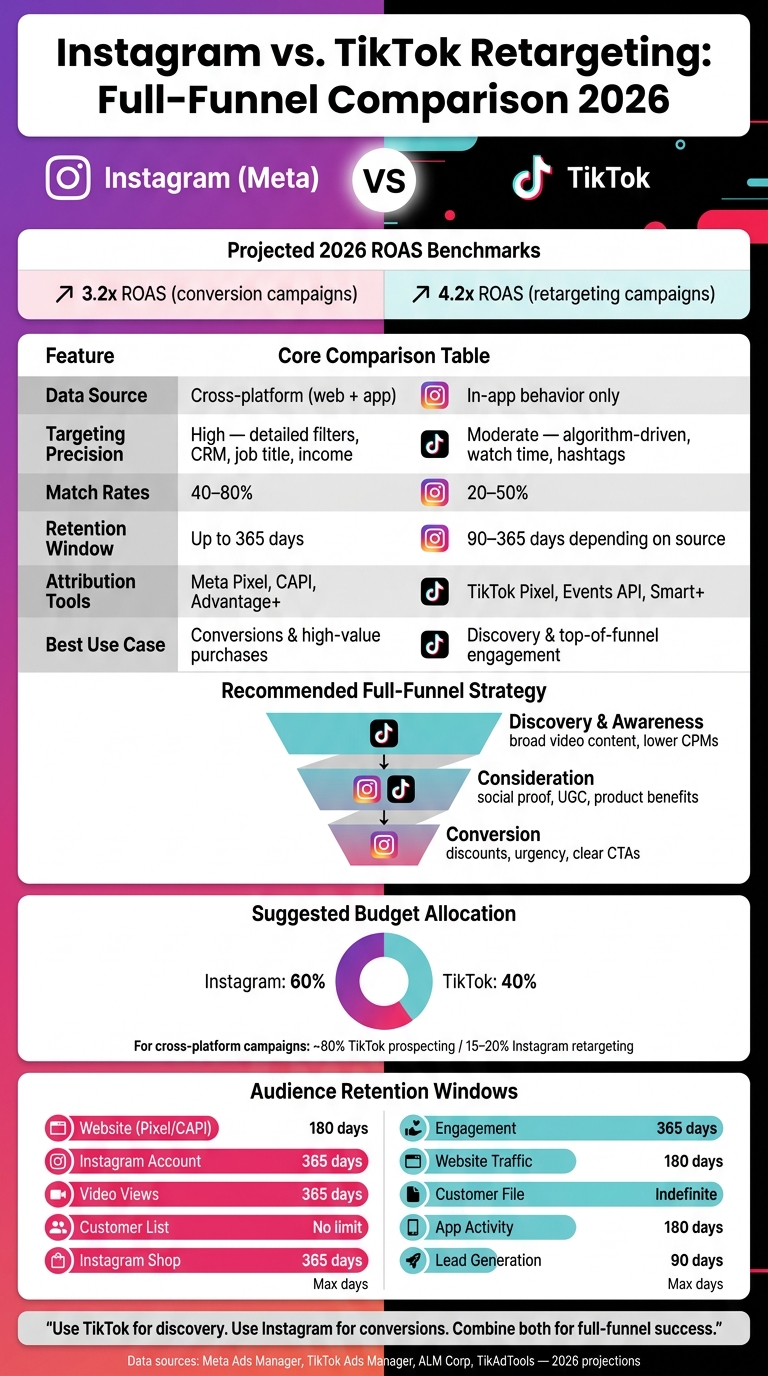
Instagram vs. TikTok Retargeting: Full-Funnel Comparison 2026
TikTok Retargeting Ads (A Step-By-Step Guide For Beginners)
Instagram Retargeting Audience Segmentation
Instagram's retargeting options are integrated within Meta Ads Manager, leveraging a wealth of cross-platform behavioral data. This data includes user actions on Instagram and signals from Meta's broader ecosystem.
Data Signals and Targeting Logic
Meta's system tracks a wide range of user behaviors, such as post saves, profile visits, direct messages (DMs), video watch percentages, and website interactions like AddToCart or InitiateCheckout. These behaviors are the backbone of Custom Audiences, which are central to Instagram retargeting.
Two tools introduced in 2026 have added even more precision to these efforts:
- "At Least" Frequency Filter: Targets users who engaged with your content a minimum number of times, like at least three interactions in the last 30 days.
- "In the Past X to X Days" Recency Filter: Focuses on users who engaged within specific time frames, such as between 15 and 45 days ago.
As Himanshu Rahi explains:
"Frequency tells you how interested someone is. Recency tells you how fresh that interest is. Together, they give you the closest thing to a real intent score."
To overcome the limitations of browser-based pixel tracking, especially with iOS privacy updates, the Conversions API (CAPI) is now crucial. It enables server-side tracking and helps recover the 10–20% of attribution data that would otherwise be lost.
Core Retargeting Audience Types
Instagram offers several audience sources for retargeting, each with its own unique data signals and retention windows:
| Audience Source | Key Data Signal | Max Retention Window |
|---|---|---|
| Website | Pixel/CAPI events (e.g., ViewContent, AddToCart) | 180 days |
| Customer List | CRM data (email, phone number) | Static/no limit |
| Instagram Account | Profile visits, post saves, DMs, ad engagement | 365 days |
| Video Views | Watch depth: 3s, 10s, 25%, 50%, 75%, 95% | 365 days |
| Instagram Shop | Viewed or saved products in IG Shop | 365 days |
Match rates for customer lists typically range from 40% to 80%, depending on the quality of the data. Including multiple identifiers (email, phone number, name) improves match rates significantly. To activate a Custom Audience, Meta requires at least 100 matched users, but for reliable ad delivery, 1,000+ matched users is recommended.
Segmentation by Funnel Stage
Aligning audience segments with specific stages of the sales funnel ensures your ad messaging is tailored to user intent. For instance, a casual 3-second video viewer and someone who abandoned their cart have vastly different needs - and your ads should reflect that.
| Funnel Stage | Audience Segment | Creative Approach |
|---|---|---|
| Top (Awareness) | Video viewers (3s–10s), profile visitors | Brand story, educational content |
| Middle (Consideration) | 50%+ video viewers, post savers, link tappers | Testimonials, UGC, product benefits |
| Bottom (Conversion) | Add to Cart (7–14 days), DM initiators | Discount codes, low-stock urgency, clear CTAs |
| Retention | Past purchasers (CRM list) | Cross-sells, new arrivals, loyalty rewards |
For high-intent actions, use shorter time frames (3–7 days), while broader segments can stretch from 30 to 180 days. Data shows that users who interact with a brand multiple times are 2–5 times more likely to convert compared to single-touch visitors. Frequency-based segments also tend to achieve a 30% lower CPA than standard retargeting.
One critical step: exclude recent purchasers from acquisition campaigns. Targeting them wastes ad spend and risks irritating customers with ads for items they’ve already bought.
Next, we’ll look at how TikTok’s retargeting strategies differ from Instagram’s approach.
TikTok Retargeting Audience Segmentation
TikTok's approach to retargeting relies heavily on its recommendation engine and real-time content signals, focusing on in-app behaviors rather than external audience criteria. Unlike Instagram, which uses more structured segmentation, TikTok's strategy is built entirely on what users do within the app. This difference highlights the unique strengths of each platform.
Data Signals and Targeting Logic
TikTok tracks a variety of in-app activities, such as how long users watch videos, profile visits, likes, comments, shares, and follows. On the website side, tools like the TikTok Pixel or Events API capture high-intent actions, such as ViewContent, AddToCart, InitiateCheckout, and CompletePayment.
The key distinction lies in where the intent signal originates. TikTok can create warm audiences based solely on on-platform behavior, even before users interact with your website. As Ahmed Ashraf explains:
"TikTok's algorithm is trained on content consumption - it knows what people are interested in better than they'd tell a survey. Trust it with broad targeting if your creative is strong."
Instead of over-segmenting, using broad targeting can help TikTok's algorithm do its job more effectively. These behaviors provide the foundation for TikTok's retargeting audience types, outlined in the table below.
Core Retargeting Audience Types
TikTok Ads Manager categorizes retargeting audiences into five main types, each based on different data sources:
| Audience Type | Data Source | Max Retention | Best Use Case |
|---|---|---|---|
| Engagement | On-platform interactions | 365 days | Retargeting video viewers and profile visitors |
| Website Traffic | TikTok Pixel / Events API | 180 days | Cart abandoners and product page viewers |
| Customer File | CRM / email / phone upload | Indefinite | Existing customer upsells and exclusions |
| App Activity | TikTok SDK events | 180 days | Re-engaging lapsed app users |
| Lead Generation | Lead form interactions | 90 days | Following up with form openers or submitters |
TikTok's match rates for customer file uploads tend to range between 20% and 50%. This is partly due to its younger user base and a unique data ecosystem. To improve match rates, format emails in lowercase and include country codes with phone numbers.
Segmentation by Funnel Stage
TikTok's engagement data aligns naturally with different stages of the marketing funnel. However, the messaging needs to match where the user is in their decision-making process. As Shaddam Hossain, Founder of TikAdTools, notes:
"Retargeting creative is not the same as prospecting creative. Cold traffic needs education. Warm traffic needs a reason to act now."
- Top of the Funnel: Users who watch short snippets of videos demonstrate low intent. This group responds well to brand storytelling or educational content designed to build awareness.
- Middle of the Funnel: Users who watch at least 50% of a video or visit your profile show genuine interest. Here, strategies like social proof, user-generated content, or showcasing product benefits are effective.
- Bottom of the Funnel: Cart abandoners and those who initiated checkout need a direct nudge. Discounts, free shipping, or urgency-driven messaging work best for this group.
Using tiered lookback windows can refine your approach - 7 days for high-intent actions like cart abandonment, 14 days for product viewers, and up to 180 days for broader engagement. To avoid ad fatigue, limit impressions for cart abandonment audiences to 3–4 per day. This helps control costs and maintains a healthy cost per acquisition.
This segmentation strategy ensures TikTok's retargeting efforts align with each stage of the customer journey, offering a clear distinction from Instagram's methods.
Instagram vs. TikTok: Side-by-Side Comparison
Let's break down how Instagram and TikTok differ when it comes to audience segmentation and targeting. These differences reflect the platforms' unique approaches to understanding and engaging with their users.
Audience Data Depth and Granularity
Instagram has a long history of collecting user data, which it uses to create highly detailed profiles. It tracks everything from post engagement to account follows and even browsing behavior across the web. This relationship-based model has been refined over years, allowing Instagram to offer highly specific audience filters, such as job titles, household income, and detailed behavior categories.
On the other hand, TikTok focuses on real-time user interests. Metrics like watch time, video completion rates, and hashtag interactions shape its targeting approach. While this makes TikTok great for surfacing trending content, it doesn’t provide the same level of precision for complex, multi-step retargeting campaigns.
If your campaign needs tight audience control - like excluding certain buyer groups or targeting based on purchase history - Instagram is the better option. TikTok, however, shines when it comes to matching content with current user preferences, thanks to its algorithm-driven approach.
Audience Types and Segmentation Controls
Here’s a quick look at how the two platforms compare in their audience segmentation capabilities:
| Feature | Instagram (Meta) | TikTok |
|---|---|---|
| Data Depth | Rich behavioral data, including job titles and household income | Focused on in-app behavior like video views and hashtags |
| Targeting Precision | Highly granular, covering demographics and behaviors | Algorithm-driven, matching content to user interests |
| Match Rates | Higher due to Meta's established data ecosystem | Typically ranges from 20–50% |
| Attribution Maturity | Advanced tools like Meta Pixel and Advantage+ | Still developing, with tools like the Events API and TikTok Pixel |
These differences influence the kinds of campaigns each platform is best suited for, as detailed below.
Best-Fit Use Cases for Each Platform
"TikTok is often where interest begins. Instagram is often where confidence builds." - ALM Corp
TikTok excels at creating buzz for impulse-buy products or visually engaging items like beauty and fashion. It’s also the go-to platform for reaching younger, discovery-driven audiences. Plus, its lower CPMs make it a cost-effective choice for top-of-funnel campaigns.
Instagram, however, is better for high-value or considered purchases, such as electronics, furniture, or premium services. These types of purchases often require multiple touchpoints, making Instagram’s advanced attribution tools a major advantage. It’s also a strong contender for B2B campaigns and niche markets.
For most brands, a balanced budget split - around 60% for Instagram and 40% for TikTok - strikes a good mix of cost-efficient awareness on TikTok and precision-driven conversions on Instagram.
Cross-Platform Retargeting Strategies
Using Both Platforms in the Retargeting Funnel
To make the most of Instagram and TikTok, it’s all about playing to their individual strengths. TikTok is perfect for top-of-funnel discovery, using fast-paced, unpolished video content to grab attention. Instagram, on the other hand, shines in the middle and bottom of the funnel with refined, conversion-driven ads that build trust and push users toward action.
Here’s an effective strategy: Start with TikTok to target broad audiences, using engaging content that hooks viewers. Then, retarget those who’ve watched at least 75% of your TikTok video with an Instagram Reels ad. These Instagram ads should focus on direct offers or showcase social proof, as users are already familiar with your brand, reducing the trust barrier. For budgeting, consider allocating around 80% of your spend to TikTok for prospecting and 15–20% to Instagram for retargeting in 2026. Remember, TikTok thrives on authentic, low-production content, while Instagram performs better with polished visuals. Avoid reusing the same ad creatives across both platforms, as this tends to underperform.
Once you’ve nailed your creative strategy, it’s time to ensure your audience management aligns across platforms.
Managing Audiences Across Both Platforms
Seamless audience management between TikTok and Instagram requires proper technical groundwork. Start by setting up both Meta and TikTok Pixels, along with their Events APIs (CAPI). This step helps fill data gaps caused by ad blockers and iOS privacy updates, especially if your ad budget exceeds $5,000.
For CRM-based audiences, upload segmented customer lists - like "lapsed leads" or "high-value customers" - into both Meta Ads Manager and TikTok Ads Manager. This keeps your messaging consistent across platforms. Keep in mind that TikTok’s match rates typically range from 20–50%, so you’ll need a larger list to meet the 1,000-user minimum required for campaigns to run.
To avoid wasting ad spend, exclude recent purchasers (within the past 30–180 days) from your retargeting audiences. Additionally, if you notice audience overlap between ad sets exceeds 30%, merge those audiences to prevent internal competition and inefficiencies.
How AI Can Improve Retargeting Segmentation
AI tools can take your retargeting efforts to the next level by enhancing audience segmentation. Meta’s Advantage+ and TikTok’s Smart+ Catalog Ads use machine learning to identify potential converters beyond your manual audience parameters. These tools automatically adjust ad delivery in real time, improving performance. To get the best results, set clear boundaries, such as geographic location or minimum age, while allowing the algorithms to optimize interests and behaviors.
Pair this with dynamic product ads, which adapt to user browsing history to show the most relevant products. These ads often achieve click-through rates 2–3 times higher than static creatives.
"Retargeting is the mechanism of showing a specific follow-up ad to someone who has already engaged with your brand. It is the highest ROI activity you can perform because the trust has already been established." - TikAdSuite
For brands looking to streamline their efforts, platforms like Outfame offer AI-powered tools to fine-tune targeting and provide real-time analytics. Their Outfame Max™ AI tool continuously monitors growth signals, refining audience segments to keep your retargeting pools sharp and your ad spend efficient.
Conclusion
Our analysis of retargeting highlights how TikTok and Instagram play distinct yet complementary roles in driving user engagement. TikTok excels at discovery, connecting with users who are open to exploring new brands. On the other hand, Instagram builds trust and drives conversions, turning interest into action.
By 2026, TikTok retargeting campaigns are projected to deliver an average 4.2x ROAS, while Instagram conversion campaigns benchmark at 3.2x ROAS. These numbers reflect their unique strengths at different stages of the funnel. The real value emerges when both platforms are used together, leveraging their individual strengths for maximum impact.
"TikTok is usually the stronger platform for attention, discovery, and lower-cost top-of-funnel reach, while Instagram is usually the stronger platform for retargeting, conversion efficiency, and campaigns that depend on mature targeting." - ALM Corp
Achieving success with these platforms requires more than just picking the right one. It calls for platform-specific creative strategies, precise audience segmentation, and maintaining clean, accurate data across ad managers.
AI tools can simplify this process by managing cross-platform data and optimizing campaigns in real time. For brands and creators aiming to streamline their targeting efforts, Outfame provides AI-driven audience tools and real-time analytics for both TikTok and Instagram. The Outfame Max™ tool ensures retargeting pools stay accurate and ad budgets focus on users most likely to convert, delivering smarter results with less manual effort.
FAQs
Which events should I track for retargeting on each platform?
On Instagram, tools like the Meta Pixel and Conversions API let you monitor key actions such as page views, cart abandonments, and completed purchases. You can also create segments based on user behaviors like profile visits or how much of a video they’ve watched.
For TikTok, the TikTok Pixel and Events API help track actions like page views, product views, add-to-carts, and checkouts. Retargeting opportunities include focusing on users who finish watching your videos or engage with your organic content.
How should I set lookback windows for warm vs. hot audiences?
Tailoring your lookback windows to align with audience intent and your product’s consideration cycle can make a huge difference. Here's how to approach it:
- Hot audiences: For high-intent users, like those who abandoned their carts, stick to shorter windows - anywhere from 3 to 14 days. These users are already close to converting, so timing is key.
- Warm audiences: For visitors who explored your site or engaged with your content, go with a slightly longer window, around 30 days. This keeps you on their radar without being too pushy.
- Broader campaigns: For a wider reach, such as re-engaging past visitors or less active users, consider longer windows - anywhere from 60 to 180 days. This approach works well for nurturing leads over time.
And don’t forget: A/B testing is crucial. It helps you find the sweet spot between audience size and conversion quality. Experiment and refine to see what works best for your goals.
How do I prevent audience overlap and ad fatigue across both?
To keep your campaigns fresh and avoid audience overlap or ad fatigue on Instagram and TikTok, it’s important to play to the strengths of each platform. TikTok is all about fast-moving, trend-driven content with a raw, unfiltered vibe. On the other hand, Instagram leans toward polished visuals and showcasing social proof.
For TikTok, aim to refresh your creatives every 4–7 days to keep up with its rapid pace. On Instagram, you can stretch that timeline a bit, updating assets every 10–14 days. Tools like Outfame can simplify this process by automating audience targeting and providing real-time growth tracking, helping you maintain steady, authentic engagement.


