
If your Instagram and TikTok look like two different businesses, you make it harder for people to know, remember, and trust you.
I’d boil the whole article down to this: keep your visuals, voice, profile details, and content themes aligned across both platforms, even if the post format changes. That matters because steady branding can drive up to 23% more revenue, steady colors can improve recognition by up to 80%, and steady messaging can make people more likely to trust what they see.
Here’s the short version:
- Use the same profile photo, handle, and core bio message
- Stick to 3–5 colors and 2 fonts
- Keep the same brand voice, even if TikTok sounds more casual
- Build 3–5 content pillars and repeat them
- Post natively to each app instead of reusing watermarked videos
- Audit both accounts every 90 days to catch drift
A simple way to think about it: Instagram and TikTok do not need the same posts. They need the same brand signals.
| Area | When Branding Drifts | When Branding Stays Aligned |
|---|---|---|
| Recognition | People take longer to connect both accounts | People know it’s you at a glance |
| Trust | Mixed signals create doubt | Repeated signals build confidence |
| Engagement | Posts blend into the feed | Steady style can support better response |
| Workflow | Each post feels made from scratch | Teams work from one set of rules |
| Conversion | Users drop off between platforms | The path from discovery to action feels clearer |
If I were fixing this today, I’d start with one page: colors, fonts, bio, tone, and content pillars. That alone can clean up most cross-platform branding problems.
What consistent branding looks like across Instagram and TikTok
Consistent branding doesn't mean posting the exact same thing on both apps. It means that when someone lands on your Instagram or TikTok, they get the same clear sense of who you are from the start. That comes through in your look, your topics, and your voice. As Vik Chadha, Founder of Magnt, puts it:
"Your brand should be recognizably the same but adapted for each platform."
That's the idea. Different formats, same brand. You don't need identical posts. You need one brand system that feels familiar across two very different feeds.
Visual identity, profile elements, and content style
The first thing people notice is the visual layer. Use the same profile photo, handle, and 3–5-color palette across graphics, text overlays, and backgrounds. A steady color palette can increase brand recognition by up to 80%.
Typography matters too. Stick to two fonts: one bold font for headings and one clean font for body text. Use them on both platforms so your posts feel tied together. On TikTok, text usually needs to be larger and higher contrast than on Instagram because the app moves fast and fills the screen.
Your profile bio should also stay aligned. Instagram bios allow 150 characters, while TikTok bios allow 80. A simple way to handle this is to write one master value proposition, then trim it down for TikTok without changing the core message.
The format should shift to fit the platform:
- Instagram leans toward polished visuals and clean layouts
- TikTok leans toward bold text and a strong hook in the first 2 seconds
Once that visual system is locked in, the next piece is voice.
Voice, messaging, and content pillars
Visuals help people spot you. Voice and content pillars help them remember you. Your brand personality should stay steady across both platforms, even if the tone changes a bit. A brand can sound more polished on Instagram and more conversational on TikTok without losing who it is.
Content pillars give both channels the same structure. Grouping your posts into 3–5 recurring themes makes the account feel organized and easy to follow. It gives people a pattern they can pick up on fast.
| Content Pillar | Purpose | Example Content |
|---|---|---|
| Educational | Share expertise | How-to guides, tips, industry insights |
| Inspirational | Motivate audience | Success stories, team spotlights |
| Promotional | Showcase offers | Product features, service highlights |
| Behind-the-Scenes | Build trust | Process clips, "day in the life" videos |
Recurring phrases, clear values, and repeated themes make an account feel deliberate. In most cases, it takes 5–7 exposures for people to recognize a brand identity on sight. If those signals start pulling in different directions, recognition gets weaker and trust tends to slip, making it harder to get real Instagram and TikTok followers who engage with your brand.
sbb-itb-3b12fba
Branding problems that hurt reach and trust
When Instagram and TikTok feel like two different brands, people notice. Recognition slips, and trust starts to wear down. The biggest trouble spots usually come from three places: visuals, voice, and posting rhythm.
Problem: mismatched visuals and profile identity
If your profile photos are different, your color schemes clash, and your bios describe the brand in different ways, the account gets harder to remember. People need more time to connect those profiles to the same business, which leads to slower recognition and weaker recall.
Every visual shift adds friction. Instead of building memory, you keep resetting it.
Once the look drifts, recognition starts from zero.
Problem: inconsistent tone and unclear positioning
A polished voice on Instagram and a totally different one on TikTok can make the brand feel split in half. At that point, followers may start wondering what the brand even does and who it serves.
That confusion comes with a cost. 73% of consumers trust brands more when they see consistent messaging across platforms, and consumers are 4.6x more likely to trust a brand that keeps its messaging steady.
Shaping your tone for each platform makes sense. Changing your identity just to chase trends is where things start to fall apart.
When the voice shifts too far, the brand feels harder to trust.
Problem: random content themes and posting patterns
When content pillars jump around from one post to the next, the 3–5 pillar pattern followers are supposed to recognize starts to break. That makes it harder for people to know what to expect from you. And when people can't tell what lane you're in, it's much easier for them to scroll past.
Those gaps also reduce performance, not just clarity.
Why consistency improves performance on Instagram and TikTok
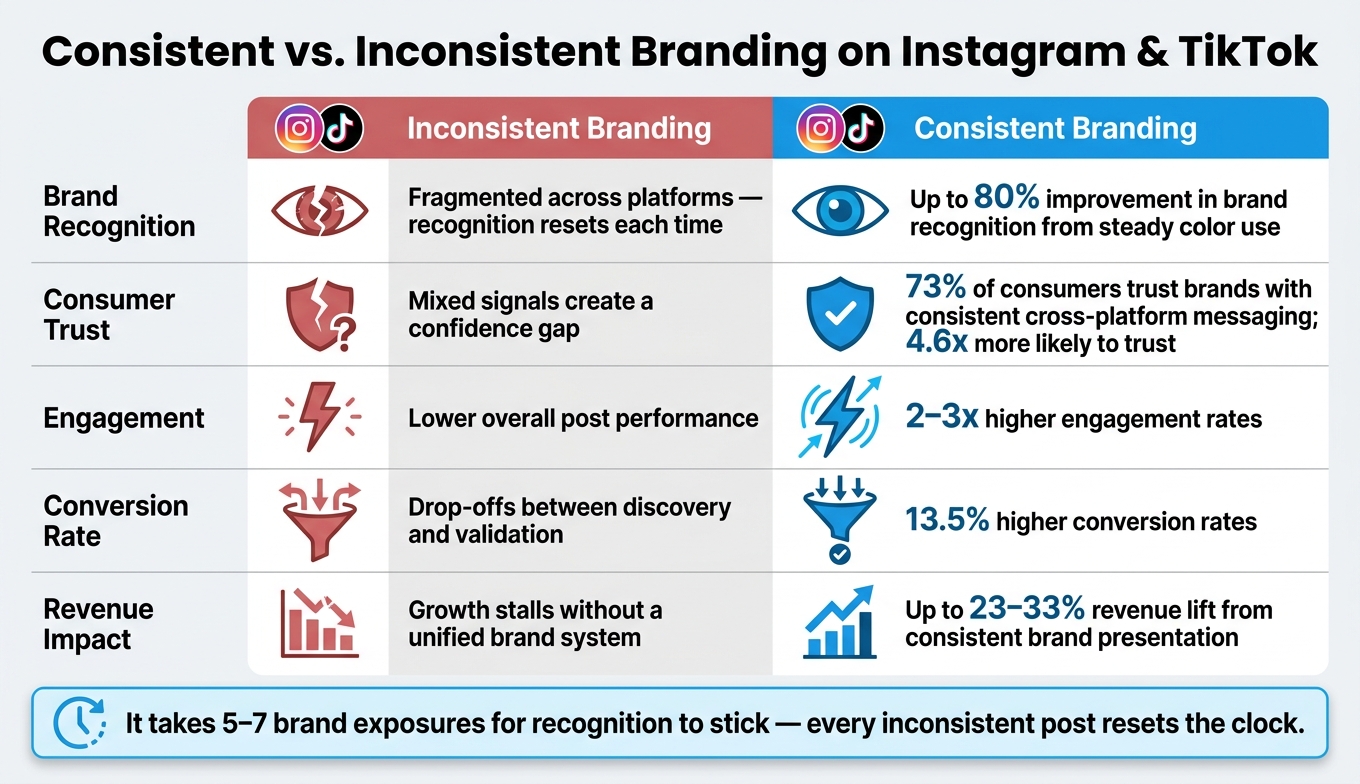
Consistent vs. Inconsistent Branding on Instagram & TikTok: Key Stats & Impact
Drifting visuals, shifting tone, and scattered content chip away at recognition, trust, and conversion. Consistency does the opposite: each post backs up the one before it, so the brand system starts to build on itself over time.
When that system stays steady, the payoff shows up fast. People recognize you sooner, trust the profile more, and move through the path to conversion with less friction.
Better recognition, stronger trust, and clearer conversion paths
Consistent color and layout help people spot your posts at scroll speed. When those choices stay the same across TikTok and Instagram, every post adds one more layer of familiarity.
This hits hardest when someone finds you on TikTok and then clicks over to Instagram. If both profiles feel like the same brand, that visit helps build trust. If they don’t line up, you lose some of that momentum.
More efficient content repurposing and team workflows
Clear brand rules save time. One idea can turn into a Reel, TikTok, Story, and caption without having to rebuild the brand direction from zero every single time.
That keeps output steady and makes team workflows smoother. Instead of debating colors, tone, or layout on each post, the team works from one shared reference point.
Comparison table: inconsistent branding vs. consistent branding
Use this comparison to spot where inconsistency does the most damage.
| Area | Inconsistent Branding | Consistent Branding |
|---|---|---|
| Brand Recognition | Fragmented across platforms | Recognizable at scroll speed |
| Trust Signals | Creates a confidence gap | Builds credibility by the 5th touchpoint |
| Engagement | Lower performance overall | 2–3x higher engagement rates |
| Content Workflow | Every post starts from scratch | One reference point for all creative decisions |
| Conversion Path | Drop-offs between discovery and validation | 13.5% higher conversion rates |
How to fix branding inconsistencies with a simple cross-platform system
Most branding issues come back to one missing thing: a shared reference point. Without it, every post turns into a judgment call. And over time, those calls start to drift.
The aim here is simple: faster recognition, stronger trust, and fewer drop-offs. The fix is one shared brand system, adjusted for each platform.
Solution: align profiles, visuals, and voice guidelines
If your profiles don’t match, start with the basics. Use the same profile photo or logo on both platforms. Then line up your handles as closely as you can. Write one master bio first, then shorten it for each platform.
Next, make a one-page brand guide. Keep it simple:
- List 3–5 colors
- Choose 2 fonts
- Add preferred phrases and phrases to avoid
A short line like “We sound like [X], not [Y]” gives every post and every team member the same point of reference.
Also, don’t upload watermarked TikTok clips to Instagram. Instagram can demote Reels with visible watermarks from rival platforms, so upload the original file to each platform separately.
Once the profile rules and visual rules are in place, lock in your content pillars.
Solution: build shared content pillars and review performance regularly
To fix content drift, choose 3–5 repeatable themes that fit both platforms. The idea is simple: the message stays the same, but the format changes.
For example, a tutorial can turn into:
- an Instagram carousel
- a TikTok clip
Same idea. Different packaging.
You’ll also want a regular review cycle so small issues don’t snowball. Check which posts are landing and whether they still match your positioning. Every 90 days, audit your last 9 posts from each platform without logos. If they no longer feel like one brand, update the guide.
Problem-to-solution table for quick implementation
Use this checklist to audit both accounts fast.
| Branding Problem | Solution Step |
|---|---|
| Mismatched profile identity | Align handles, use the same logo file, and write parallel bios from one master version. |
| Inconsistent visuals | Document 3–5 hex codes and 2 fonts, then apply them to every template. |
| Inconsistent voice | Create a "Do/Don't" word list and a one-sentence "sound like X, not Y" guide. |
| Watermark reach penalty | Upload original files to each platform and avoid any visible cross-platform watermark. |
| Content drift over time | Run a 90-day audit and compare the output against the one-page brand guide. |
| Unclear positioning | Define one "Point of View" sentence and paraphrase it across every third post. |
| Broken or inconsistent links | Use a single link hub in both bios and audit it monthly. |
Conclusion: consistent branding makes growth easier to maintain
Once you have a system in place, consistency gets a lot easier to keep up with. Branding consistency means your voice, visuals, and core message stay the same across platforms, with small tweaks for each format.
Over time, that recognition starts to stack up. Consistent brand presentation across platforms can drive a revenue lift of up to 33%, and founders who keep branding consistent are 3.5x more likely to achieve strong brand visibility. That’s because connected touchpoints build on each other instead of forcing you to start over every time.
The system can stay simple:
- a one-page brand guide
- 3–5 content pillars
- a 90-day audit cycle
Those guardrails help each post feel familiar and recognizable, even when the format changes.
FAQs
How do I keep my brand consistent without posting the same content twice?
Focus on tailoring your core message to each platform’s format while keeping your visual identity, voice, point of view, offer, and posting rhythm easy to spot.
Stick with the same colors, fonts, and overall look, but change the structure and length to fit Instagram and TikTok. A simple brand rulebook can help you stay on track without posting the exact same thing twice.
What should I include in a one-page brand guide?
A one-page brand guide should include the core pieces you need to keep your Instagram and TikTok content consistent: logo usage, color palette with hex codes, typography, and brand voice and tone.
It should also cover platform-specific rules for image sizes, video formats, and caption style. Add a few examples of on-brand and off-brand content so the team can spot the difference at a glance.
Keep the whole thing short, clear, and easy to scan. The goal is simple: a quick-reference sheet people can use without digging through a long document.
How often should I audit my Instagram and TikTok branding?
Audit your Instagram and TikTok branding quarterly to keep it consistent across both platforms.
That gives you a simple way to spot and fix issues early, before small mismatches turn into a bigger problem.


