
Want to turn your social media viewers into active followers or paying customers? It all starts with your captions. While visuals grab attention, captions drive engagement, conversions, and even boost discoverability. Here's what you need to know:
- Set a clear goal: Define the action you want readers to take (e.g., save, comment, click a link).
- Use a proven structure: Hook → Context → Insight → Call-to-Action (CTA).
- Focus on one CTA: Avoid confusing your audience with multiple asks.
- Tailor to the platform: Instagram favors longer, engaging captions; TikTok thrives on concise, keyword-rich text.
- Track performance: Metrics like "See more" clicks, saves, and dwell time reveal what works.
Pro Tip: A strong hook and specific CTA can make or break your caption. For example, "Comment 'GUIDE' for a free resource" outperforms vague asks like "Let me know your thoughts."
This checklist will help you write captions that stop the scroll and drive meaningful actions.
How to Write Instagram Captions That Convert #InstagramTips #InstagramStrategy #IGTips
What Makes a Caption Convert
Crafting a caption that truly delivers results starts with understanding its purpose. Not all captions are created equal, and their effectiveness depends on the specific goal you’re aiming to achieve. A caption meant to drive sales won’t look the same as one designed to boost profile visits or encourage saves. That’s why defining your conversion goal before you even start writing is key. Whether you’re after sales, engagement, or clicks, your goal will guide the tone, structure, and content of your caption.
What 'Conversions' Mean on Instagram and TikTok
On platforms like Instagram and TikTok, a "conversion" goes far beyond just making a sale. In today’s social media landscape, conversions include actions like profile visits, link-in-bio clicks, saves, shares, comments, and even direct sales through DMs or product tags. For instance:
- A save shows your content has long-term value.
- A profile visit means you’ve sparked curiosity about your brand or personality.
- A DM signals a deeper level of trust, opening the door to meaningful conversations.
Your conversion goal will determine your approach. If you’re aiming for saves, your caption should offer actionable insights or tips that users will want to revisit. On the other hand, if your goal is to drive clicks, your caption needs to make the next step crystal clear and eliminate any confusion.
How Caption Structure Drives Action
High-performing captions tend to follow a proven formula: Hook → Context → Insight → CTA. Here’s how each part works:
- Hook: Grabs attention and stops the scroll.
- Context: Sets the stage with relevant background.
- Insight: Delivers the value or key takeaway.
- CTA (Call-to-Action): Directly tells the reader what to do next.
It’s crucial to focus on a single, specific CTA. Overloading your caption with multiple requests - like asking for a save, a comment, and a click - can confuse your audience and hurt your conversion rate. For example, a caption like, “Comment ‘GUIDE’ and I’ll send it to your DMs,” performs three times better than a vague ask like, “Let me know what you think”.
"Rule of thumb: if the first sentence could open a hundred other posts, it is not a hook. Rewrite until it could only open yours." - HowSociable Editorial Team
Using Analytics to Write Better Captions
Data is your best friend when it comes to improving captions. Tools like Outfame help creators analyze which caption formats - like listicles, bold opinions, or problem-solution structures - resonate most with their audience. This kind of feedback turns guesswork into a repeatable process.
Pay close attention to two key metrics: "See more" clicks and save rates. "See more" clicks reveal whether your hook is effective enough to draw readers into the rest of the caption. Save rates, on the other hand, indicate whether the body of your caption is delivering value worth revisiting. By identifying patterns in your top-performing captions, you can develop a formula that consistently works for your audience. This data-driven approach lets you refine your captions over time for even better results.
Pre-Writing Checklist: Before You Write a Single Word
Creating effective captions starts long before you type the first word. It’s all about preparation that turns casual scrolling into meaningful action.
Set a Clear Goal for Your Post
Every caption should have a single, focused purpose. Start by completing this sentence: "After reading this caption, I want someone to ______." Maybe it’s "DM me the word 'LINK'" or "save this for later." That goal determines everything else - your tone, structure, and especially your call-to-action (CTA).
"Write the CTA first - knowing what action you want makes the rest of the caption easier to reverse-engineer." - Monolit
As of 2026, Instagram’s algorithm favors saves and link taps over likes. If expanding your reach is the goal, these are the actions to design your caption around. Keep in mind: asking for multiple actions often backfires. Captions with more than one CTA can reduce conversion rates by up to 50%.
Know Your Target Audience
Once your goal is clear, focus on who you’re speaking to. The same message can resonate differently depending on whether your audience is a B2B company, a lifestyle influencer, or a Gen Z consumer. Ask yourself: Does this caption feel like a casual text to a friend, or does it sound like a corporate press release?
"Nobody cares about your excitement. Lead with their problem or benefit." - Monolit
Ditch brand-focused language and highlight what matters to the reader. Captions that directly address the audience’s needs or interests can boost engagement by up to 3x compared to generic text. The more tailored your message is to a specific group, the more likely they’ll feel it’s written just for them.
Match Caption Length and Tone to the Platform
Caption length isn’t universal - it varies depending on the platform. For example, Instagram cuts off captions at about 125 characters on mobile, so your opening line needs to hook the reader before that point. TikTok, however, treats captions more like SEO tags - they should be short, keyword-heavy, and optimized for discoverability.
| Platform & Format | Ideal Length | Purpose |
|---|---|---|
| Instagram Feed/Carousel | 1,200–2,000 characters | Encourage saves, shares, and longer engagement |
| Instagram Reels | Under 200 characters | Provide context or deliver a punchline |
| TikTok | 50–150 characters | Focus on search categorization and SEO |
For Instagram Reels and lifestyle content, stick to concise captions. For educational carousels, longer captions can encourage more time spent on your post. On TikTok, think like your audience - use keywords they’d type into the search bar.
Step-by-Step Checklist for Writing Captions That Convert
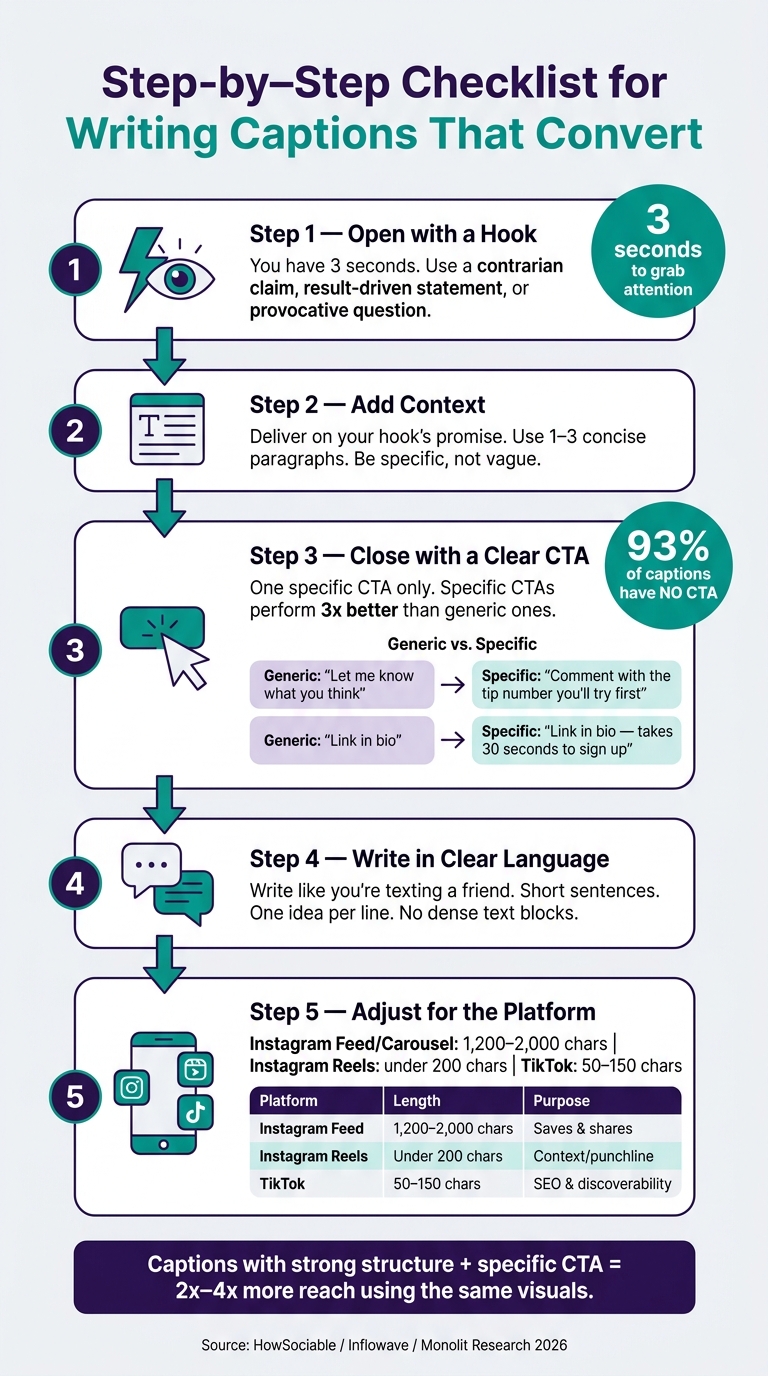
Caption Writing Checklist: Hook to Conversion
When crafting captions that drive action, it's all about following a reliable structure: hook, context, and call-to-action (CTA). This approach works across all niches and content types, making it a go-to formula for creating captions that resonate.
Open with a Hook That Captures Attention
Instagram users typically decide within 3 seconds whether to read a caption or scroll past it. That means the opening line has to grab their attention instantly. Skip the fluff and get straight to the point.
The best hooks often follow specific patterns:
- A contrarian claim: "Why posting consistently is actually hurting your growth."
- A result-driven statement: "How I went from $0 to $30K MRR in 8 months."
- A provocative question: "Why does your engagement keep dropping even though your content is better?"
What makes these hooks effective is their use of concrete details, which instantly establish credibility.
"The visual gets them to stop. The caption is what makes them tap your profile. If the visual is the trailer, the caption is the first five minutes of the movie." - Inflowave Team
Add Context
Once you've captured attention, deliver on the promise of your hook. This is where you provide the insight, steps, or story that make your caption worth reading. Stick to one to three concise paragraphs to keep readers engaged. Avoid vague motivational phrases; instead, focus on specific details that add value.
Think of this section as the link between your opening hook and your CTA. It should answer the question your hook raised and naturally guide the reader toward the action you want them to take.
Close with a Clear Call-to-Action
The CTA is the most critical part of your caption, yet 93% of social media captions fail to include one. A well-crafted CTA encourages readers to take action, and specific CTAs perform 3x better than generic ones.
Here’s a comparison of generic versus specific CTAs:
| CTA Type | Generic (Low Conversion) | Specific (High Conversion) |
|---|---|---|
| Engagement | "Let me know what you think." | "Comment with the number of the tip you'll try first." |
| Traffic | "Link in bio." | "Link in bio - takes 30 seconds to sign up." |
| Sales | "Check out our new drop." | "Comment 'ME' if you want the early-access link." |
| Retention | "Hope this helps." | "Save this post for your next content sprint." |
Place your CTA as the final line, separated by a line break to make it stand out.
Write in Clear Language
Before posting, read your caption out loud. Write like you’re texting a friend. Use short sentences, focus on one idea per line, and break up your text with clear line breaks. Avoid dense blocks of text that might discourage readers.
Formatting is just as important as the words themselves. Make your caption visually easy to read to keep your audience engaged.
Adjust for the Platform and Content Type
Different platforms require different approaches. For Instagram, longer, story-driven captions work well for carousel posts since the algorithm favors dwell time. On TikTok, shorter captions that align with search behavior perform better. Use phrases like "3 things I wish I knew about [topic]" or "How to [solve specific problem]" to help TikTok index your content effectively.
For Instagram Reels and TikTok, keep captions under 150 characters, treating them like keyword tags. For educational carousels, you can go longer - up to 2,000 characters - but ensure every line adds value.
Caption Tips for Instagram and TikTok
Instagram and TikTok have distinct approaches to captions, and tailoring your strategy for each platform is key to boosting engagement. What works on Instagram might not translate well on TikTok, so here’s how to make the most of each.
Instagram Caption Best Practices
On Instagram, captions are more than just an afterthought - they act as a second layer of content. Creators who treat captions this way often see 2x–4x greater reach. Since 2026, Instagram’s algorithm has focused heavily on dwell time, meaning longer, engaging captions can directly improve your post’s performance.
The golden rule? Start with a strong hook. Instagram truncates captions on mobile, so grab attention immediately. After the hook, adjust your caption length to fit the content type. For Reels, keep captions short - under 150 characters - since the video is the main focus. For educational carousels, longer captions (1,200–2,000 characters) perform better because they encourage users to stay on the post longer.
When it comes to hashtags, less is more. Stick to 3–5 niche-specific hashtags instead of cramming in 20–30 broad ones. Hashtags have lost about 40% of their organic reach value since 2023, so focus on naturally incorporating keywords into your caption instead. And ditch generic calls to action (CTAs) like “link in bio.” Instead, try prompts that encourage comments, like “Comment ‘GUIDE’ and I’ll send it to you.” This approach reduces user friction and increases engagement through comments.
These strategies aren’t just about getting likes - they’re designed to drive meaningful actions like saves and comments, which Instagram now prioritizes.
"Instagram's ranking model now weights how long a user spends on a single post far more heavily than it does likes or follows." - Inflowave Team
While Instagram thrives on storytelling, TikTok takes a completely different approach.
TikTok Caption Best Practices
On TikTok, captions function more like SEO metadata. With nearly 1 in 3 users now treating TikTok as a primary search engine, your captions need to include the exact keywords people are searching for. Forget clever taglines - think straightforward, search-friendly phrases.
TikTok only displays a snippet of your caption during video loops, so brevity is key. Stick to 50–150 characters, and use that space to add context not covered in the video - whether it’s a stat, a punchline, or a direct call to action like “Comment ME for the link”. To maximize discoverability, make sure your caption keywords align with any text overlays in your video. When these elements match, TikTok’s algorithm better categorizes your content and serves it to the right audience.
By focusing on keywords and concise messaging, TikTok captions can drive both visibility and engagement.
"TikTok is a search engine now. Include keywords people are actually searching for." - Krumzi
Post-Publishing Checklist: Reviewing and Improving Your Captions
Planning your captions is just the beginning. What happens after you hit "post" is equally important. A solid post-publishing routine ensures your captions evolve and perform better over time.
Track the Right Performance Metrics
Not all metrics are created equal. While likes might seem like a quick win, they don't reveal much about how well your captions are actually working. Instead, focus on metrics like dwell time, link taps, and comments - these offer real insights into your caption's effectiveness.
| Metric | What It Tells You |
|---|---|
| Dwell Time | Shows your hook and structure kept readers engaged |
| Link Taps | Indicates your CTA was clear and compelling |
| Comments | Reflects whether your caption sparked meaningful interaction |
Dwell time is especially relevant in 2026. If your caption can hold a reader's attention for 15–30 seconds, it signals to Instagram's algorithm that your content deserves a broader reach.
"The visual gets them to stop. The caption is what makes them tap your profile." - Inflowave Team
Once you've gathered data, use it to identify trends that drive better engagement.
Spot Patterns in Your Best-Performing Captions
After a few weeks of posting, start analyzing your top-performing captions. Which hooks got readers to click "See more"? Was it curiosity-driven phrasing, bold claims, or direct promises of value? Which CTAs encouraged the most interaction - comments, saves, or shares? Did shorter captions work better, or did longer ones resonate more?
To make this process easier, keep a log of your best hooks, CTAs, and caption structures. Organize these into categories like educational posts, behind-the-scenes content, or social proof. This approach helps you identify what types of content your audience connects with most.
For a faster and more detailed analysis, consider using AI tools.
Use AI Tools to Keep Improving
Manually spotting trends can be time-consuming, but AI tools can handle the heavy lifting. Platforms like Outfame provide real-time analytics to help refine your caption strategy. Outfame examines engagement triggers such as curiosity-driven hooks and readability while aligning its insights with current algorithm trends. This helps you quickly identify what’s working - and what’s not.
The real-time analytics dashboard is especially useful. Instead of waiting days to assess performance, you can catch underperforming posts early and adjust your strategy for the next one. AI tools act as diagnostic aids, helping you fine-tune your captions without losing your personal touch.
Conclusion: Writing Captions That Get Results
Creating captions that truly connect with your audience is an ever-changing process. The checklist here gives you a solid foundation: define your goal before you write, grab attention with the first line, provide meaningful value, and end with a clear, specific call-to-action (CTA).
To sum it up: captions with a well-thought-out structure and a strong CTA can significantly boost engagement. In fact, creators who prioritize captions as a key part of their content strategy often see 2–4x more reach using the same visuals.
Keep evolving your strategy by analyzing performance data. Captions that keep readers engaged signal algorithms to promote your posts more often. Track metrics like dwell time, save rates, and link clicks every week. Identify what resonates, cut out what doesn’t, and remember - this checklist isn’t static. Your goals, hooks, value delivery, and CTAs will need regular tweaks as your audience and social platforms continue to shift.
With tools like Outfame’s real-time analytics and AI-driven insights, you can fine-tune your captions based on live data and keep your audience engaged consistently.
FAQs
How do I choose the best CTA for my post?
When crafting a call-to-action (CTA), clarity is key. Stick to one clear instruction - multiple requests can confuse your audience and reduce conversions.
Align your CTA with your specific goal. For instance:
- If you want to increase visibility, encourage actions like saving or sharing your post.
- For more targeted results, use direct commands such as “DM me [keyword]” to prompt specific actions.
Steer clear of vague phrases like “Let me know your thoughts.” Instead, go for specific and actionable requests, such as asking followers to tag a friend or comment with a particular word. This makes it easier for your audience to engage and helps you achieve your desired outcome.
What hook types work best for my niche?
- Contrarian hooks: "Everyone is wrong about X…"
- Curiosity hooks: "Nobody talks about this…"
- Question hooks: "Why does X keep happening to you?"
- Confession/story hooks: "I used to believe X. Then…"
- Result/number hooks: "I got X in Y days - here’s how."
Keep your hooks short - under 125 characters - to trigger a “see more” tap. Make sure they provide value and end with a clear call-to-action, like asking viewers to comment, save, or share.
How long should I wait before judging caption performance?
To keep your caption strategy sharp, review your performance metrics on a weekly basis. Pay attention to key indicators like link-in-bio clicks and direct messages. Experiment with different hooks and writing styles each week, then analyze how these changes impact engagement rates. Look for patterns in what drives profile visits, follows, saves, and comments.
By consistently monitoring your results, you can fine-tune your approach using real-time data. This steady adjustment helps you stay on track for long-term growth.


