
Using niche hashtags on Instagram and TikTok can greatly improve how your content reaches the right audience. Here's the key takeaway:
- Instagram: Hashtags act as content classification tools, helping the algorithm categorize posts for discovery on Explore, Reels, and Search. Stick to 3–5 relevant hashtags, as overloading posts with generic tags can hurt engagement. Focus on Save Rate (saves divided by reach) to measure success.
- TikTok: Hashtags guide videos to niche audiences on the For You Page. Use 3–5 specific hashtags that align with your video's topic. The algorithm prioritizes watch time and completion rate, so hashtags should support, not define, your video's success.
Quick Comparison
| Feature | TikTok | |
|---|---|---|
| Main Purpose | Content classification (SEO) | Audience targeting (FYP grouping) |
| Hashtag Limit | 5 max | 3–5 recommended |
| Key Metric | Saves and shares | Watch time and completion rate |
| Discovery | Explore, Reels, Search | For You Page |
| Overuse Penalty | Up to 5x reach penalty | Moderate reach dilution |
Instagram hashtags are about precision, while TikTok hashtags are about connecting with trends and interests. Tailor your strategy to the platform’s strengths for better engagement.
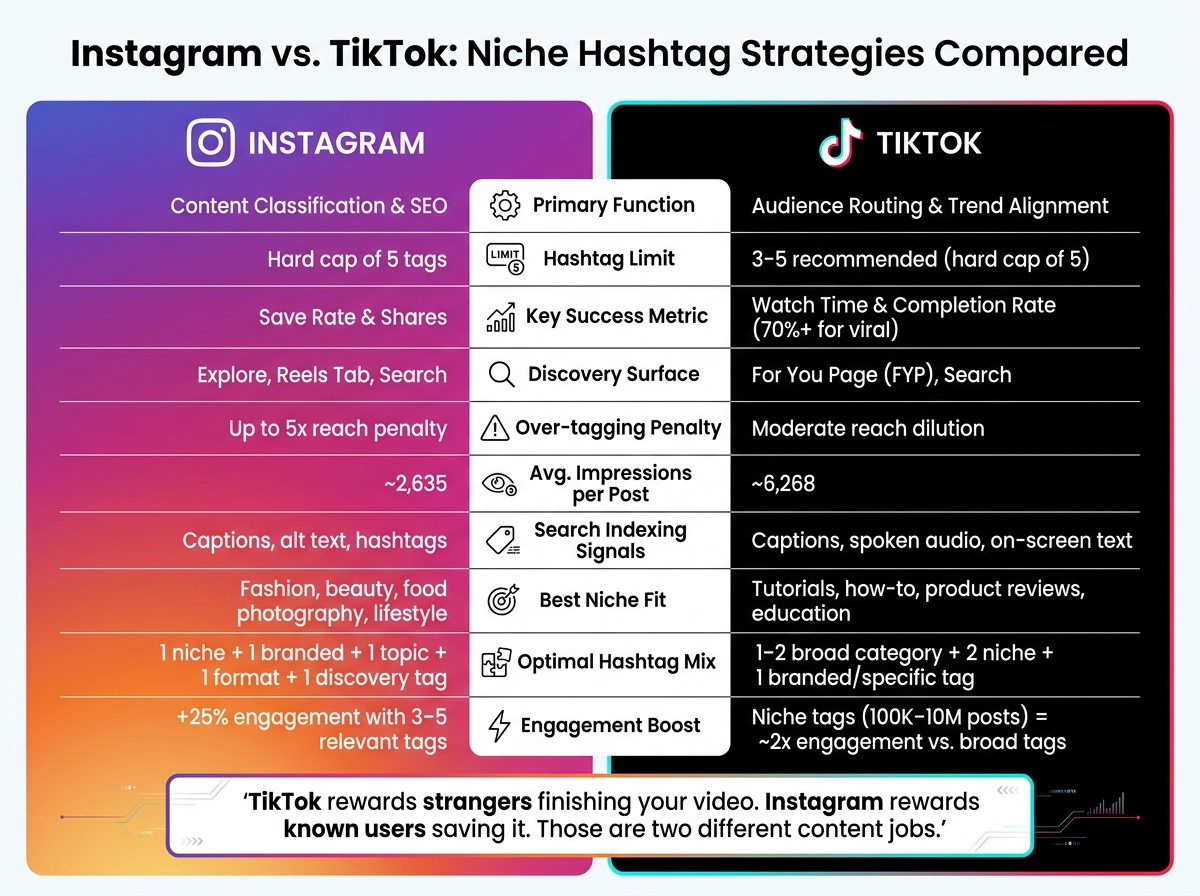
Instagram vs. TikTok Niche Hashtag Strategy: Side-by-Side Comparison
Use This NEW Hashtag Strategy To Go VIRAL on Instagram in 2026 (HUGE CHANGES)
How Hashtags Work Differently on Instagram and TikTok
Instagram and TikTok approach hashtags with distinct purposes: Instagram uses them to classify content, while TikTok employs them to group topics. These differences impact how you should use hashtags strategically on each platform.
Instagram: Search, Categorization, and Explore Page Discovery
On Instagram, hashtags function like SEO tools, helping the algorithm classify content for discovery on the Explore page, Reels, and Search. They’re not standalone drivers of reach but work in tandem with captions and alt text.
"Hashtags now function as content classification signals for Instagram's algorithm, not standalone reach drivers; content quality, watch time, and engagement behavior carry more weight." - Talar Mazloumian, Later
Since Instagram removed the ability to follow hashtags in December 2024, hashtagged posts now reach non-followers mainly through algorithmic recommendations. Then, in December 2025, Instagram introduced a hard cap of 5 hashtags per post or Reel. Posts using 3–5 relevant hashtags tend to see about 25% higher engagement compared to posts overloaded with 10 or more tags.
Placement is also key. For accounts with fewer than 5,000 followers, placing hashtags in the caption can increase reach by around 36% compared to hiding them in the first comment.
While Instagram prioritizes content classification and precise discovery, TikTok takes a different path.
TikTok: For You Page Algorithm, Trends, and Content Clustering
TikTok’s algorithm uses hashtags to connect videos with specific interest groups on the For You Page (FYP), shaping which niche audiences see your content first.
"TikTok doesn't show you content from people you follow - it shows you content it predicts you'll watch." - Jamie Partridge, CEO, PostEverywhere
Hashtags on TikTok act as an initial signal, but broader reach depends on key metrics like watch time and completion rate. As of 2026, videos need about a 70% completion rate to qualify for viral distribution. TikTok also introduced follower-first testing that year, where new videos are shown to existing followers first to gauge engagement before being pushed to a larger audience.
The ideal hashtag count on TikTok is 3–5 tags. Using more than 5–7 tags can confuse the algorithm, making it harder to properly categorize your content.
These differences underscore the need for tailored strategies on each platform.
Key Differences Between Niche Hashtag Strategies on Each Platform
| Feature | TikTok | |
|---|---|---|
| Primary Function | Content classification & SEO | Topic clustering & trend alignment |
| Hashtag Limit | Hard cap of 5 tags | No hard cap; 3–5 recommended |
| Core Discovery | Social graph + interest graph | Pure interest graph |
| Top Ranking Signal | Saves and shares | Watch time & completion rate |
| Search Indexing | Captions, alt text, tags | Captions, spoken audio, on-screen text |
| Average Impressions per Post | ~2,635 | ~6,268 |
In short, Instagram favors precise, context-driven hashtags to help its algorithm understand your content. On TikTok, hashtags are just the starting point - success depends on how well your video captures and holds attention right from the start.
Niche Hashtag Strategy for Instagram
With Instagram's recent updates - like removing hashtag following in December 2024 and enforcing a strict 5-hashtag limit in December 2025 - it's clear that hashtag strategies need a serious overhaul. Now, every hashtag you use has to pull its weight.
How to Build a Balanced Niche Hashtag Mix
The 5-Tag Framework is a reliable way to make the most of the limited slots: include one niche community tag, one branded tag, one topic tag, one format tag (like #ReelsTutorial), and one rotating discovery tag. This setup provides a strong balance, helping Instagram’s algorithm categorize your content effectively.
Pay attention to hashtag volume tiers. Niche tags (10K–500K posts) are great for staying visible in Top Posts. Mid-tier tags (500K–5M posts) give your content broader exposure, while a single broad tag (5M+ posts) can help define your category.
A good example of this strategy in action comes from fitness brand Sweaty Betty. In June 2026, they paired the niche tag #GlobalRunningDay with their branded tag #IAmASweatyBetty. This combination drew in fitness enthusiasts searching for specific content while also encouraging user-generated posts. Their top-performing posts surpassed 2,000 likes.
"Mastering your hashtag strategy in 2025 is about moving from a broadcaster mindset to a librarian mindset. Instead of trying to reach everyone, you are labeling content so it is easier for the right audiences to find." - eOptimize Editorial Staff
Once you have a framework in place, analytics will help you fine-tune it for better results.
Using Analytics to Track and Improve Hashtag Performance
Instagram Insights' "From Hashtags" metric is your go-to tool for tracking non-follower traffic. But in 2026, the Save Rate (saves divided by reach) is an even better indicator of how well your content resonates. With saves and shares carrying more weight in Instagram’s algorithm than likes, focusing on Save Rate gives you a clearer picture of your content’s effectiveness. If a hashtag set is driving impressions but not saves, it’s likely reaching the wrong audience.
To improve results, make A/B testing a regular part of your strategy. Post similar content three days apart, using different hashtag sets, and compare metrics like reach, impressions, and saves. Creators who test and rotate their hashtags consistently have reported up to a 40% boost in reach over three months. Also, audit your main hashtags monthly. If a tag’s "Recent Posts" section is hidden or shows a content warning, it’s likely restricted and will hurt your post’s visibility.
Avoid common mistakes so your analytics reflect genuine engagement.
Common Instagram Hashtag Mistakes to Avoid
Gone are the days of stuffing posts with 30 hashtags. In 2026, using too many generic tags can trigger spam signals. Stick to 3–5 relevant hashtags and rotate them every 5–10 posts. Copy-pasting the same block of tags repeatedly can lead to "hashtag fingerprinting", where the algorithm flags your account for spam-like behavior.
Another pitfall is semantic mismatch. Instagram’s AI now uses computer vision to ensure your hashtags align with your visual content and captions. Using a trending tag that doesn’t match your post can suppress its reach instead of boosting it.
Here’s a quick comparison of best practices versus common mistakes:
| Best Practice | Common Mistake |
|---|---|
| Use 3–5 relevant hashtags | Overloading posts with 30 generic tags |
| Rotate hashtag sets every 5–10 posts | Copy-pasting the same block on every post |
| Use niche tags (10K–500K post volume) | Relying only on mega-tags (#love, #fitness) with 1B+ posts |
| Match tags to visual content and caption keywords | Using unrelated trending tags |
| Check tags for restrictions before posting | Using banned or restricted hashtags unknowingly |
| Focus on Save Rate and Share metrics | Measuring success by Like count alone |
Niche Hashtag Strategy for TikTok
TikTok's hashtag game is a whole different ballpark compared to Instagram. In August 2025, TikTok introduced a strict 5-hashtag limit, redefining hashtags as tools to confirm a video's topic rather than expand its reach. The platform's algorithm does the heavy lifting - analyzing audio, scanning on-screen text, and determining your video's subject. Hashtags simply back up what the algorithm already knows.
How to Build Effective Niche Hashtag Sets on TikTok
With only five hashtags to work with, you need to make every one count. A smart mix includes:
- 1–2 broad category tags (10M+ posts)
- 2 niche tags (100K–10M posts)
- 1 branded or content-specific tag
Niche tags in the 100K–10M range often deliver about twice the engagement of broader tags. Forget generic hashtags like #FYP, #ForYou, or #Viral - they don't boost your visibility in 2026 and waste valuable space. Instead, go for specific, descriptive tags that match what your audience is searching for. For instance, #BestBudgetLaptop will bring in more focused traffic than something vague like #Tech.
Adidas nailed this strategy in January 2026 with a James Harden post. They used a mix of fan-specific tags like #jamesharden, branded tags like #adidas, #UNO, and #vol10, and a broader tag like #sneakers. This blend targeted both niche communities and wider audiences.
Trend Research and Hashtag Testing on TikTok
TikTok itself is a goldmine for finding niche hashtags. Tools like TikTok CreatorSearch Insights show search volume for specific keywords, and the autocomplete bar reveals what users are actively looking for. When testing hashtags, focus on top travel influencers or mid-tier creators with 100K–1M views. These accounts often use repeatable hashtag strategies that yield consistent results, unlike viral posts that can be one-hit wonders.
Avoid reusing the same hashtag sets repeatedly, as it can trigger spam signals and hurt your visibility. Testing and tweaking your tags will help you adapt to TikTok's dynamic trends.
TikTok-Specific Opportunities and Limitations
One clever approach is combining location and niche tags. For example, pairing #NYCfoodie with #foodblogger helps you connect with local, highly engaged micro-communities. For brands, dedicated hashtags can double as social listening tools. Jellycat’s branded hashtag #jellycat is a perfect example - it has surpassed 1 billion views by encouraging fans to share their collections, transforming a simple tag into a thriving user-generated content hub.
However, there are some limitations. Hashtags in the comments section don’t carry the same weight as those in the video caption, as the algorithm prioritizes the main description. Before using a tag, check its page. If there are no "top videos" or if a warning appears, the tag may be suppressed, which could hurt your visibility. Refresh your hashtag sets every 90 days to stay in tune with shifting trends and engagement levels.
"The algorithm watches your video, transcribes the audio, scans on-screen text and then uses tags as a tiebreaker." - HowSociable Editorial Team
Instagram vs. TikTok Niche Hashtag Strategies: A Side-by-Side Comparison
Both Instagram and TikTok limit users to 5 hashtags per post, but the way hashtags function on each platform is entirely different. Misunderstanding these differences can trip up niche creators looking to maximize their reach and engagement.
Comparing Key Strategy Dimensions
The role of hashtags on Instagram is primarily about categorization. They help the algorithm figure out where your content fits - whether it's on Explore, Reels, or in Search. On TikTok, hashtags act more like a roadmap, guiding the algorithm to an initial audience that might resonate with your video. Instagram prioritizes metrics like saves and shares to boost your content's reach, while TikTok focuses on watch time and how often viewers finish your video.
"The brands and creators seeing real Instagram reach growth in 2026 are the ones who understand what hashtags actually do for the algorithm now: they're classification signals, not traffic sources." - Talar Mazloumian, Later
This difference becomes even more apparent when analyzing performance data. Posts without hashtags on Instagram tend to perform better in raw reach, with a median view count of 24,528. However, posts using 3–5 niche hashtags, while achieving a lower median view count of 9,420, see a save rate of 0.616% - more than double that of posts without hashtags. This shows how niche hashtags can help you connect with a more engaged audience, even if overall reach is lower.
| Dimension | TikTok | |
|---|---|---|
| Primary Function | Classification & search indexing | Audience routing & trend alignment |
| Optimal Volume | 3–5 (hard cap of 5) | 3–5 (hard cap of 5) |
| Discovery Surface | Explore, Reels Tab, Search | For You Page, Search |
| Key Metric | Saves and Shares | Watch Time and Completion Rate |
| Over-tagging Risk | Up to 5x reach penalty | Moderate reach dilution |
| Niche Fit | Visual identity, aesthetics, lifestyle | Tutorials, queries, how-to content |
Which Platform Fits Your Niche Best
When deciding between Instagram and TikTok, the nature of your niche should guide your choice. Instagram is better suited for visually driven niches like fashion, beauty, home decor, and food photography. These communities thrive on aesthetic consistency, and Instagram rewards content where visuals, captions, and hashtags work together seamlessly. For instance, fitness brand Sweaty Betty uses a mix of trending tags like #GlobalRunningDay and branded tags like #IAmASweatyBetty to engage their audience, consistently earning over 2,000 likes per post in 2026.
TikTok, on the other hand, shines in niches where audiences are actively searching for answers - think education, product reviews, or tutorials.
"TikTok is usually the better place to test direct query intent first... Instagram is usually stronger when search and visual identity work together." - Impressive Magazine
If your content answers questions like "how-to" or "what's the best", TikTok's search-driven algorithm gives you an edge. But if you're building a lasting visual brand identity, Instagram's layered ecosystem is likely the better fit. Once you've chosen the platform that aligns with your goals, the next step is mastering how to measure and refine your hashtag strategies on both.
Cross-Platform Niche Hashtag Optimization and Performance Tracking
Keeping Hashtag Use Consistent Across Platforms
When working with a niche identity, it's important to tailor your hashtag strategy to each platform. While you might target the same audience on Instagram and TikTok, that doesn’t mean you should copy and paste the same hashtags across both. Instead, adapt your core niche identity to fit each platform's unique dynamics - keeping your topic consistent but tweaking the execution.
On Instagram, your hashtags should tie your content to a visual niche. A solid mix might include community tags, branded tags, topic-specific tags, format-based tags, and a rotating discovery tag. On TikTok, however, the focus shifts to search intent. This means using query-style phrases and trend-driven tags that align with what your audience is actively searching for. For instance, a food creator might use #CastIronCooking on Instagram to connect with a community, but switch to #CastIronRecipes on TikTok to target search traffic. Build a small library of these adaptable hashtag sets and rotate them regularly to keep your content fresh while reinforcing the unique hashtag functions of each platform.
How to Measure and Refine Hashtag Performance
Once you’ve tailored your hashtag strategy, tracking performance becomes essential. Each platform has its own metrics to watch. On Instagram, the "Reach from Hashtags" metric in Insights shows how many non-followers discovered your post through tags. Pair this with the save rate - posts with 4–6 niche hashtags have a save rate of 0.616%, which is more than double the rate of untagged posts. On TikTok, focus on watch time and completion rates, as these are the metrics the algorithm prioritizes.
To refine your hashtag approach, follow this simple four-step loop:
- Research: Use tools like TikTok CreatorSearch Insights or Instagram’s Explore page to find active hashtags with 10,000–500,000 posts.
- Test: Experiment with different hashtag sets across platforms to identify what works best.
- Measure: Check Instagram’s "Reach from Hashtags" and TikTok’s completion rates to evaluate performance.
- Refine: Replace stagnant or restricted hashtags with new ones based on ongoing research.
"Hashtags shifted from being reach drivers to being classification labels. Instagram's algorithm now reads your hashtags the same way it reads your caption keywords." - Lilian Makena, Creator Economy Reporter
One key step that’s often overlooked is manually searching hashtags on Instagram before using them. Restricted or banned hashtags can severely limit your post’s reach - not just for that tag but for the entire post.
How Outfame Supports Niche Hashtag Growth
Managing hashtag performance across multiple platforms can be a time sink. That’s where Outfame comes in. This tool combines AI-powered audience targeting with real-time analytics, making it easier to see which niche segments are engaging with your content - all without needing to juggle multiple dashboards.
Conclusion: Key Takeaways for Niche Hashtag Strategies on Instagram and TikTok
Instagram and TikTok approach hashtags in distinctly different ways. On Instagram, hashtags serve as classification tools, helping content get indexed for Explore, Reels, and Search. TikTok, on the other hand, uses hashtags as metadata to direct content to an initial test audience, where metrics like watch time and completion rate take center stage.
These differences shape how hashtags should be used on each platform. For Instagram, sticking to 3–5 relevant hashtags can boost engagement by 25%, whereas using over 10 generic tags tends to dilute results. On TikTok, accounts that post across more than three unrelated topics often see their reach drop by about 45%.
"TikTok rewards strangers finishing your video. Instagram rewards known users saving it. Those are two different content jobs." - Influencers-Time
Key ranking signals also differ: Instagram increasingly values saves and DM shares, while TikTok prioritizes rewatches and completion rates. To get the most out of your content, tailor your hashtags to encourage the behaviors each platform favors.
Instead of treating hashtag strategies as static, think of them as evolving systems. Regularly audit your approach and adjust based on performance data. Staying adaptable and diving into niche hashtag research will help you stay ahead as Instagram and TikTok continue to change.
FAQs
How do I pick the best niche hashtags fast?
Finding the right niche hashtags doesn't have to be complicated. Most platforms offer built-in tools that make the process easier, and focusing on engagement signals can help you narrow down your options.
On Instagram, start by searching your topic under the Tags tab. Look for hashtags with around 10,000 to 500,000 posts - this range often strikes a balance between visibility and competition. Once you've found some options, test out 3–5 highly relevant hashtags to see how they perform.
For TikTok, use the platform's keyword search and autocomplete suggestions to discover hashtags that align with your niche and what your audience is searching for. Again, select 3–5 hashtags that feel like a good fit.
Keep an eye on your content's Insights to track performance. Stick with the hashtags that drive the most engagement, and refine your choices as you go.
When should I change my hashtag sets?
To keep your content fresh and avoid triggering spam filters, rotate your hashtag sets regularly. Platforms like Instagram and TikTok cap posts at five hashtags, so prepare several sets of 3–5 relevant tags and alternate between them. Combine niche hashtags, content-specific ones, and trending tags to send stronger classification signals without becoming repetitive. Tools like Outfame can assist in crafting effective hashtag strategies to support organic growth.
Why do my hashtags get views but no results?
If your hashtags are getting views but not translating into meaningful engagement, it might be because they’re being used more as tools to boost reach rather than to signal relevance. Algorithms care more about the context of your content than the hashtags themselves, so overly broad tags like #fyp often attract viewers with little interest or intent.
Instead, stick to 3–5 niche-specific hashtags that align closely with your content. This approach helps the algorithm connect your posts with an audience that’s genuinely interested. Plus, metrics like saves, shares, and watch time will have a bigger impact on your success than sheer reach.


