
Want to earn more as a creator? Start negotiating your brand deals. Most creators leave 30–50% of potential revenue on the table by accepting the first offer. Negotiation isn’t just about money - it’s about protecting your rights, like avoiding “in perpetuity” content usage that lets brands profit from your work forever without extra pay.
Here’s the bottom line:
- Brands expect negotiation. 68% already budget for higher rates.
- Understand key terms. Licensing, exclusivity, and kill fees can make or break your deal.
- Preparation is key. Set your target rate, know your walkaway number, and back your ask with data like engagement rates.
Creator Agreement Basics
What Is a Creator Agreement?
A creator agreement - also known as an influencer brand agreement or sponsored content agreement - is a formal contract between a creator and a brand (or agency). This document spells out the obligations of both parties, covering deliverables, content usage rights, payment schedules, and legal restrictions. When an agency is involved, it typically takes care of communications, approvals, and payments for the brand. Relying on informal agreements, like verbal promises or direct messages, leaves you with little to no legal recourse if things go wrong. As attorney Hansen Tong explains:
"A creator agreement is the legal document that defines exactly what each party owes the other. Without one, a brand can find itself with no rights to repurpose a video it paid for."
Under U.S. copyright law, creators automatically own the rights to their content unless they sign a contract transferring those rights to the brand. This makes it crucial to fully understand what you're agreeing to before signing. Knowing these basics is the first step to navigating the various types of agreements creators encounter.
Common Types of Creator Agreements
The structure of your deal impacts everything from the contract's complexity to how much you can charge. Here are four common types of creator agreements:
| Agreement Type | Duration | What It Covers |
|---|---|---|
| Sponsored Post | Short-term (1–7 days) | One-off deliverables for a specific campaign |
| Brand Ambassadorship | 6–24 months | Ongoing content with exclusivity and potential bonuses |
| UGC Licensing | 30 days to perpetual | Content used in brand marketing without requiring a post |
| Whitelisting | Campaign-specific | Brand runs paid ads directly from your social accounts |
The differences go beyond duration. For instance, a $5,000 one-time post and a $50,000 annual partnership come with vastly different legal considerations. As Hansen Tong notes:
"A $5,000 flat-fee post and a $50,000 annual partnership each carry very different legal risks, and the contract should reflect that."
Deals like whitelisting and UGC licensing often require extra attention. These agreements are less about creating new content and more about how the brand intends to use your existing work.
Key Legal Terms to Know
You don’t need to be an attorney to negotiate a creator agreement, but understanding a few key terms can make all the difference:
- Licensing vs. Assignment: Licensing gives the brand temporary rights to use your content, while an assignment permanently transfers ownership. Most agreements are better structured as licenses.
- Usage Rights: These define where and how the brand can use your content. "Organic rights" allow reposts on the brand's social channels, while "paid usage rights" (for use in ads) are more valuable and often justify a 30–50% premium over your base rate.
- Exclusivity: This clause limits your ability to work with competing brands for a set period. To avoid unnecessary restrictions, specify narrow categories - like "energy drinks" instead of all "beverages." Premiums for exclusivity typically range from 20–35% for 30 days to 100–150% for a full year.
- Kill Fee: Protects you if the brand cancels after you've started work. Standard terms include 25% of your fee before production begins and 50–75% after production starts.
- Indemnification: This outlines who covers legal costs if a third party files a claim. Push for mutual indemnification to ensure you're not held liable for issues related to the brand's product.
"The brand manager who promised 'don't worry, we'd never run this on a billboard' is irrelevant the moment you sign a contract that grants billboard rights. The signed document controls - full stop." - Promise Legal
Understanding these terms can help you protect your rights and ensure fair compensation in any creator agreement.
sbb-itb-3b12fba
How to negotiate and land paid brand collaborations💪🏽
How to Prepare for Negotiation
Negotiation success often hinges on preparation. Walking into discussions with a well-researched, structured plan can help you secure better outcomes.
Set Your Goals and Limits
Before engaging with a brand, establish two essential numbers: your target rate (what you'd ideally like to earn) and your walkaway number (the lowest amount you're willing to accept). Beyond monetary considerations, think about other key factors: Does the brand align with your values? How many revisions are acceptable? Are exclusivity clauses workable for you? Setting these boundaries ahead of time ensures you're not caught off guard or pressured into unfavorable terms.
Another critical element is your BATNA, or "Best Alternative to a Negotiated Agreement." This is your backup plan if the deal doesn't go through. A strong BATNA not only provides confidence but also gives you the leverage to walk away from a poor offer.
Use Data to Back Your Rates
Brands are moving away from focusing solely on follower counts. While follower numbers accounted for 60% of a creator's perceived value in 2022, that figure may drop to just 25% by 2026. Metrics like engagement quality, audience sentiment, and conversion rates now carry more weight.
One way to calculate fair rates is by using the CPM formula:
(average views ÷ 1,000) × target CPM.
For example, Instagram Reels creators in the mid-tier range can often aim for CPMs between $12–$35, while TikTok creators typically see CPMs of $10–$25. Highlight metrics that demonstrate business impact, such as click-through rates, saves, or shares, rather than relying solely on follower counts.
"Data shifts the conversation from 'is this creator worth it?' to 'how do we make this deal work?'" - Aayush Upadhyay, Co-founder, Snippet
Another effective tactic is to quote a rate 20–30% higher than your target. This gives you room to make concessions while still meeting your earnings goal.
Build a Negotiation Toolkit
Having a well-organized toolkit not only reflects professionalism but also helps streamline the negotiation process. Here’s what your toolkit should include:
| Resource | What It Includes |
|---|---|
| Media Kit | Your bio, audience demographics, platform stats, and previous brand collaborations |
| Rate Card | Detailed pricing, including base rates, usage fees, exclusivity charges, and payment terms |
| Case Study Deck | Campaign analytics, screenshots, conversion data, and brand testimonials |
| Contract Checklist | Key terms like deliverable limits, revision policies, usage timelines, and kill fees |
After every campaign, document your performance metrics - impressions, engagement rates, and clicks. Over time, this "proof deck" becomes a powerful asset for negotiations. Additionally, keep a completed W-9 form ready to simplify onboarding and demonstrate your professionalism.
Use Strong Metrics to Improve Your Position
Your performance metrics are your strongest leverage. For example, a creator with an engagement rate above 5% is often more appealing to brands than someone with twice as many followers but weaker audience interaction. With organic reach on Instagram dropping below 5% for many accounts, your engagement data needs to stand out.
This is where tools like Outfame can help. Outfame uses automated audience targeting and real-time analytics to build a genuinely engaged following. When brands see that your audience is authentic and actively engaged, the conversation naturally shifts toward structuring a deal that benefits both parties.
Contract Terms to Review and Negotiate
When it comes to contract negotiations, knowing which clauses to focus on can make the difference between a fair deal and leaving a significant chunk of your earnings behind. Research indicates that 62% of creators sign their first brand deal without negotiating any terms, potentially forfeiting 20–40% of their earnings by accepting standard agreements. Below are the key areas to review and negotiate for a more equitable arrangement.
Deliverables and Scope of Work
Vague terms around deliverables can lead to extra work without additional pay. Phrases like "content as reasonably requested" are a red flag.
"A well-drafted scope of work specifies the exact number of posts, stories, reels, or videos required, the platforms where content will be published, content format requirements (length, orientation, resolution), whether the brand has approval rights... and the timeline." - Agarunov Law Firm
Be specific. Outline the exact content requirements, such as "3x 30-second vertical Reels at 1080p", specify the platforms for posting, and include a clear timeline that covers product delivery, content creation, brand review, and the go-live date. Watch out for hidden obligations like event appearances, voiceovers, or delivering raw files. If raw footage is required, price it separately, as it gives brands flexibility to repurpose the content beyond the final cut.
Equally important is how your content will be used after it's created.
Usage Rights and Licensing
This is a critical area where creators often lose control or money. Licensing terms should clearly define the duration and geographic scope of use. Avoid giving away ownership through clauses like "work made for hire" or full IP assignment.
Every licensing agreement should answer these key questions: Where can the brand use your content? How will it be used (e.g., organic posts, paid ads, or whitelisting)? For how long? And who can use it (just the brand, or also their agencies and affiliates)? A 30-day U.S.-only paid ad license is vastly different from a worldwide, multi-year license and should be priced accordingly. Paid social ad rights often add 25% or more to the deal for short-term use, and over 100% for extended rights. Be wary of terms like "in perpetuity", "irrevocable", or "all media now known or later developed", as they can block future collaborations in the same niche.
If the brand wants whitelisting or Spark Ads access (running ads through your account), treat this as a premium service that increases the value of your deal.
Exclusivity and Non-Compete Clauses
Broad exclusivity clauses can quietly limit your earning potential. For example, a clause that bans you from working with "any skincare brand" for 90 days could cut off lucrative opportunities. Instead, negotiate for a narrower scope, naming specific competitors rather than an entire category, and ensure the clause has a clear time limit. Compensation for exclusivity is standard - expect an additional 20–40% for a 30-day restriction and up to 100% for a 90-day period.
Compensation and Payment Terms
Default payment terms like "Net 60" or "Net 90" can leave you waiting months to receive payment. To maintain steady cash flow, negotiate for Net 30 terms with a 50% upfront deposit - especially for new partnerships or deals over $3,000. Larger contracts, exceeding $10,000, often use a three-part payment structure: 33% upon signing, 33% upon content approval, and 34% upon posting.
Include a late payment clause to protect yourself - 1.5% monthly interest on overdue balances is a common standard. To safeguard against cancellations, use a tiered kill fee structure:
| Cancellation Stage | Kill Fee (% of Total Fee) |
|---|---|
| After concept development | 25% |
| After filming/production | 50% |
| After content submission | 75% |
| After posting | 100% |
Approval Timelines and Revision Limits
Without clear deadlines for approvals, brands can delay your content indefinitely, disrupting your schedule and income. Contracts should specify a 48–72 hour approval window, with a clause that automatically deems the content approved if the brand doesn't respond within that timeframe.
Set limits on revisions to avoid excessive back-and-forth. A reasonable cap is one major and one minor revision round. If the brand requests a complete overhaul after the first draft, treat it as a new project with additional fees. Extra revision rounds typically cost $200–$500 each or 10–15% of the deal value.
Step-by-Step: How to Negotiate a Creator Agreement
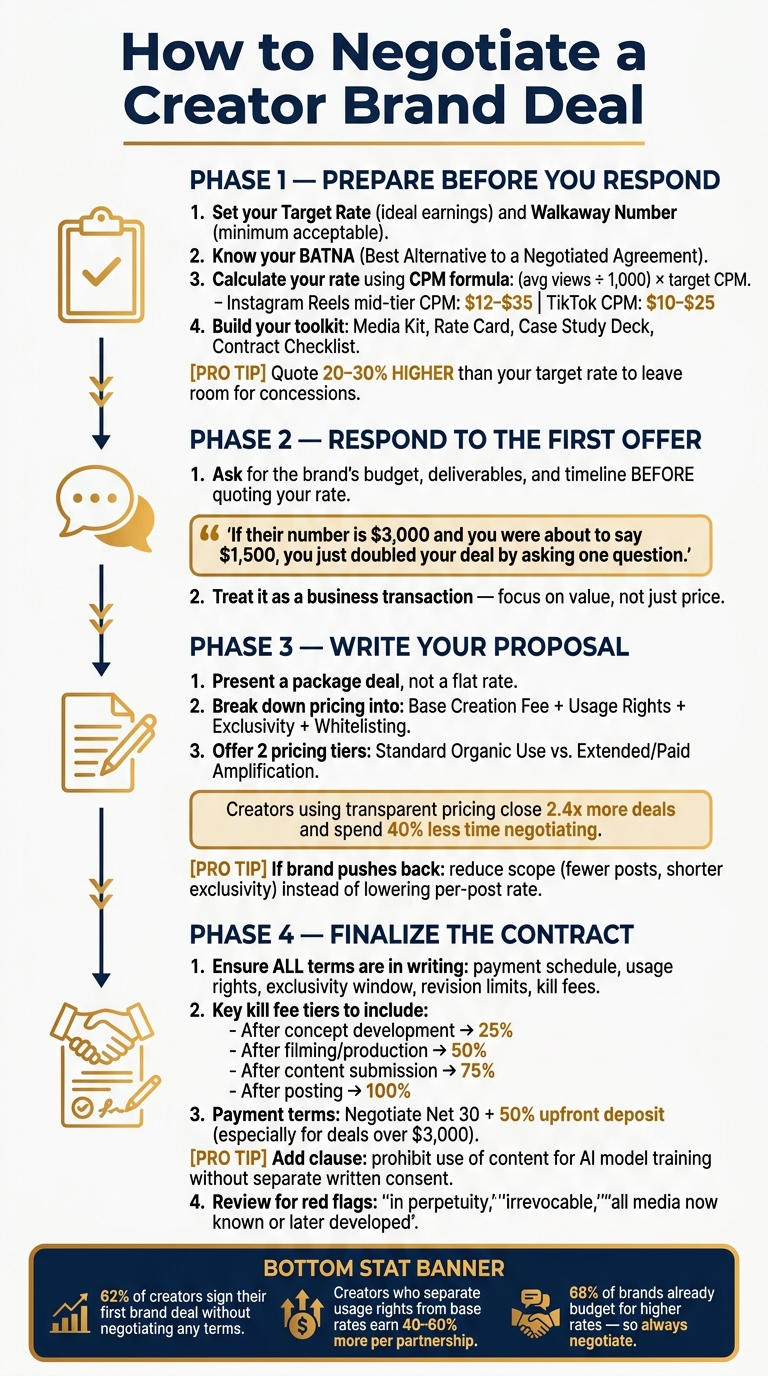
How to Negotiate a Creator Brand Deal: Step-by-Step Guide
Once you're prepared for negotiations, these steps can help you lock in a fair and mutually beneficial creator agreement.
How to Respond to the First Offer
When a brand reaches out, your first move should be to request their budget, deliverables, and timeline before quoting your rate. This small adjustment can significantly impact the outcome of your negotiation.
"If their number is $3,000 and you were about to say $1,500, you just doubled your deal by asking one question." - Andrew Masek, Co-founder, Snippet
By starting with their numbers and expectations, you avoid guessing and position yourself to negotiate with clarity. Treat the process like a business transaction, focusing on value and fairness.
How to Write Your Proposal
When crafting your proposal, think of it as a package deal rather than a simple list of services. Start with an opening ask that's 20–30% higher than your target rate, then adjust the details of the package as needed. Break down your pricing so the brand can clearly see what they’re paying for, including the base creation fee and any extras like usage rights, exclusivity, or whitelisting.
A great strategy is to offer two pricing tiers: one for standard organic use and another for extended use, such as paid amplification. This approach provides the brand with options while keeping your per-deliverable rate intact. Creators who use this transparent pricing method close 2.4 times more deals annually and spend 40% less time negotiating.
How to Handle Counteroffers
If a brand pushes back with budget constraints, don’t immediately lower your rate. Instead, ask for their number and look for ways to adjust the scope of work to fit their budget. For example, you could say, "What's the budget you're working with? I’d like to see if we can align the scope with that." Avoid offering discounts - instead, trade deliverables for adjustments in pricing. This might mean reducing usage rights, cutting back on Story posts, or removing exclusivity clauses. Keep in mind, 68% of brands expect creators to negotiate down from their initial ask.
Once you’ve addressed any counteroffers, you’re ready to move toward finalizing the agreement.
How to Finalize the Agreement
After reaching an agreement, make sure all negotiated terms - such as payment schedule, usage rights, exclusivity, revision limits, and kill fees - are clearly outlined in a signed contract.
"Negotiating the rate is only half the job. The contract determines whether you actually get paid what you agreed to, and whether hidden clauses cost you money after the deal is signed." - Aayush Upadhyay, Co-founder, Snippet
Before signing, carefully review the contract for any red flags mentioned earlier. Additionally, include a clause that prohibits the brand from using your content to train AI models without separate written consent and compensation. Once everything is confirmed, document the next steps - like delivery timelines, approval processes, and go-live dates - to ensure both parties are on the same page.
Managing Agreements After You Sign
Signing a contract is just the beginning. What truly matters is how you manage it afterward - this can impact everything from getting paid on time to avoiding disputes and setting yourself up for better deals in the future.
Track Your Contract Details
After signing, make sure to log all the key dates in one centralized place. This includes content delivery deadlines, payment due dates, exclusivity end dates, and auto-renewal notice windows. Exclusivity clauses can extend beyond the campaign itself, often lasting 30–90 days after your final deliverable. Missing that exclusivity end date could unintentionally put you in breach of a future agreement with another partner.
Auto-renewal clauses are another tricky area. Many contracts require you to notify the other party 30–90 days before the renewal date if you want to opt out. If you miss this window, you might find yourself stuck with outdated terms for another full contract period. A simple spreadsheet with columns for each critical date and a reminder system can help you stay organized.
| Term Type | Common Duration | What to Track |
|---|---|---|
| Organic Usage Rights | 6–12 months | Date content must stay live |
| Exclusivity Window | 30–90 days post-campaign | Exclusivity end date |
| Payment (Net Terms) | Net 15, 30, or 60 days | Invoice follow-up and late fee trigger |
| Auto-Renewal Notice | 30–90 days prior | Deadline to cancel or renegotiate |
Once you've tracked these dates, ensure you also document your work thoroughly to back yourself up in case of disputes or future renegotiations.
Document and Deliver Your Work
Keep a record of everything - raw files, final edits, and published links. This is critical because 34% of creator-brand partnerships encounter disputes over payment or scope. Having timestamped proof of delivery can give you a strong advantage if issues arise.
In addition to saving files, secure written approvals at every stage - whether it’s for the brief, drafts, or final content. Verbal agreements or casual messages on platforms like Slack likely won’t hold up if a brand later disputes the deliverables. Another smart move? Collect performance data - impressions, engagement rates, link clicks - during the first 30 days after posting. This data can be a powerful tool when negotiating future deals.
With solid documentation and performance metrics, you’ll be better prepared for renewal discussions.
Renegotiating Extensions and Renewals
When it’s time to discuss an extension or renewal, present a clear campaign wrap report. As Aayush Upadhyay, Co-founder of Snippet, explains:
"A creator who can say 'my last 5 sponsored posts averaged a 7.1% engagement rate' has fundamentally more leverage than one who says 'I have 200K followers.'"
If a brand wants to extend the use of your content beyond the original license period, charge an additional 30–50% of the initial rate for each extra 30 days. For renewals, push to narrow the scope of any exclusivity clauses so they don’t block other potential income opportunities. And if your audience has grown since the original deal, use those updated metrics to justify a rate increase.
Conclusion: Key Steps for Better Creator Negotiations
Successful creator negotiations hinge on three core elements: preparation, clear communication, and ensuring your rights are protected before signing any agreement. As Andrew Masek, Co-founder of Snippet, explains:
"The creators making $10K+/month aren't necessarily better negotiators. They have systems."
The data supports this approach. Creators often leave 40–80% of potential deal value on the table during negotiations. To avoid this, it’s essential to understand your worth. Start by calculating your rates using platform CPM benchmarks, breaking down base fees and add-ons, and establishing a firm walk-away point.
When negotiating, aim to anchor your rate 20–30% higher than your target. Avoid being the first to quote a number, and use the scope of work as leverage. If a brand can't meet your rate, consider reducing deliverables or shortening exclusivity periods instead of lowering your per-post fee. Creators who separate usage rights and exclusivity from their base rates typically earn 40–60% more per partnership compared to those who bundle everything into a single flat fee.
Once you’ve secured terms, a detailed contract review is critical. Pay close attention to specifics like avoiding perpetual usage rights, defining clear timeframes for organic and paid content usage, and including protections against unauthorized use in AI-generated campaigns. To safeguard your time and income, include clauses for kill fees, late payment penalties, and upfront deposits when working with new brands.
After the contract is signed, stay organized. Track important dates, document deliverables, and collect performance data within the first 30 days. This information can provide valuable leverage when it’s time to negotiate renewals.
FAQs
How do I know if I’m giving away too much usage rights?
When you're negotiating rights, it's crucial to carefully examine the scope, duration, and territory of what you're granting. Be cautious about agreeing to terms like perpetual or worldwide rights unless you're receiving additional compensation. These broad terms can significantly reduce your control over your work and limit future earning opportunities.
Instead, aim to define clear boundaries. For example, negotiate for specific timeframes (such as 6-12 months), platforms, and territories. If the other party wants broader or extended rights, make sure you're being fairly compensated for them. Remember, the more rights you give away, the more potential value you could lose if you're not properly paid.
What should I do if a brand won’t meet my rate?
If a brand can't meet your rate, don't compromise by lowering your price for the same work - that diminishes your worth. Instead, consider adjusting the project scope. You could reduce the deliverables, limit the usage rights, or propose a smaller package with the possibility to expand later. If the terms still don't align with your minimum or feel unfair, it's perfectly fine to step away and prioritize opportunities that value your skills.
Which contract clauses should I never sign as-is?
Avoid agreeing to clauses that hand over full ownership of your work to the brand or give them perpetual, unrestricted usage rights without proper boundaries or compensation. Watch out for overly broad exclusivity agreements that could prevent you from collaborating with competitors for extended periods. It's important to negotiate terms that clearly define the scope, duration, and geographic limits of usage rights to safeguard your content and future prospects.


