
AI audience insights are transforming how creators and brands grow on platforms like Instagram and TikTok. By analyzing real-time data, AI tools go beyond basic demographics to reveal audience behaviors, preferences, and engagement trends. This allows you to predict what content will perform best, optimize posting times, and improve both organic and paid reach.
Key Takeaways:
- AI tools analyze data like demographics, psychographics, and behavioral patterns to understand your audience.
- Predictive analytics can cut audience research time from 4–6 hours to just 15–30 minutes per campaign.
- AI-driven segmentation boosts conversion rates by 23% and lowers customer acquisition costs by 31%.
- Privacy concerns are addressed through anonymized data and compliance with regulations like GDPR and CCPA.
- Tools like Outfame automate growth, helping creators gain followers and engagement quickly and securely.
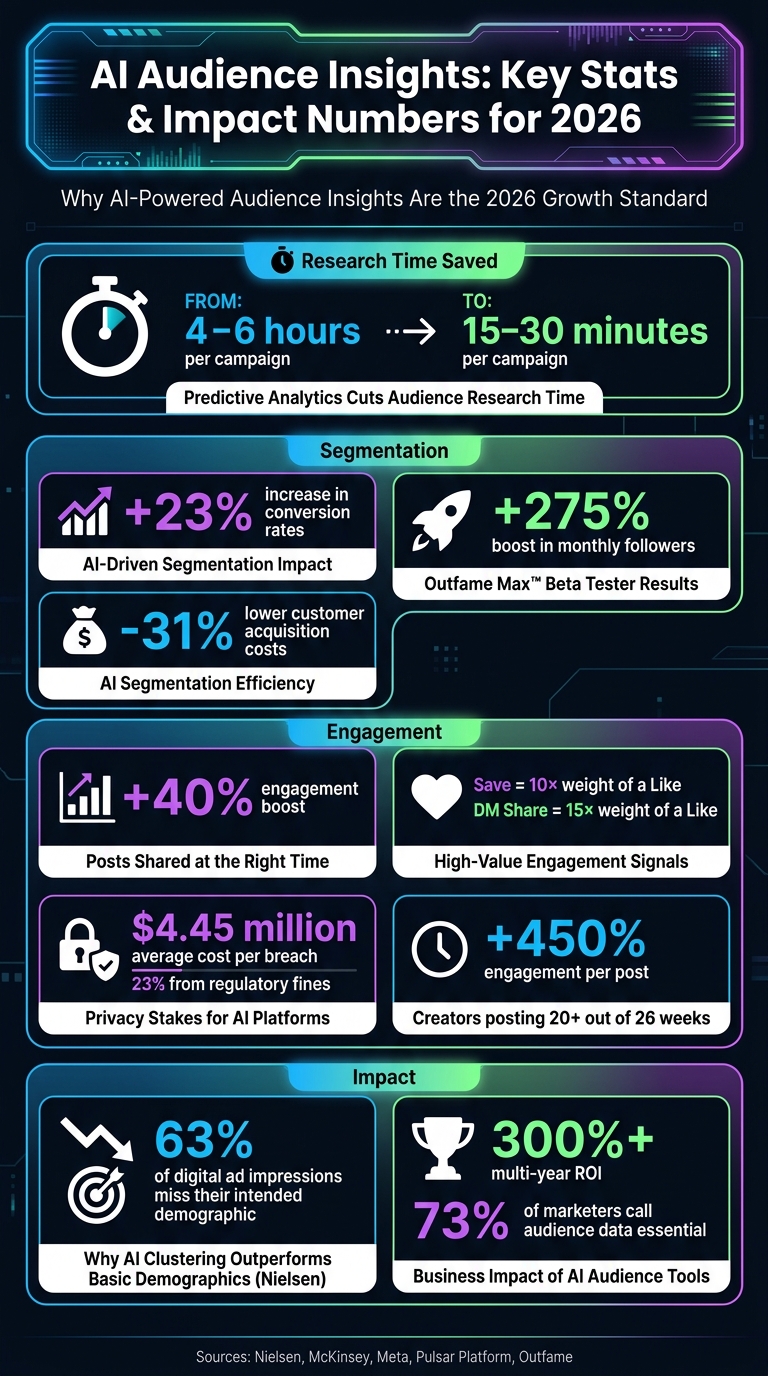
AI Audience Insights: Key Stats & Impact Numbers for 2026
Understanding AI Audience Insights
Key Dimensions of Audience Insights
AI goes beyond just scratching the surface of demographics. Modern systems dig deeper into audience behavior by analyzing four major dimensions: demographics (like age, gender, and location), psychographics (such as interests, values, and lifestyle choices), behavioral patterns (how users engage with content, including frequency and duration), and technographic data (which devices and platforms they favor).
One trend reshaping audience analysis is the move toward community-based analysis. Instead of merely categorizing people by age or location, this approach focuses on how groups form around shared interests and values. On platforms like Instagram and TikTok, this means going beyond follower numbers to understand the "why" behind user engagement. This shift highlights the importance of uncovering motivations, not just metrics. Let’s explore the data sources that fuel these insights.
Data Sources Used in AI Analysis
AI systems combine various data streams to create a well-rounded view of your audience. For example, TikTok Business accounts offer analytics on follower demographics, video performance, and trending content. Similarly, Instagram provides metrics like engagement timing, story completion rates, and interaction ratios, all of which contribute to a deeper understanding of user behavior.
Here’s a breakdown of the types of data AI tools analyze:
| Data Type | What It Captures | Example on Instagram/TikTok |
|---|---|---|
| Demographic | Age, gender, location | Age group distributions and regional breakdowns |
| Psychographic | Interests, values, lifestyle | Insights into user passions, like sustainability |
| Behavioral | Actions and engagement patterns | Peak engagement times and interaction depth |
| Technographic | Device and platform usage | Mobile vs. desktop usage trends |
By integrating these data types, AI tools provide a nuanced understanding of audience behavior. But with great data comes great responsibility - privacy concerns must be addressed.
Privacy and Data Considerations
Data collection is only part of the equation. Ensuring privacy and ethical use of information is critical for any AI-driven analysis. Reliable tools rely on anonymized and aggregated data, meaning they focus on overall trends rather than identifying individual users.
Adhering to regulations like GDPR and CCPA is essential for platforms handling user data. The stakes are high: data breaches cost companies an average of $4.45 million, with regulatory fines accounting for 23% of that amount. Companies that prioritize first-party data - information collected directly from their audience - are often better positioned than those relying on third-party sources, which can be less transparent.
"Transparent communication about data collection increases willingness to share. When audiences understand why you're collecting data and how you'll use it, trust increases." - Pulsar Platform
To maintain ethical standards, AI platforms analyze behavior at the segment level. This means they provide actionable insights while safeguarding individual privacy. These insights lay the groundwork for more advanced audience targeting strategies, which will be explored further.
Grow Your TIKTOK Channel FAST with AI Insights!
AI Techniques for Audience Targeting
Knowing your audience is just the starting point. The real game-changer lies in using AI to transform that raw data into actionable strategies that perform well on platforms like Instagram and TikTok.
Clustering and Segmentation
Grouping users by basic demographics like age or location often falls short. In fact, 63% of digital ad impressions miss their intended demographic target, according to Nielsen. AI-driven clustering offers a more accurate approach by focusing on user behavior - what content they engage with, how often, and the shared cultural touchpoints that define their interactions.
Instead of forcing users into rigid categories, clustering algorithms let the data guide the process. As Sal Morton, Content Marketing Lead at Pulsar Platform, explains:
"AI segmentation discovers the structure: clustering algorithms identify natural groupings in the data and the analyst interprets what those groupings represent."
This method allows for highly targeted strategies that can deliver impressive results. For example, in May 2026, a major e-commerce brand used Pulsar TRAC's community detection to identify three distinct audience clusters within a single demographic. By tailoring content to each group, they achieved a 40% boost in engagement, compared to their earlier broad-strokes approach.
Such precise segmentation also sets the stage for predicting audience behavior, a key step in advanced AI-driven strategies.
Predictive Analytics for Content and Growth
Once segmentation insights are in place, predictive analytics takes things further by helping brands anticipate trends. Instead of merely reacting to past performance, these models forecast which content will resonate, when audiences are most engaged, and where growth opportunities lie.
Predictive analytics can drastically cut the time spent on audience research - from 4–6 hours per campaign to just 15–30 minutes. For example, a furniture brand leveraging Meta's Advantage+ Audience used predictive models to serve dynamic ads to users who had previously viewed specific products. This approach led to a 25–40% improvement in engagement rates compared to using fixed ad schedules.
Natural Language Processing (NLP)
NLP goes beyond numbers, diving into the language your audience uses to uncover deeper insights. By analyzing captions, comments, and messages, NLP identifies key themes, sentiment, and communication patterns that define different audience segments.
Why does this matter? The words people use reveal what truly matters to them. For instance, a fitness influencer's audience might split into two distinct groups: one focused on performance and another on mental wellness. Pulsar TRAC's NLP engine, which processes over 700 million sources, can detect these nuanced communities by analyzing shared language and engagement behaviors. This allows creators and brands to craft messages that resonate with each group individually, rather than relying on generic, one-size-fits-all content.
Applying AI Insights to Social Media Growth
Knowing your audience is just the beginning. The real game-changer lies in using AI to turn those insights into actions that drive noticeable growth on platforms like Instagram and TikTok.
AI-Powered Audience Segmentation
Traditional audience segmentation relies on basic categories like age, gender, or location. AI, however, digs deeper by identifying how audiences naturally group themselves based on shared behaviors, interests, and signals. This approach uncovers "sub-tribes" that traditional filters often miss entirely.
The impact? AI-driven segmentation can increase conversion rates by 23% and reduce customer acquisition costs by 31%. A great example is Crayola, which used Emplifi's AI social listening tool in March 2026 to analyze TikTok trends. The results were impressive: processing viral content 80% faster, doubling TikTok engagement monitoring, and detecting emerging trends 90% quicker.
"Emplifi lets us pick up on behavior we wouldn't have caught otherwise. That kind of signal is gold for our cross-functional teams. We're not just reacting anymore. We're listening with purpose." - Brittany Mehalick, Social Media Engagement and Trends Manager, Crayola
One thing to note: audience segments identified by AI are not fixed. Interests and behaviors evolve, so it’s crucial to refresh these segments at least every quarter to stay aligned with "audience drift". Once your segments are set, timing becomes the next critical step.
Optimizing Content and Posting Schedules
Once you’ve refined your audience segments, timing your posts becomes vital. Posts shared at the right time can boost engagement by 40%, yet only 32% of social media managers use data to guide their schedules. AI bridges this gap by analyzing your audience’s specific activity patterns to pinpoint the best times to post.
Different types of content thrive at different times. For instance, educational posts tend to perform better in the morning, while entertainment content sees higher engagement in the evening. AI schedulers handle these nuances automatically, adjusting recommendations weekly as audience behaviors shift. Timing is especially critical in the first 60 minutes after posting:
"The first 60 minutes are diagnostic: early engagement velocity trains the initial retrieval layer and determines whether a post reaches its second-tier audience." - DigitalApplied
In 2026, Instagram places greater emphasis on saves and shares rather than likes. AI tools that monitor these high-value interactions help you understand not just when to post, but also what type of content will encourage these actions. These insights are just as valuable for paid campaigns as they are for organic strategies.
Improving Paid and Organic Reach
Effective segmentation and optimized timing set the stage for both paid and organic growth. For paid campaigns, AI often recommends starting with broad targeting. Tools like Meta's Advantage+ and TikTok's Smart+ are designed to identify potential converters within large audience pools. Overly narrow targeting can limit these algorithms, but switching to broad AI-powered targeting can lower Customer Acquisition Costs (CPA) by up to 32%.
On the organic side, metrics like completion rate and average watch time are key. Both Instagram and TikTok algorithms use these signals to determine whether to push your content to a wider audience. Consistency is also critical - creators who post at least 20 out of 26 weeks see a 450% increase in engagement per post compared to sporadic posters. AI scheduling tools make it easier to maintain this level of consistency, cutting the time spent on social media management from 15 hours a week to just 2 hours.
Measuring the Impact of AI Audience Insights
Key Metrics to Track
By 2026, Instagram's algorithm places a much higher value on certain interactions. For instance, a save now carries about 10× the weight of a like, while a DM share is worth 15× as much.
"A Reel with 500 saves and 80 likes beats a Reel with 80 saves and 5,000 likes for monetization." - Vytas, Founder at CreatorFlow
When tracking performance, focus on these metrics: Intent Velocity, Post-Level Follower Growth, and Sentiment Score. Another crucial metric is Dwell Quality, which distinguishes between users actively engaging with your content and those passively letting videos loop in the background.
For e-commerce, Attributed Revenue is a game-changer. By connecting sales across platforms using encrypted IDs, brands have seen sales increase by 34%.
Before-and-After Comparisons
To measure the impact of AI, compare 30 to 90 days of baseline data against post-AI results. The table below highlights how measurement standards have evolved by 2026:
| Metric Goal | 2023 Method | 2026 Standard (Current) |
|---|---|---|
| Growth Tracking | Net follower gain per month | Post-level attribution (exact source) |
| Engagement | Likes & generic comments | Intent Velocity & Sentiment Score |
| Content Testing | Posting and praying | Predictive forecasting (24-hour trend) |
| Carousel Success | Total swipes | Micro-Friction Data (drop-off per slide) |
| ROI / Sales | Link-in-bio clicks | Attributed Revenue (cross-platform tracking) |
Take Rishi Jain (@rrishijain, 244,338 followers) as an example. In April 2026, after noticing a 91% drop in daily engaged accounts (from 8,155 to 746), he used Windsor.ai and Claude to audit his Instagram data. The culprit? "Copy-Paste Caption Syndrome" - 25 out of 30 posts had nearly identical 300-word captions, which led to algorithmic suppression. Over four weeks, he introduced varied carousels and unique hooks, successfully recovering his engagement.
Spotting Trends and Audience Fatigue
AI tools don't just highlight successes - they also help identify potential problems. One red flag is a rising "Noise" ratio in your Sentiment Score. If comments shift from meaningful engagement to spam or generic responses, it may signal that your content is losing its appeal.
Another concern is AI Fatigue, which can be spotted by comparing retention rates for human-created content versus AI-assisted material. A consistent gap in performance suggests a need for more personalized, human-driven content. Instagram's Trial Reels feature also plays a role here. It tests your content on a small group of non-followers first. If they skip within 2 seconds, the algorithm may limit its reach - even to your existing followers.
"If the AI cannot understand the focal point of your video within the first 1.5 seconds, human users won't either." - InstantDM
To stay ahead of these challenges, run a 14-day Discovery Test every 60–90 days. This involves testing three distinct content angles using comment-to-DM triggers. By analyzing which topics generate the highest response rates, you can quickly adjust your strategy to maintain engagement. These tactics lay the groundwork for leveraging AI insights more effectively, as explored in the next section.
Implementing AI Audience Insights with Outfame
Outfame takes advanced AI techniques and turns them into measurable growth strategies. It analyzes over 25 engagement factors across millions of top-performing Instagram and TikTok accounts to pinpoint users most likely to follow and engage with your profile. During its initial learning phase, the system tests different audience groups in real time - tracking profile visits, follows, and video views - to narrow its focus on attracting high-quality followers.
"The first few weeks of growth with Outfame are called the learning phase, and it's a crucial part of building safe, sustainable, and high-quality growth." - Siegfried, Outfame Help Center
Outfame’s targeting engine works automatically, identifying the right audience based on niche-specific interests, similar accounts, browsing habits, and content engagement patterns. For creators and brands looking to scale quickly, Outfame Max™ uses pattern-recognition technology to supercharge growth. Beta testers of this feature saw a 275% boost in monthly followers. The platform operates 24/7 through Instagram and TikTok’s official APIs, eliminating the need for passwords and ensuring accounts remain secure.
Steps to Get Started with Outfame
Setting up Outfame is simple and quick. All you need is your Instagram or TikTok username - no password required. Once connected, configure your targeting by entering similar accounts in your niche and relevant hashtags, helping the AI identify your ideal audience.
Next, choose a growth speed setting that fits your account’s goals:
| Growth Speed | Best For | Estimated Monthly Followers |
|---|---|---|
| Slow | New or cautious accounts | Up to 650 followers |
| Moderate | Balanced option for most creators | Up to 1,500 followers |
| Glory | Established accounts aiming to scale | Up to 3,500 followers |
Once activated, the AI starts promoting your profile to targeted users automatically. Most users notice new followers within 24 to 48 hours. Plus, there’s a 3-day free trial so you can explore the platform and test your targeting settings before committing to a paid plan.
Benefits of Outfame for Creators and Brands
After setup, Outfame delivers consistent results for its community of over 65,000 creators and brands. Users typically experience engagement rates between 3% and 5%, far exceeding the industry average of 1%, along with a 94% follower retention rate after six months. The platform also processes data from over 1 million posts monthly, maintaining a 98% accuracy rate in its insights.
"I was stuck at 8K followers for over a year... Within 6 months of using Outfame, I hit 87K and my engagement rate tripled." - Lifestyle Creator
"Outfame grew my account from 12K to 156K in 8 months. Now I'm getting paid to visit destinations I only dreamed about. The followers are real travelers who actually engage." - Travel Creator
Beyond follower growth, Outfame’s real-time analytics dashboard provides actionable insights like follower trends, engagement rates, and AI-calculated "Best Time to Post" recommendations based on audience activity. By automating engagement tasks, creators report saving 20+ hours per week, freeing up time to focus on content creation and strategy. Whether you’re a solo creator or managing multiple accounts, this time savings makes consistent growth far more manageable.
Conclusion
Key Points Recap
AI is reshaping how creators and brands understand their audiences by offering tools that quantify intent through metrics like saves (weighted 10×) and DM shares (weighted 15×). It identifies how communities naturally form around shared interests, predicts content performance within the first hour of posting, and even tracks revenue without requiring direct link clicks. These features are setting the 2026 benchmark for creators and brands aiming to stay competitive.
"Personalization is no longer about a 'name in an email'; it is about orchestrated journeys that tie together identity, intent, and timing. Brands that ignore a consumer's values in 2026 risk a high disengagement rate from their core audience." - McKinsey & Company
Now, 73% of marketers view audience data as essential, and companies leveraging these insights have reported multi-year ROI exceeding 300%. The message is clear: understanding and applying audience insights is the key to meaningful growth.
Start Growing with AI Today
Using advanced insights through platforms like Outfame allows creators and brands to turn data into measurable growth. With 87% of brands now demanding detailed audience analytics during contract negotiations, and creators who track their analytics earning 34% more through brand deals, the importance of these tools is undeniable.
Outfame provides a secure, user-friendly way to access these insights. With no account password required for the free trial and pricing starting at just $39/month, it’s tailored for those ready to focus on real engagement and authentic followers - not just vanity metrics.
"The industry has matured past its bot-era Wild West phase. For creators and businesses serious about audience development, AI-first growth platforms like Outfame now offer a legitimate, scalable path." - TechBullion
AI-powered audience insights are no longer optional - they’re the new standard for lasting success. Start using AI today to connect with your audience in a meaningful way.
FAQs
What’s the difference between demographics and psychographics?
Demographics tell you who your audience is by using measurable factors like age, gender, income, education level, and location. On the other hand, psychographics dive into the why behind their decisions, exploring values, lifestyles, personalities, motivations, and attitudes. While demographics offer a general framework for understanding your audience, psychographics bring in more detail, allowing you to fine-tune your messaging and create emotional connections that drive stronger engagement and conversions.
Which engagement metrics matter most on Instagram and TikTok now?
By 2026, Instagram and TikTok are prioritizing deeper forms of interaction over surface-level metrics. On Instagram, saves, shares, and meaningful comments are the metrics to watch. These actions indicate a stronger connection to your content compared to simple likes. Reels remain a powerful tool for increasing visibility, while carousels often generate more engagement from users who see your posts.
Over on TikTok, the focus shifts slightly. Metrics like watch time, video completion rates, and shares carry the most weight. TikTok's algorithm rewards content that people want to share and watch all the way through, making these factors crucial for growth.
No matter the platform, your engagement rate - the ratio of interactions to reach or followers - is the ultimate measure of how well your content resonates with your audience. It’s not just about being seen; it’s about sparking genuine interaction.
How does Outfame grow followers safely without my password?
Outfame puts security front and center by ensuring it never asks for your password. Instead, it connects to your profile using official platform APIs and publicly accessible data. This approach keeps your account entirely in your hands. Plus, Outfame doesn't post, send messages, or perform actions on your behalf. This reduces the chances of issues like being flagged or shadowbanned, all while helping you safely grow your audience.


