
User-generated content (UGC) is dominating social media marketing in 2026, outperforming traditional branded content by a wide margin. Shoppers engaging with UGC convert at rates 161% higher, and platforms like TikTok and Instagram are prioritizing creator-led content with significantly better engagement. Incentivizing UGC - offering rewards like discounts, loyalty points, or exclusive perks - is now a must for brands looking to consistently generate impactful content.
Key trends shaping UGC strategies this year include:
- AI-driven personalization: Tailored prompts improve content quality and generate valuable data for search engines.
- Short-form video: TikTok and Instagram Reels are driving purchase decisions for Gen Z and Millennials.
- Gamified campaigns: Challenges and contests turn content creation into a fun, rewarding experience.
To succeed, brands need structured campaigns with clear goals, the right contributors, and well-defined guidelines. Incentive models range from monetary rewards, like discounts or tiered prizes, to recognition-based perks, such as featuring creators on official channels. Tools like Outfame simplify UGC management, from tracking submissions to analyzing performance.
The best-performing brands focus on continuous testing, securing legal rights early, and building long-term UGC programs. Ads featuring UGC deliver 4x higher click-through rates and lower costs, making it a powerful tool for driving engagement and sales.
How to Build a UGC Incentive Campaign Strategy
Setting Goals for Your UGC Campaign
Before you bring creators on board, make sure you’ve nailed down clear objectives for your campaign. Why? Because a campaign aimed at building awareness looks entirely different from one designed to drive purchases. Mixing these goals can lead to confusion and poor results.
A simple way to stay on track is to align your goals with the buyer’s journey. At the awareness stage, challenges and Reels are great for maximizing reach. For consideration, detailed reviews and Q&A videos help establish trust. When it’s time to convert, photo reviews and star ratings can ease doubts. And for retention, ambassador programs keep your loyal customers engaged. Each stage has its own metric to measure success: View-Through Completion Rate (VCR) gauges attention for awareness content, while Cost Per Acquisition (CPA) shows how well your conversion efforts are working.
| Funnel Stage | Best UGC Type | Key Metric |
|---|---|---|
| Awareness | TikTok/Reels challenges | Reach, Impressions, VCR |
| Consideration | YouTube reviews, Q&As | Watch time, Sentiment |
| Conversion | Photo reviews, star ratings | Conversion rate lift, CPA |
| Retention | Ambassador programs | Repeat purchase rate, CLV |
Take a moment to review your existing UGC to see which formats are already performing well.
Finding the Right UGC Contributors
Here’s a tip: follower count doesn’t always equal campaign success. What matters most is how well a creator’s tone and style match your target audience. The best contributors are the ones who feel relatable and genuine to your buyers - not necessarily the ones with the biggest audiences.
Start by tapping into your own customer base. Real customers often produce content that feels authentic, and that authenticity tends to drive results in paid ads. Beyond this group, consider recruiting brand loyalists (repeat buyers) and even employees who can bring enthusiasm and consistency to your campaigns. If you need to widen the net, explore niche hashtags on platforms like TikTok and Instagram. These are far more effective for finding authentic voices than generic “UGC creator” tags.
"The best UGC creators don't look like influencers. They look like customers." - Sofía Giménez Gontard, Senior Creative Strategist, Hustler Marketing
Here’s a great example: During the launch of Bioré’s Clean Detox in early 2026, the brand partnered with Moburst to source personalized, authentic UGC creators. The result? The campaign achieved 10.2 million impressions and 9.6 million views, landing in the top 1% of clicks in the brand’s history. The secret? The content felt more like a friend’s recommendation than a traditional ad.
For brands looking to scale, tools like Outfame can help you grow an engaged audience on Instagram and TikTok. This gives you a larger pool of relevant contributors to choose from.
Once you’ve identified your ideal creators, make sure to set clear expectations with well-defined campaign guidelines.
Writing Campaign Rules and Content Guidelines
Your campaign brief isn’t just a creative suggestion - treat it like a contract. Be clear about non-negotiables, such as banned competitor mentions, required disclosures, deadlines, and content usage rights. At the same time, give creators the freedom to inject their own style into the content.
Keep it simple. Overcomplicated rules can scare off contributors. A good test? Hand your brief to someone outside your team and ask them to explain the rules. If they’re confused, it’s time to simplify. Also, make sure to specify technical details like safe zones for on-screen text, clean audio, and a minimum resolution of 1080p at 60 fps.
One common pitfall: social rights and commercial rights are not the same thing. Just because you have permission to repost content on your social feed doesn’t mean you can use it in paid ads. If you plan to boost UGC, make sure to get explicit permission for that upfront - and in writing. Establishing a rights-first workflow from the start will save you a lot of headaches down the road.
The UGC Strategies Making Creators Money in 2025 🤑💰
Incentive Models for Instagram and TikTok
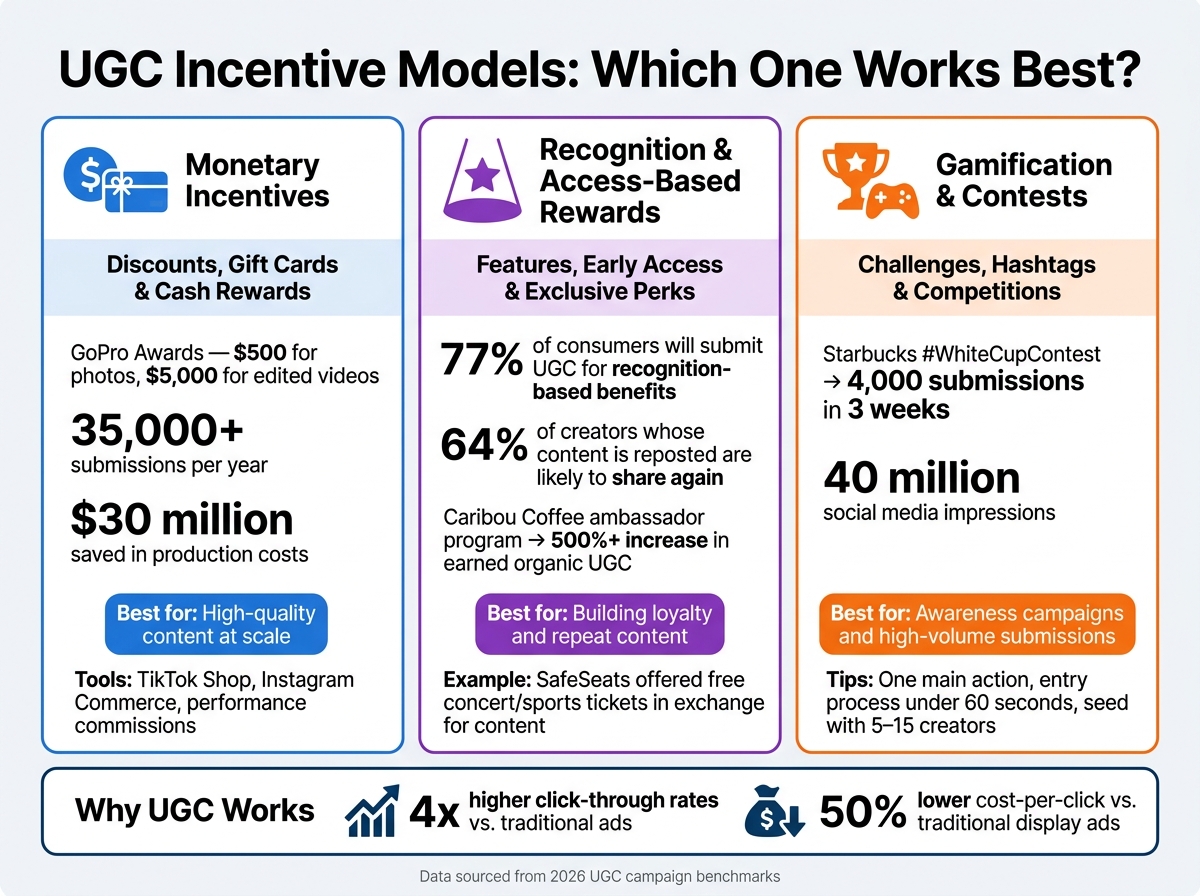
UGC Incentive Models Compared: Monetary vs. Recognition vs. Gamification
Monetary Incentives: Discounts, Gift Cards, and Rewards
Monetary incentives are a reliable way to encourage high-quality user-generated content (UGC). A hybrid model - combining a base payment with performance-based commissions - can keep creators invested while aligning costs with measurable outcomes. Tools like TikTok Shop and Instagram Commerce make this easier by enabling revenue-based commission tracking. This means brands can reward creators based on actual sales rather than estimations. Platforms such as Outfame streamline this process further with real-time analytics and automated audience targeting, ensuring your spending is tied directly to results.
Tiered prize structures are another effective strategy. For example, offering one grand prize, several category-specific rewards, and additional honorable mentions can encourage both quality and participation. GoPro’s Awards program is a standout example of this approach. By offering cash prizes ranging from $500 for photos to $5,000 for edited videos, GoPro has managed to collect over 35,000 submissions annually. This approach has reportedly saved the company $30 million in production costs as of April 2026.
Beyond cash, offering exclusive perks or public recognition can also motivate creators and enhance your UGC pipeline.
Recognition and Access-Based Rewards
While cash incentives are effective, non-monetary rewards like recognition and exclusive access can be just as powerful. In fact, 77% of consumers are willing to submit UGC in exchange for benefits such as being featured, early access to products, or discounts. What’s more, 64% of customers whose content gets reposted by a brand are more likely to share again. This creates a cycle of engagement that keeps fresh content coming in.
One of the easiest ways to provide recognition is by featuring creators’ content on your brand’s official channels. This not only validates the creator but also serves as social proof for your audience. For example, Caribou Coffee’s ambassador program encouraged loyal customers to share content, resulting in a 500%+ increase in earned organic UGC on Instagram and TikTok.
Experience-based rewards can take this a step further. SafeSeats, for instance, recruited Detroit-area creators by offering free concert and sports tickets for them and a guest. In return, creators shared content on both their own pages and SafeSeats’ platforms.
"UGC works because it transfers trust from customers who have already bought to prospects who have not yet decided." - Tomas Laurinavicius, Growth Engineer & Founder, Marketful
Gamification: Challenges and Contests
Gamification adds an interactive element to your incentive strategy, keeping engagement levels high. Challenges and contests can generate a large volume of submissions with minimal investment, as long as the mechanics are simple and aligned with your goals. For instance, branded hashtag challenges are great for building awareness, while review or tutorial formats are better suited for conversion-focused content.
To maximize participation, avoid making contest rules too complex. Stick to one main action, such as posting a video with a specific hashtag, and ensure the entry process takes less than 60 seconds. Starbucks’ #WhiteCupContest is a great example: customers were asked to decorate their cups and share a photo. This straightforward concept resulted in 4,000 submissions in three weeks and 40 million social media impressions.
TikTok-specific strategies include focusing on an eye-catching hook in the first two seconds, encouraging unpolished and authentic content, and leveraging trending sounds. To kickstart a challenge, seed it with 5 to 15 creators who set the tone and provide templates for others to follow.
"The best program is not 'pay a creator for a video.' It is: source continuously, brief narrowly, post broadly, reward repeatedly, and reuse what proves itself." - Jibran Khalil, Lightreel
How to Run and Manage UGC Campaigns
Once you've outlined your campaign strategy and set up a clear incentive structure, managing it effectively becomes the next priority for achieving strong results.
Planning and Launching Your Campaign
Before launching, determine which stage of the marketing funnel your campaign targets. For instance, an awareness campaign will require different types of content and performance metrics compared to one focused on conversions. With that in mind, create a unique and memorable branded hashtag (like #MyBrandStory) to track submissions and generate buzz. This hashtag will also save you time when searching for relevant content later.
Next, prepare a short but detailed content brief. This should outline essential guidelines, such as video length, tone, and music usage. However, leave enough flexibility for creators to maintain their authenticity. Well-structured briefs can significantly improve campaign efficiency, boosting first-approval rates by up to 40% and cutting revision requests by 60%. To set the tone, start by working with 5–15 creators who can establish quality benchmarks before opening the campaign to a wider audience.
Finding and Organizing UGC
Using spreadsheets to manage submissions might seem simple at first, but it can quickly lead to inefficiencies and missed opportunities. Many teams find that switching to specialized UGC management platforms reduces manual tracking by about 35%. These platforms offer real-time updates on submission statuses, payments, and content approvals, streamlining the entire process.
For storage, consider using a Digital Asset Management (DAM) system. This acts as a centralized hub for all your content, allowing you to tag assets with metadata like buyer journey stage, featured products, and technical details (e.g., aspect ratio). Take Apple’s #ShotOniPhone campaign as an example: it has generated over 27 million Instagram posts. Without a structured system, managing such a massive volume of content would be overwhelming. When sharing assets with partners or influencers, create curated "Portals." These branded libraries allow access to specific files without exposing your entire archive.
Avoid downloading content directly from social platforms. Instead, request original files through secure upload links. Tools like Outfame can further simplify UGC management, offering features like real-time analytics to track campaign performance.
Once your content is organized, the next step is securing the proper rights to use it.
Permissions, Rights, and Legal Compliance
Securing usage rights early is critical to ensuring your campaign runs smoothly. Remember, copyright belongs to the creator the moment they publish their content. Using a branded hashtag, liking a post, or tagging the creator does not automatically grant you commercial rights. This is a common - and often expensive - mistake.
"A common misperception is that works published on the Internet, including on social media platforms, are in the public domain and may be used without the rights owner's authorization. That perception is simply false." - WIPO
To legally repost, embed, or use UGC in ads, you need a written license. This agreement should cover six essential areas: permitted platforms, duration, paid advertising permissions, editing rights, geographic scope, and compensation. For example, obtaining paid advertising rights often adds a 20–50% premium to the creator's base fee. Plan your budget accordingly and secure rights for at least one month beyond your campaign's end date to avoid interruptions.
From a compliance perspective, the FTC requires clear disclosure of any material connection, such as payment, free products, or contest entries. Use #ad or #sponsored at the start of captions and ensure disclosures are visible or audible in videos. Relying solely on platform-native labels isn’t enough to meet these requirements. Additionally, be mindful of music licensing. Tracks from TikTok’s library, for example, are licensed only for organic, on-platform use. If you plan to promote a video or use it elsewhere, you’ll need separate commercial music clearance.
| Term | What It Covers | Standard |
|---|---|---|
| Permitted Platforms | Owned, paid, and third-party channels | Required |
| Duration | How long you can legally use the content | 6–12 months typical |
| Paid Advertising | Permission to run the content as an ad | +20–50% fee |
| Derivative Works | Edits, crops, subtitles | Specify explicitly |
| Geographic Scope | Territories where content may run | Specify explicitly |
| Compensation | Fee tied to the breadth of rights granted | Based on rights breadth |
How to Measure and Improve Incentivized UGC
Once your campaign is live, it’s time to track its performance and make adjustments quickly. Tools like Outfame can provide real-time analytics for platforms like Instagram and TikTok, helping you refine your incentives and improve your long-term UGC strategy.
Key Metrics for UGC Campaign Performance
Measuring UGC success involves breaking it down into three main areas:
- Participation: Keep an eye on the number of eligible entries and approval rates. If your approval rate dips below 60%, it might be a sign that your entry requirements are too complicated.
- Distribution: Analyze metrics like reach, impressions, video views, and shares to assess how far your content is spreading. For TikTok and Instagram Reels, Cost Per View (CPV) and video completion rate (VCR) are especially useful for gauging whether your content grabs and holds attention.
- Business Impact: Track clicks, conversions, and Cost Per Acquisition (CPA) to see how your UGC translates into revenue. These metrics help pinpoint what’s working so you can scale it effectively.
Here’s a quick look at some key metrics and what they reveal:
| Metric | Formula | What It Tells You |
|---|---|---|
| CPM | (Spend / Impressions) × 1,000 | How efficiently you’re driving awareness |
| CPV | Spend / Video Views | The cost of engaging viewers with video content |
| CPA | Spend / Conversions | The cost of acquiring new customers |
| VCR | (Completions / Starts) × 100 | How well your content keeps viewers engaged |
| Entry Conversion Rate | Eligible entries / Landing page sessions | How appealing your campaign is to participants |
Another often-overlooked metric is Approved Usable Assets - the number of content pieces you’ve secured legal rights to repurpose. High submission volume means little if you can’t reuse the content for ads or other campaigns.
Using Data to Improve Incentive Strategies
Data is your best guide for making improvements. For instance, if CPV rises week over week or CPA climbs 15% above your benchmarks, it’s time to tweak your creative prompts, adjust the campaign length, or revisit your incentive budget.
Beyond these adjustments, dive deeper into what’s working. Compare content types - does unboxing content lead to more conversions than testimonials? Are outdoor videos outperforming studio clips in terms of completion rates? Once you spot a winning trend, brief your next batch of creators to focus on those elements.
Here’s an example: During a six-week campaign in 2026, the dating app PreVue tested various UGC formats alongside cross-channel creatives. This iterative approach led to a 370% reduction in cost-per-install and a 270% improvement in cost-per-signup, outperforming their original KPIs by 27%.
"A single piece of UGC is a starting point, not a strategy. The best-performing brands are running continuous creative tests." - Julia Salume, Head of Influencer Marketing, Moburst
To stay ahead, cut underperforming content within 48–72 hours if it has less than a 1.5% click-through rate or an average watch time under four seconds. Refresh the weakest 25% of your content weekly to boost algorithm favorability.
Building a Long-Term UGC Program
Short-term metrics are important, but building a sustainable UGC system can create lasting benefits. The top-performing brands don’t rely on one-off campaigns - they develop always-on systems that treat creator content as a long-term marketing asset. Interestingly, while 87% of brands use UGC, only 16% have a dedicated strategy for managing it. That leaves a huge opportunity for brands willing to invest in a structured approach.
A strong UGC program typically includes:
- A creator cohort: A group of 15–30 micro-creators who post content consistently.
- A tiered incentive system: Immediate rewards like free products, bonuses tied to performance metrics, and long-term commissions.
- A governance policy: Clear rules for managing content rights and ensuring brand safety.
Take GoPro, for example. Their Awards program offers $500 for photos and up to $5,000 for edited videos. This initiative generates over 35,000 submissions annually and has saved the company an estimated $30 million in production costs. Regular audits of your content library - checking for outdated assets, ensuring rights are still valid, and identifying gaps - can help keep your program running smoothly.
"The brands doing it well are building public pipelines, training creators before the brief, turning creators into recruiters, and letting repeatable native formats do the scaling." - Jibran Khalil, Lightreel
Conclusion: Growing Engagement Through UGC
Encouraging user-generated content (UGC) goes beyond offering discounts and hoping for results. The brands thriving in 2026 are those that truly understand why their audience creates content. Whether it’s for recognition, a sense of community, a greater purpose, or simply to help others, aligning your incentives with these motivations naturally encourages participation.
The numbers back this up: ads featuring UGC deliver 4x higher click-through rates and a 50% lower cost-per-click compared to traditional display ads. These results highlight the importance of building a consistent, well-structured program rather than relying on occasional campaigns.
Scaling such a program requires precision and the right tools. Platforms like Outfame offer real-time analytics and AI-driven audience targeting to help brands on Instagram and TikTok pinpoint which content resonates most. This means you can brief your next wave of creators with confidence, making data-driven decisions instead of relying on trial and error. Understanding what works before scaling is the key to running an efficient, cost-effective program.
FAQs
How do I choose the best UGC incentive type for my goal?
The type of incentive you choose for your user-generated content (UGC) campaign hinges on your main objective. If your goal is high participation, go for straightforward rewards. Contests or hashtag challenges paired with product bundles or small cash prizes can work wonders here.
On the other hand, if you're aiming to inspire high-quality content, consider offering tiered rewards. Think bigger cash prizes, exclusive access to your brand, or unique experiences that resonate with your audience.
For brands looking to build long-term engagement, micro-incentives are a smart choice. Discounts, shoutouts, or community recognition can help nurture ongoing relationships with your audience.
The key is to match your incentives to your campaign's priority - whether it's driving volume, improving content quality, or strengthening community ties.
What rights do I need before using UGC in paid ads?
You must obtain explicit, written permission from the creator before using user-generated content (UGC) in paid advertisements. This agreement should clearly define the scope of use, duration, platforms, and rights granted. Additionally, it's crucial to comply with copyright laws and FTC disclosure requirements to steer clear of any legal complications.
Which UGC metrics matter most on TikTok and Instagram?
In 2026, the top metrics for user-generated content (UGC) on TikTok and Instagram revolve around engagement, reach, and conversions. Metrics such as likes, comments, shares, and saves highlight how well the audience is connecting with the content. However, click-through rates (CTR), conversions, and revenue per visitor dig deeper, offering a clearer picture of how UGC drives sales.
Additionally, tracking reach, impressions, and the tone of comments can reveal how well a brand is building awareness and connecting emotionally with its audience. Together, these metrics tie UGC performance to key business objectives like increasing sales and acquiring new customers.


