
Want to improve your retargeting campaigns? Here's the bottom line: TikTok is great for generating interest, while Instagram excels at converting that interest into sales.
- TikTok: Best for reaching new audiences with low-cost, engaging content. Lower CPMs ($9.80) and higher CTR (1.45%) make it ideal for warming up potential customers. However, its tracking and conversion capabilities are less reliable.
- Instagram: Best for retargeting high-intent users and driving purchases. With higher ROAS (3.2x) and advanced tools like Dynamic Product Ads, it outperforms TikTok for closing sales.
Quick Comparison
| Metric | Instagram (Meta) | TikTok |
|---|---|---|
| Average CPM | $14.90 | $9.80 |
| Average CTR | 1.15% | 1.45% |
| Average ROAS (E-com) | 3.2x | 2.4x |
| Creative Lifespan | 21–28 days | 7–14 days |
| Custom Audience Match Rate | 60%-80% | 35%-50% |
Takeaway: Use TikTok for awareness and Instagram for conversions. A 60% Instagram / 40% TikTok budget split often delivers the best results.
Instagram vs. TikTok Retargeting: Key Metrics Compared (2025–2026)
Instagram Retargeting Analytics: Tools, Metrics, and Insights
Meta Ads Manager for Instagram Retargeting
Meta Ads Manager is the backbone of Instagram retargeting, offering detailed insights into user engagement and strategies to reconnect with them. Two essential tracking tools here are the Meta Pixel and the Conversions API (CAPI). While the Pixel tracks user actions, it falls short on iOS devices due to Apple's App Tracking Transparency (ATT) framework, missing 20–40% of conversions. That’s where CAPI steps in, capturing server-side events like story_link_tap, profile_visit, and dm_initiation to fill these gaps.
With Meta Ads Manager, audience segmentation is highly specific. You can create custom audiences based on factors like website visits, Instagram engagement (likes, saves, comments), video view percentages (from 25% to 95%), and even shopping actions. The platform’s filtering options - such as "At Least" and "In the Past X to X Days" - allow for precise targeting. This means you can focus on users who engage repeatedly over a set timeframe or build dynamic audiences that refresh automatically.
Dynamic Product Ads (DPA) take personalization a step further by showcasing ads featuring the exact products users viewed or added to their cart. These ads pull directly from your product catalog. Pairing this with Advantage+ Creative, which optimizes ad elements like music, text, and visuals for placements like Reels and Stories, gives advertisers significant control over both targeting and delivery. This combination of tools and features lays the groundwork for tracking the metrics that matter most.
Key Metrics for Instagram Retargeting Campaigns
When running retargeting campaigns, certain metrics are especially important: Cost Per Acquisition (CPA), Conversion Rate (CVR), Return on Ad Spend (ROAS), frequency, and event completion rates. Each plays a role in understanding campaign performance.
Frequency, often overlooked, is crucial. Aim for 3–7 impressions per week and update your creative every 10–14 days to avoid ad fatigue and rising CPAs. Additionally, segmenting audiences by engagement levels can significantly impact CPA. For instance, targeting users with multiple engagements typically results in a 30–50% lower CPA compared to standard audiences.
| Retargeting Tier | Engagement Frequency | Recommended Creative | Expected CTR |
|---|---|---|---|
| Cold-Warm | 1–2 times in 30 days | Brand storytelling, educational content | 1.5% – 2.5% |
| Warm | 3–5 times in 14 days | Product benefits, testimonials, case studies | 2.5% – 4.0% |
| Hot | 5+ times in 7 days | Direct offers, urgency ("Last chance"), strong CTAs | 4.0% – 7.0% |
To optimize spend, exclude recent purchasers (7–30 days) from your retargeting campaigns.
Where Instagram Retargeting Analytics Stands Out
Instagram brings unique strengths to retargeting, especially with its first-party data depth. Meta’s ecosystem, which includes Facebook, Messenger, and WhatsApp, benefits from over 15 years of behavioral data. This maturity in targeting and campaign controls gives Instagram a clear edge over newer platforms like TikTok.
Another standout feature is the 180-day lookback window for custom audiences. This extended timeframe allows advertisers to re-engage users who interacted with their brand months ago - far longer than what many other platforms offer. Instagram’s analytics also excel in tracking lower-funnel conversions, as users often visit the platform in "validation mode" - checking reviews, exploring product pages, or comparing options.
Although Meta's attribution model tends to underreport conversions by 20–30%, this conservative approach actually makes the data more reliable for decision-making.
Here’s an example: In April 2026, a women’s fashion DTC brand scaled its Instagram ad spend from $0 to around $880/day in just six weeks. By using CAPI for server-side tracking and a tiered retargeting structure - Reels for prospecting and Feed carousels for engaging 7-day site visitors - the brand achieved a stable blended CPA of $47 and a 2.9x ROAS. Regularly refreshing creative every 14 days played a key role, with Reels contributing to 61% of total purchases.
Next, we’ll explore how TikTok approaches retargeting analytics.
TikTok Retargeting Analytics: Features and Limitations
TikTok Ads Manager for Retargeting
TikTok Ads Manager offers a Dashboard, Campaigns, and Analytics section, with Audience Manager and Events Manager serving as the core tools for retargeting.
Audience Manager allows you to create Custom Audiences using five sources: customer files, website traffic, app activity, on-platform engagement, and lead generation forms. However, TikTok requires at least 1,000 matched users for ad delivery, and match rates for customer files typically range between 20–50%. This means your CRM list may not fully translate into a targetable audience.
Events Manager oversees the TikTok Pixel and Events API. The Events API operates server-side, bypassing browser-level obstacles like ad blockers and iOS restrictions. This method can improve signal quality by 20–30% compared to pixel-only tracking. Reliable data from these tools is critical for bottom-funnel retargeting. Additionally, using Advanced Matching to pass hashed identifiers (like email or phone numbers) can increase attributed conversions by 15–25%.
TikTok's Smart+ Catalog Ads function similarly to Meta's Dynamic Product Ads, automatically showcasing specific products users interacted with, sourced from a connected catalog. For brands selling through TikTok Shop, in-app shop viewers form a valuable retargeting segment. Rachel Tipograph, Founder and CEO of MikMak, highlighted this strategy's potential:
"Once we started treating TikTok Shop audiences as a distinct retargeting segment, our blended TikTok ROAS moved from 1.4x to 2.9x in about six weeks."
Key Metrics for TikTok Retargeting Campaigns
TikTok retargeting success hinges on four key metric categories: delivery health, engagement, video performance, and conversion.
| Metric Category | Key Metrics | What It Tells You |
|---|---|---|
| Delivery | CPM, Reach, Frequency | Insights into audience saturation and cost efficiency |
| Engagement | CTR, 2s View Rate, 6s Focused View | Evaluates the strength of your creative's opening hook |
| Video | Completion Rate (100%), Avg Watch Time | Measures how well your content retains attention |
| Conversion | CPA, ROAS, CVR, Assisted Conversions | Tracks ROI and multi-touch attribution |
One critical engagement metric is the thumb-stop rate - the percentage of impressions that result in at least two seconds of viewing. If this rate falls below 50%, your opening hook likely needs improvement. For retargeting campaigns, where audiences are already familiar with your brand, this is especially important.
For eCommerce brands on TikTok, the median CPM in 2025 was $13.26, while the median CPA reached $32.74. Another overlooked metric is frequency. Ideally, aim for 2–4 impressions per user per week. Going beyond this range risks audience fatigue, especially since retargeting pools are smaller and tire faster than broader prospecting audiences. Refresh your creative every 2–3 weeks to maintain effectiveness.
TikTok's creative demands are also unique. Unlike Meta's middle-funnel ads, which can rely on static product images and offers, TikTok content must feel native to the platform. Cody Plofker, CMO of Jones Road Beauty, summed it up:
"TikTok retargeting isn't about reminding people you exist. It's about re-seducing them. The creative has to do more work than anything you'd run on Meta's middle funnel."
TikTok Attribution and Analytics Limitations
TikTok's attribution system introduces challenges with its click-through windows (1, 7, 14, or 28 days) and view-through windows (off, 1 day, or 7 days). The default setting - 7-day click and 1-day view - often skews results to appear overly optimistic. Additionally, expect a 10–30% discrepancy between TikTok Ads Manager data and third-party tools like Google Analytics 4 or MMPs.
Another issue is TikTok's 24–48 hour reporting lag, which can lead to premature decisions. Cutting an ad based on early data might mean shutting down a campaign that was actually working.
TikTok also tends to generate demand that converts through other channels. Around 30–50% of customer journeys influenced by TikTok retargeting end on platforms like Google search, direct website visits, or email. This makes last-click ROAS a poor metric for measuring TikTok's impact. Instead, focus on assisted conversions, branded search lift, and your overall Marketing Efficiency Ratio (MER) for a more accurate picture.
While TikTok's Events API has improved since its 2023 launch, it still lags behind Meta's CAPI in robustness. One critical metric to monitor is the Event Match Quality (EMQ) score, which ranges from 0 to 10 and reflects how well TikTok matches website events to real users. Aim for a score of 6 or higher; anything above 8 indicates strong performance. A low EMQ score can directly harm retargeting audience quality and attribution accuracy, making it a key factor to troubleshoot when campaigns underperform.
Instagram vs. TikTok: Retargeting Metrics Compared
Platform Metrics Side by Side
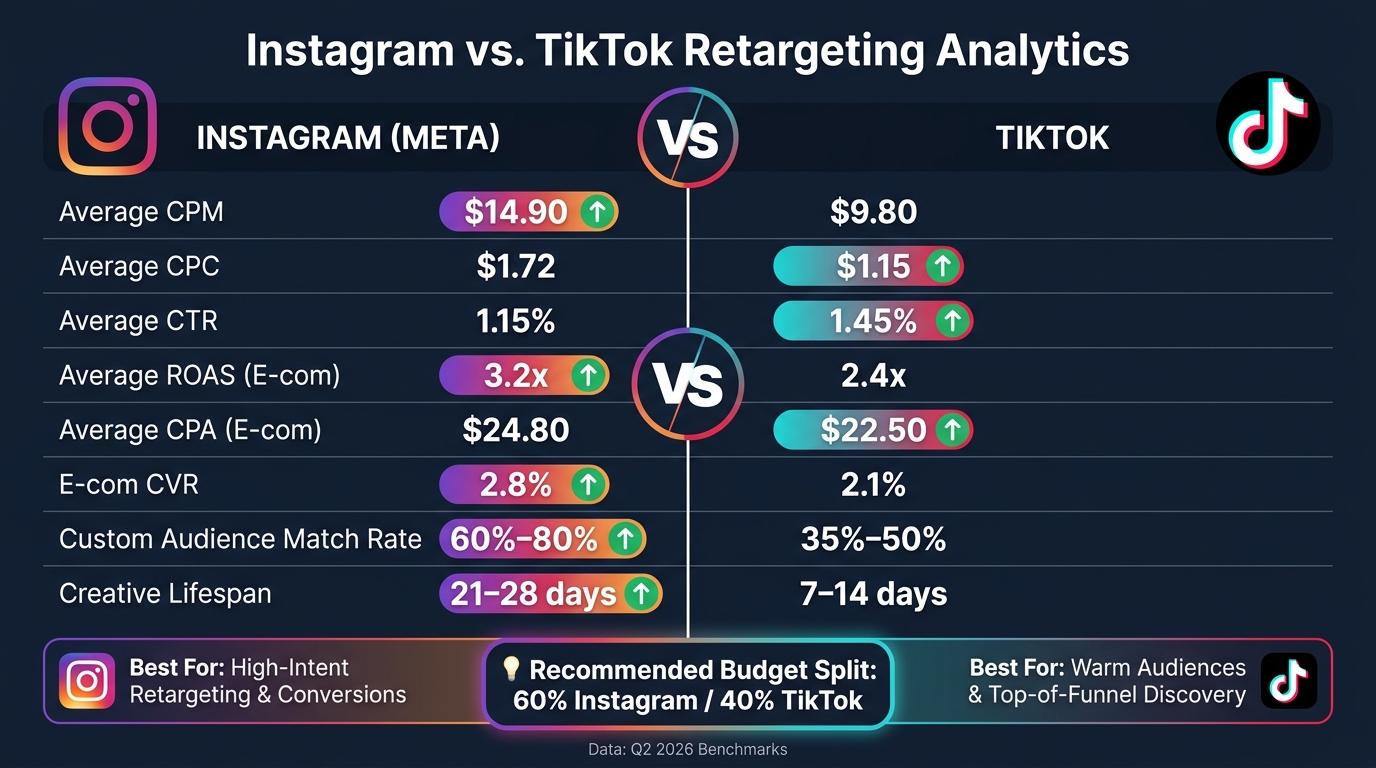
When comparing Instagram and TikTok, one thing stands out: TikTok is less expensive to reach, but Instagram delivers better conversions. For instance, in Q2 2026, TikTok's average CPM was $9.80, about 34% lower than Instagram's $14.90. Similarly, TikTok's CPC averaged $1.15, while Instagram's was $1.72.
| Metric | Instagram (Meta) | TikTok |
|---|---|---|
| Average CPM | $14.90 | $9.80 |
| Average CPC | $1.72 | $1.15 |
| Average CTR | 1.15% | 1.45% |
| Average ROAS (E-com) | 3.2x | 2.4x |
| Average CPA (E-com) | $24.80 | $22.50 |
| E-com CVR | 2.8% | 2.1% |
| Custom Audience Match Rate | 60%–80% | 35%–50% |
| Creative Lifespan | 21–28 days | 7–14 days |
| Event Match Quality | High (Mature CAPI) | Moderate (Maturing API) |
TikTok does have an edge in engagement, with a higher CTR of 1.45% compared to Instagram's 1.15%. However, Instagram takes the lead in key conversion metrics, such as its 2.8% e-commerce CVR and 3.2x ROAS, which outperform TikTok's 2.1% CVR and 2.4x ROAS. These numbers suggest that while TikTok might drive clicks, Instagram is better at turning those clicks into purchases.
Audience match quality also plays a big role. Instagram's Custom Audiences match 60%–80% of uploaded lists, whereas TikTok's match rate falls between 35%–50%. This difference limits TikTok's ability to effectively retarget and track conversions, further widening the performance gap.
As ALM Corp puts it:
"A click that costs more but converts at a meaningfully higher rate is not expensive. It is efficient."
By using these metrics to align with specific buyer journey stages, brands can craft strategies that maximize both engagement and conversions. While TikTok and Instagram differ in cost structure, the numbers highlight how each platform serves distinct roles in the marketing funnel.
Warm Audiences vs. High-Intent Retargeting: Which Platform Wins
Both platforms shine in different parts of the buyer journey, and treating them as interchangeable tools can lead to wasted resources.
TikTok is ideal for engaging warm audiences. Its lower CPMs make it a cost-effective choice for reaching users who have shown some interest, like watching a video or visiting a profile, even if they aren't ready to purchase yet.
Instagram is better for high-intent retargeting. Shoppers who have abandoned their carts, visited product pages, or made past purchases tend to convert more efficiently on Instagram. Its advanced shopping tools - like Dynamic Product Ads, Advantage+ Shopping, and a well-developed Conversions API - make it easier to drive sales. For example, a fashion e-commerce brand used TikTok for awareness and then retargeted those users on Instagram, seeing a 45% improvement in ROAS compared to running campaigns on just one platform.
Another example involves a DTC apparel brand managed by MHI Media. During its Q4 2025 launch, the brand allocated 70% of its budget to TikTok for two weeks, generating 4.2 million organic impressions. Afterward, they shifted 60% of the budget to Instagram retargeting, achieving a 4.6:1 ROAS and a blended ROAS of 3.4:1.
As ALM Corp explains:
"TikTok is usually the stronger platform for attention, discovery, and lower-cost top-of-funnel reach, while Instagram is usually the stronger platform for retargeting, conversion efficiency, and mature targeting."
For established brands, a 55%–65% Instagram / 35%–45% TikTok budget split often strikes the right balance between generating demand and driving conversions.
Attribution and Optimization: How the Platforms Differ
Attribution and Conversion Tracking on Each Platform
Both Meta and TikTok use a 7-day click/1-day view attribution window, but their tracking systems vary in reliability and effectiveness.
Meta's setup, which combines the Meta Pixel with the Conversions API, leverages deterministic matching based on login data. This approach achieves custom audience match rates of 60%–80% in the U.S.. On the other hand, TikTok's Events API, introduced in 2023, depends on SKAdNetwork (SKAN) 4.0. This reliance introduces delays of 24–48 hours and provides only coarse conversion data, which limits real-time optimization.
This difference in tracking capabilities has a direct impact on campaign performance. As Shamanth Rao, Founder of RocketShip HQ, explains:
"Meta's signal infrastructure provides stronger optimization signal accuracy versus TikTok's SKAN-dependent system, especially for subscription and purchase events."
To mitigate signal loss caused by iOS privacy updates and ad blockers, it’s crucial to run both browser-side pixels and server-side APIs on each platform simultaneously. However, since both platforms might claim credit for the same conversion in multi-touch journeys, using a neutral attribution tool - like Google Analytics 4 or a mobile measurement partner such as AppsFlyer - can help normalize data across channels.
These differences in tracking systems influence how each platform approaches optimization.
Optimization Signals for Retargeting Campaigns
Meta and TikTok take distinct approaches to retargeting, shaped by their unique optimization strategies and objectives.
Meta (Instagram) relies on deep conversion data, such as purchase history, catalog interactions, and high-LTV (lifetime value) user profiles. It also benefits from cross-platform signals gathered from Facebook, Messenger, and WhatsApp. Meta’s Advantage+ tool automates audience matching using these rich data points but needs about 50 conversions per week per ad set to effectively "learn" and optimize. Without sufficient audience size, the algorithm struggles to gain traction.
TikTok, by contrast, emphasizes content over direct conversion. Its algorithm prioritizes video engagement metrics - like watch time, shares, and early interactions - over purchase intent. The Smart+ tool automates optimization based on these signals, making TikTok ideal for discovery campaigns. However, this focus on engagement often makes TikTok less effective at converting high-intent buyers compared to Meta.
A practical example of these differences comes from Outer Aisle in Q3 2025. Growth Director Joanna Coles used creator-led recipe videos on TikTok to generate engagement. These "warmed" audiences were then retargeted on Meta with direct-response static ads offering a 15% discount. The result? The TikTok-seeded Meta audience converted at 2.3× the rate of cold Meta prospecting, while the blended customer acquisition cost dropped from $38 to $26.
"Once we stopped thinking about TikTok as a performance channel and started thinking about it as a warming machine, everything changed. We stopped asking TikTok to close the sale and let Meta do what Meta does best." - Joanna Coles, Growth Director, Outer Aisle
To maximize retargeting efficiency, align lookback windows with user intent. For example, use a 7-day window for cart abandonment and a 30-day window for broader actions. Additionally, exclude recent purchasers by creating a CompletePayment custom audience.
TikTok Ads Retargeting Tutorial (Full 2026 Guide)
Conclusion: Which Platform Should You Use for Retargeting Analytics
Instagram stands out for closing deals with its advanced tracking and higher conversion rates (ranging from 1.1% to 1.8%, compared to TikTok's 0.4% to 1.2%). On the other hand, TikTok takes the lead in sparking initial interest with its lower CPMs ($6–$10 versus Instagram's $8–$14) and impressive engagement rates.
When deciding between the two, focus on your specific goals. For most brands, a combination of both platforms works best: allocate around 60% of your budget to Instagram for driving conversions and 40% to TikTok for nurturing warm audiences. For instance, a mid-market DTC apparel brand that tested a 50/50 split between TikTok Spark Ads and Instagram Reels retargeting experienced a 25% drop in blended CAC and saw their ROAS improve from 3.1x to 4.2x over a 90-day period.
If you're managing campaigns on both platforms, keeping your audience data organized and analytics up-to-date is critical. Tools like Outfame can simplify this process by providing real-time analytics and automating audience targeting. This makes it easier to balance TikTok's discovery-driven signals with Instagram's conversion-focused strengths - without the hassle of manually piecing together data.
FAQs
How do I set the right lookback windows for retargeting on Instagram vs. TikTok?
When defining lookback windows, it's important to align them with your product's consideration cycle and the intent of your customers. Here's how to approach it for different platforms:
- Instagram: Use broader windows, such as 30–180 days, for awareness campaigns where you're targeting a wider audience. For high-intent actions, like cart abandonment, shorter windows of 3–14 days work better to capture recent interest.
-
TikTok: A tiered strategy works well here:
- 7 days for visitors showing high intent.
- 14 days for users who viewed product pages.
- 30 days for those who engaged more generally.
Additionally, exclude recent purchasers within a 14–90 day timeframe to avoid wasted ad spend and improve campaign efficiency.
What should I do if TikTok attribution doesn’t match GA4 or my store data?
If you're noticing discrepancies between TikTok attribution and GA4 or your store's data, don't worry - it’s expected. The difference comes down to how each platform tracks conversions. TikTok includes view-through conversions, while GA4 relies on last-click attribution and doesn’t account for impressions.
To align your TikTok tracking better, set its attribution window to 7-day click and 1-day view. Also, implement the TikTok Pixel alongside the Events API, ensuring both use a shared event_id for proper deduplication.
When it comes to revenue reporting, always prioritize your store’s financial data for the most accurate numbers.
How can I avoid ad fatigue while retargeting on both platforms?
To keep your ads fresh and avoid fatigue on Instagram and TikTok, it's important to adapt your approach to each platform's unique rhythm.
On TikTok, focus on frequent updates - weekly or even daily for your top-performing campaigns. Prioritize creating new hooks and content that feels native to the platform for better engagement.
On Instagram, take a slightly slower approach by refreshing your creatives every 2–3 weeks. Keep an eye on key metrics like CTR (click-through rate) and CPA (cost per acquisition) to identify when updates are needed. Rotate between 3–5 creative variations, replace assets that aren't performing well, and exclude users who've recently made purchases. This helps you save budget while maintaining credibility with your audience.


