
Real-time data on platforms like Instagram and TikTok lets you adjust campaigns while they’re live, saving money and improving results. Unlike static models that rely on post-campaign analysis, real-time metrics like engagement, click-through rates, and conversions allow immediate changes for better performance. Brands using dynamic audience segments can lower acquisition costs by 20–35% and reduce wasted spend by 15–40%.
Key insights:
- Instagram focuses on relationships: Saves and DM shares drive algorithm performance.
- TikTok prioritizes content discovery: Completion rates and watch time expand reach.
- Segment your campaigns: Break down by audience, location, or creative for clear data.
- Act fast: Identify underperforming segments or high-performing content within 24–72 hours.
- Use AI tools like Outfame: Automate tracking, audience insights, and budget reallocation.
Real-time targeting helps brands reduce costs, improve engagement, and make smarter decisions mid-campaign, turning data into actionable results.
Target High-Value Customers Precisely: Data-Driven Audience Strategy
Understanding Real-Time Audience Data on Instagram and TikTok
To make the most of your content on Instagram and TikTok, it's important to understand how each platform tracks and evaluates your performance. While both provide live metrics, the way they measure success and engage with audiences varies significantly.
Key Real-Time Metrics for Instagram and TikTok
On Instagram, the main metrics include:
- Reach: The number of unique accounts that viewed your content.
- Views: Replacing Impressions as of April 2025, this now offers breakdowns by follower type and content format.
- Interactions: Likes, comments, shares, and saves. Among these, saves hold the most weight in terms of algorithm influence. In 2026, one save was estimated to have the same distribution impact as 10 likes. Shares sent through direct messages (DMs) are even more impactful, carrying 15 times the weight of a like.
On TikTok, the focus shifts to:
- Video Views
- Average Watch Time
- Completion Rate: A completion rate above 30% is considered strong, while anything over 50% is excellent.
Both platforms also emphasize "sends per reach" - the frequency with which users privately share your content. Adam Mosseri, Instagram's Head, has called this the most critical factor for expanding your audience. On TikTok, shared content tends to generate five times more engagement compared to non-shared posts.
These metrics offer a real-time view of how your audience connects with your content, helping you adjust strategies on the fly.
How Instagram and TikTok Analytics Differ
Each platform's analytics reflect its unique approach to content distribution.
"TikTok shortens the distance between users and the content they actually care about, while Instagram is still catching up when it comes to frictionless discovery." - Morgane Wasilewski, Social Media Manager, Channable
TikTok relies on a content-first algorithm, pushing videos to users based on their interests and viewing habits. This allows videos with high completion rates to quickly reach new audiences, even if they don’t follow you. Instagram, on the other hand, prioritizes relationship-based signals. It factors in who already follows you, how quickly your content gains traction in the first 30–60 minutes, and demographic details like age, gender, and location.
Here’s a quick comparison:
| Feature | TikTok | |
|---|---|---|
| Algorithm Focus | Relationships & engagement velocity | Content interest & watch time |
| Key Performance Indicator | Saves and shares | Completion rate and shares |
| Audience Data Detail | Detailed age, gender, city-level info | Age ranges and regional trends |
| Typical Engagement Rate | 1%–3% | 3%–9% |
Understanding these distinctions is key to tailoring your strategy for each platform.
How Outfame Enhances Real-Time Analytics
To fully capitalize on real-time insights, you need more than just the native analytics tools provided by Instagram and TikTok. That’s where Outfame comes in. This AI-powered platform complements native dashboards by offering advanced audience insights and actionable recommendations.
Outfame continuously monitors follower activity and engagement trends, eliminating the need for manual review. Its AI targeting system identifies niche interests, similar accounts your audience follows, and engagement behaviors to pinpoint the best audience for your content. This allows for real-time adjustments and smarter targeting.
For creators and brands managing campaigns across both platforms, Outfame provides a unified layer of analysis, making it easier to identify trends and act on them quickly.
Setting Up Real-Time Tracking for Campaign Optimization
How to Structure Instagram and TikTok Ad Campaigns
For effective campaign tracking, structure your ad sets to keep data clear and actionable. A common pitfall is mixing different audiences, creatives, and placements in a single ad set, which makes it hard to pinpoint what’s working.
Instead, break your ad sets into specific segments. For instance, you could create one ad set targeting 25–34-year-old women in Chicago who are interested in fitness, and another targeting the same demographic in Los Angeles. This segmentation lets you tweak or pause underperforming segments without affecting the rest of your campaign. It also simplifies tracking and attribution.
To ensure accurate real-time attribution in GA4, use a consistent UTM structure. Pair UTM links with unique discount codes (e.g., SARAH15) to capture delayed conversions. This is especially helpful for influencer-driven purchases, which often have attribution windows of 30 to 90 days.
Remember, both Instagram and TikTok require Business or Creator accounts to access their native analytics dashboards.
Setting Up Dashboards and Alerts
Once your campaigns are well-structured, the next step is to set up tools and alerts to monitor performance shifts as they happen.
"Tracking Instagram influencer campaign performance in real time is not just about counting engagement after the fact - it is about having the visibility to make smart decisions while the campaign is still running." - Hyperr Volt Blog
Use third-party tools connected to Meta's or TikTok's API for verified data refreshes every 15–30 minutes. Set alerts for key performance metrics, such as a CTR drop of more than 20%, CPC exceeding $0.25, or ad frequency surpassing 3.5. These alerts help you distinguish normal variations from actual performance issues.
Don’t forget that Instagram Stories data expires after 24 hours. Use API-connected tools to auto-capture this data or manually save screenshots before it disappears. Before launching your campaign, record baseline metrics like follower count, traffic, and conversions to measure its impact effectively.
With real-time alerts established, you can further enhance your tracking by integrating tools like Outfame.
How Outfame Supports Real-Time Campaign Monitoring
Outfame takes real-time monitoring to the next level by focusing on follower growth and engagement quality - areas where native dashboards might fall short. This tool complements the segmented campaign structure and real-time alerts discussed earlier.
Outfame’s AI dives into niche interactions, helping refine your targeting. Most users start seeing new, relevant followers within 24–48 hours. Its 24/7 growth monitoring ensures that the audience you’re reaching aligns with your niche, giving you confidence that every campaign adjustment is backed by accurate, up-to-date data.
Making Real-Time Audience Targeting Adjustments During Campaigns
Once your tracking is active and alerts are firing, the real challenge begins: using live data to fine-tune your campaign on the spot. Performance trends often start to surface within the first 24 to 72 hours of launch. This early window is your chance to make adjustments before unnecessary spending piles up. These initial insights are crucial for guiding your next steps.
How to Identify Underperforming Audience Segments
Not all underperformance looks the same. For instance, if a segment has high reach but low engagement, it’s a sign that your message isn’t connecting with that audience. On the other hand, a high click-through rate (CTR) but low conversion rate often points to issues with your landing page or offer. Spotting these nuances helps you tackle the right problem without wasting time.
Here’s a quick guide to common real-time metrics, their likely causes, and what you can do about them:
| Metric Indicator | What It Indicates | Recommended Action |
|---|---|---|
| High Reach / Low Engagement | Content isn’t resonating with the segment | Revise your messaging or try a different format (e.g., Reels) |
| High CTR / Low Conversion | Landing page mismatch or price barrier | Update the destination page or offer a flash discount |
| Frequency > 3.5 | Audience saturation or creative fatigue | Introduce fresh creative assets immediately |
| High Exit Rate (Stories) | Weak opening or poor product integration | Request a follow-up Story with a stronger hook |
If your data shows the wrong demographic engaging with your ads - like men clicking when you’re targeting women - pause those ad sets right away.
How to Scale High-Performing Micro-Segments
Once you’ve paused the underperforming segments, shift your focus to scaling the ones that show promise. Start with 10–20 micro-segments and watch for spikes in key metrics like add-to-cart events or product page visits during the first 48 hours. Micro-influencer-driven segments (accounts with 5,000–50,000 followers) are especially worth noting - they tend to average a 4.1% conversion rate, outperforming macro-influencers who average 2.6%.
When you spot a high-performing segment, reallocate your budget toward it. To maintain momentum, create dynamic lookalike audiences based on your recent converters. Refresh these audiences every 30 to 60 days to keep your targeting aligned with buyers who are actively engaging.
Running Real-Time A/B Tests for Targeting Refinement
Mid-campaign A/B testing is most effective when you test one variable at a time. Keep your budget, creative, and optimization goals consistent across ad sets, but change the audience segment. This way, any performance differences can be directly tied to targeting.
In 2026, ad creative itself has become a powerful targeting tool. For example, testing opening hooks like “Nurses, this one’s for you” versus a generic opener can help platforms quickly pinpoint your ideal audience. Monitor completion and tap-through rates in the first 24 to 48 hours, and reallocate your budget to the better-performing variant. Keep in mind, Meta typically needs 50 optimization events within 7 days for an ad set to exit the learning phase and stabilize.
Automating Adjustments with Outfame's AI Tools
While manual adjustments can be effective, automation takes it to the next level. Outfame uses AI to continuously analyze interests, similar account connections, and engagement habits, ensuring that your audience remains aligned with your goals without constant hands-on management.
The Outfame Max™ tool goes a step further, accelerating follower growth during the learning phase by testing various audience groups to find those most connected to your content. As Siegfried from Outfame explains:
"The learning phase is the key to real, organic, and lasting growth. Let the system do its work, and you'll see your account attract the right audience naturally." - Siegfried, Outfame
Give the system 1 to 2 weeks to work before making manual changes. Jumping in too early can disrupt the AI’s process of identifying the most valuable niche audience. Campaigns that use AI-driven, dynamic segments often see 20% to 35% lower cost-per-acquisition compared to static targeting, which is a game-changer when every dollar matters.
Platform-Specific Strategies: TikTok vs. Instagram
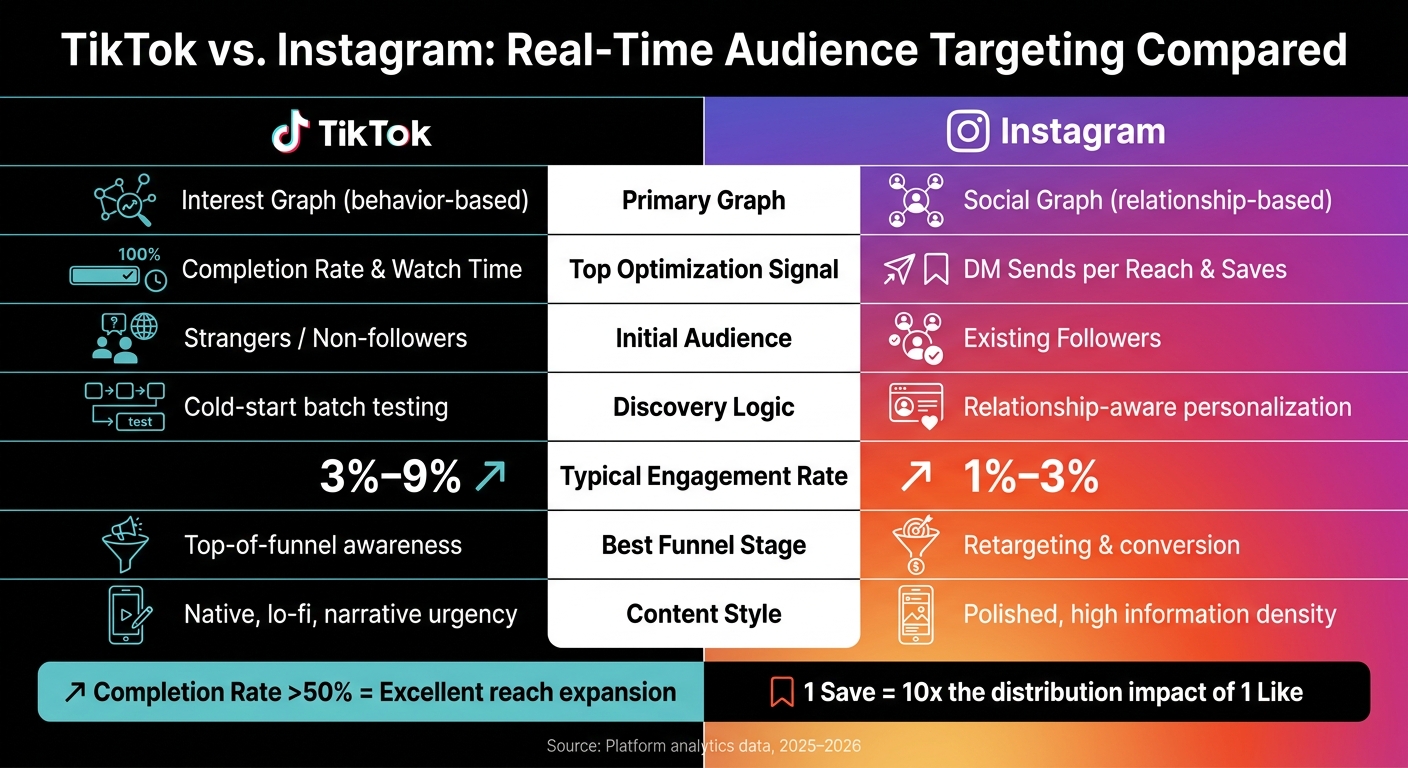
TikTok vs. Instagram: Real-Time Audience Targeting Compared
When it comes to campaign optimization, TikTok and Instagram demand distinct strategies due to their unique audience behaviors and platform mechanics. Marcus Lane from Platform Playbooks sums it up perfectly:
"TikTok rewards strangers finishing your video. Instagram rewards known users saving it. Those are two different content jobs." - Marcus Lane, Platform Playbooks
This difference in how each platform operates is the foundation of effective targeting decisions.
TikTok: Broad to Focused Targeting
TikTok's algorithm revolves around an interest graph, prioritizing content discovery for non-followers. The platform uses a cold-start batch test to gauge engagement in real time. Here’s how it works: TikTok shows your video to a small group of users, and if the engagement - especially watch time - is strong, it expands the audience. Your content's performance directly dictates its reach.
To succeed, your video must grab attention within the first 1.5 seconds. If viewers aren't engaged by 3 seconds, the algorithm halts further distribution. Use TikTok Studio to track retention rates and pinpoint where viewers drop off. If retention dips below 60% past the 3-second mark, targeting efforts are likely to stall.
As campaigns progress, you can shift from broad interest categories to more precise micro-segments. TikTok is also becoming more search-oriented. Real-time hashtag trends, popular sounds, and even spoken keywords (indexed through auto-captions) significantly influence content visibility. Incorporating these elements early in your videos can improve discoverability.
Instagram: Leveraging Placement and Demographics
Instagram operates differently, relying on a social graph that prioritizes relationships and connections. It uses four ranking systems - Feed, Reels, Stories, and Explore - each with its own set of signals. Real-time optimization on Instagram involves identifying which content placement performs best and doubling down on it.
One of Instagram’s key metrics is DM shares, which indicate which surface (e.g., Feed, Stories) deserves more attention. Saves are another critical signal, especially for Feed posts like tutorials or checklists, which often trigger the algorithm to push content to the Explore page. For Stories, interactive stickers (e.g., polls, questions, sliders) generate immediate engagement, helping your content stand out in the Stories tray.
A smart tactic is to experiment with Instagram’s Trial Reels feature. This allows you to test content with non-followers, gathering completion and share-rate data without spending on ads. Once you’ve validated your creative, you can confidently allocate your budget to scale it.
Real-Time Data Usage on TikTok vs. Instagram: A Side-by-Side Comparison
Here’s how the two platforms stack up when it comes to leveraging real-time data:
| Feature | TikTok | |
|---|---|---|
| Primary Graph | Interest Graph (behavior-based) | Social Graph (relationship-based) |
| Top Optimization Signal | Completion Rate & Watch Time | Sends per Reach (DMs) & Saves |
| Initial Audience | Strangers / Non-followers | Existing followers |
| Discovery Logic | Cold-start batch testing | Relationship-aware personalization |
| Search Signal | Trending sounds & spoken keywords | Keyword-rich captions (30% more reach vs. hashtags alone) |
| Best Funnel Stage | Top-of-funnel awareness | Retargeting & conversion |
| Content Style | Native, lo-fi, narrative urgency | Polished, high information density |
Each platform has a distinct way of interpreting and using real-time data, making it essential to tailor your approach to fit their unique systems.
Conclusion: Building a Repeatable Real-Time Targeting Process
Real-time targeting requires constant fine-tuning. Successful brands and creators focus on setting clear SMART KPIs before launching campaigns, prioritizing high-value actions like saves and DM shares over superficial metrics like likes. They test one variable at a time and keep a record of successful audience configurations for future use. By consistently applying these practices, brands can scale their audience targeting in a sustainable way.
It's worth noting that Instagram DM shares and saves hold much more weight in content distribution than likes. Relying solely on surface-level metrics often leads to less effective targeting strategies.
This disciplined approach to monitoring and adjusting KPIs allows for quick and effective campaign optimization. For example, in early 2026, UK retailer B&Q identified a standout performer within just 48–72 hours. By quickly securing additional content from that creator, they surpassed their average view rate target by 283%. This highlights the value of tracking live data and making timely decisions.
"Manual management simply can't keep pace with the volume of optimization opportunities. AI agents... process thousands of data points simultaneously and act on insights within minutes instead of days or weeks." - Ira Bodnar, Ryze AI
These strategies form the foundation of a repeatable, data-driven targeting process. Automating these adjustments boosts efficiency, and that’s where Outfame steps in. For creators and brands looking to scale their real-time targeting on platforms like Instagram and TikTok, Outfame offers a hands-free solution. Its AI dives deep into niche interests, engagement patterns, and browsing behaviors to ensure your content reaches the right audience around the clock.
Outfame Max™ beta users reported a 275% increase in monthly followers, thanks to its pattern-recognition capabilities. Most users saw consistent results after a 30-day learning phase. With plans starting at $39 per month, a 3-day free trial, and a growth guarantee, Outfame provides a powerful tool for scalable and sustainable audience targeting.
FAQs
What real-time metrics matter most on Instagram vs. TikTok?
On Instagram, it’s all about tracking engagement-driven metrics like saves, DM shares, and comments to gauge how well your content resonates with your audience. Additionally, keeping an eye on follower growth and profile visits can give you a sense of audience loyalty and interest.
Over on TikTok, the focus shifts to discovery metrics. Pay attention to video completion rates and watch time - these are key indicators of how likely your content is to go viral.
With tools like Outfame’s real-time analytics, creators can easily keep tabs on these platform-specific metrics, making it easier to achieve steady growth.
How soon should I change targeting after launching a campaign?
During the first 24–48 hours of your campaign, keep a close eye on its performance to identify both wins and potential problems. You can make quick adjustments to elements like creatives, captions, or budgets based on the data you're seeing. However, it's important to let a learning phase of around seven days play out, especially if you're using broad targeting, to give the system time to optimize. For services like Outfame, which focus on ongoing audience engagement, anticipate an initial calibration period of a few weeks to fine-tune and maintain consistent, high-quality results.
How can Outfame help automate real-time targeting updates?
Outfame leverages a custom-built AI engine to dive deep into engagement data, pinpointing the content styles and audience segments that fuel growth. It goes a step further by analyzing competitor audiences, hashtag trends, and geographic data to fine-tune targeting. The AI adjusts on the fly to keep your strategy aligned with attracting followers who are genuinely interested. On top of that, it provides round-the-clock growth tracking and compliance checks to maintain consistent and reliable performance.


